Stock Analysis · ConnectOne Bancorp Inc (CNOB)
Overview
ConnectOne Bancorp Inc. is the parent company of ConnectOne Bank, a regional bank focused mainly on businesses, professionals, real estate operators, and consumers in the New York metropolitan area, New Jersey, and South Florida. Like most regional banks, it makes money by gathering deposits, lending those funds at higher rates, and providing fee-based banking services. Its business mix is centered on commercial relationships rather than mass-market retail banking.
The company’s revenue is primarily generated from net interest income, which is the difference between what it earns on loans and securities and what it pays on deposits and borrowings. Non-interest income is a smaller but still useful contributor. Based on recent annual reporting structure, the main sources can be summarized as follows:
- Net interest income: approximately 80% to 90% of total revenue in a typical year. This includes interest earned on commercial real estate loans, commercial and industrial loans, residential and other consumer loans, and investment securities, net of funding costs.
- Service charges and deposit-related fees: approximately 3% to 6%. This includes account fees, treasury management, and other banking service charges.
- Gain on loan sales, loan syndication, and other lending-related fees: approximately 2% to 5%. These are linked to certain loan origination and distribution activities.
- Other non-interest income: approximately 3% to 8%. This can include bank-owned life insurance income, swap fees, and other miscellaneous fee revenue.
Over the last several years, total revenue has expanded meaningfully, but profitability has been pressured by the sharp rise in interest expense as deposit costs reset higher. In other words, the bank has grown its earning base, yet a larger share of that revenue has recently been absorbed by funding costs and operating expenses.
The overall pattern shows a larger revenue base than a few years ago, but also a much heavier interest-cost burden. That helps explain why net income has not kept pace with revenue growth.
Key Figures
| Metric | Value | Sector ⓘ |
|---|---|---|
| Date | Oct 24, 2026 | |
| Context | ||
| Sector | Financial Services | |
| Industry | Banks - Regional | |
| Market Cap ⓘ | $1.55B | |
| Beta ⓘ | 1.07 | |
Value (Cheapness) | ||
| P/E Ratio ⓘ | 10.03 | 12.46 |
| P/B Ratio ⓘ | 1.02 | 1.25 |
| FCF Yield ⓘ | 8.28% | 9.82% |
| Dividend Yield ⓘ | 2.42% | 2.94% |
| EBIT / EV ⓘ | 4.96% | 8.11% |
| PEG ⓘ | 1.83 | |
Growth (Business expansion) | ||
| Revenue Growth ⓘ | 134.20% | 9.10% |
| RPS Growth (5Y CAGR) ⓘ | 11.35% | 12.31% |
| EPS Growth (5Y CAGR) ⓘ | -4.28% | -6.97% |
| BVPS Growth (5Y CAGR) ⓘ | 5.67% | 5.02% |
| Margin Growth (5Y Trend) ⓘ | -36.68% | -4.00% |
| FCF Growth (5Y CAGR) ⓘ | -15.65% | 4.71% |
| DPS Growth (5Y CAGR) ⓘ | 12.26% | 8.92% |
Quality (Business durability) | ||
| ROIC (Latest) ⓘ | 3.23% | 9.18% |
| ROE (Latest) ⓘ | 10.11% | 13.93% |
| ROA (Latest) ⓘ | 1.13% | 1.57% |
| ROIC (5Y Median) ⓘ | 4.15% | 7.80% |
| ROE (5Y Median) ⓘ | 7.62% | 12.15% |
| ROA (5Y Median) ⓘ | 0.89% | 1.28% |
| Net Debt / EBIT (Latest) ⓘ | -0.06 | 1.02 |
| Net Debt / EBIT (5Y Median) ⓘ | 4.40 | 0.72 |
| Net Debt / EBITDA (Latest) ⓘ | -0.05 | 0.88 |
| Operating Margin (Latest) ⓘ | 18.07% | 22.30% |
| Operating Margin (5Y Median) ⓘ | 23.20% | 24.50% |
| Debt to Equity (Latest) ⓘ | 2.02% | 59.34% |
| Profit Margin (Latest) ⓘ | 36.09% | 26.42% |
| Free Cash Flow (Latest) ⓘ | $128.71M | |
Momentum (Price trend) | ||
| 3Y Return ⓘ | +115.80% | +95.73% |
| 12M Return (excl. last month) ⓘ | +25.29% | +17.30% |
| 6M Return ⓘ | +18.64% | +6.07% |
| Price vs. 200-Day MA ⓘ | +10.74% | +5.36% |
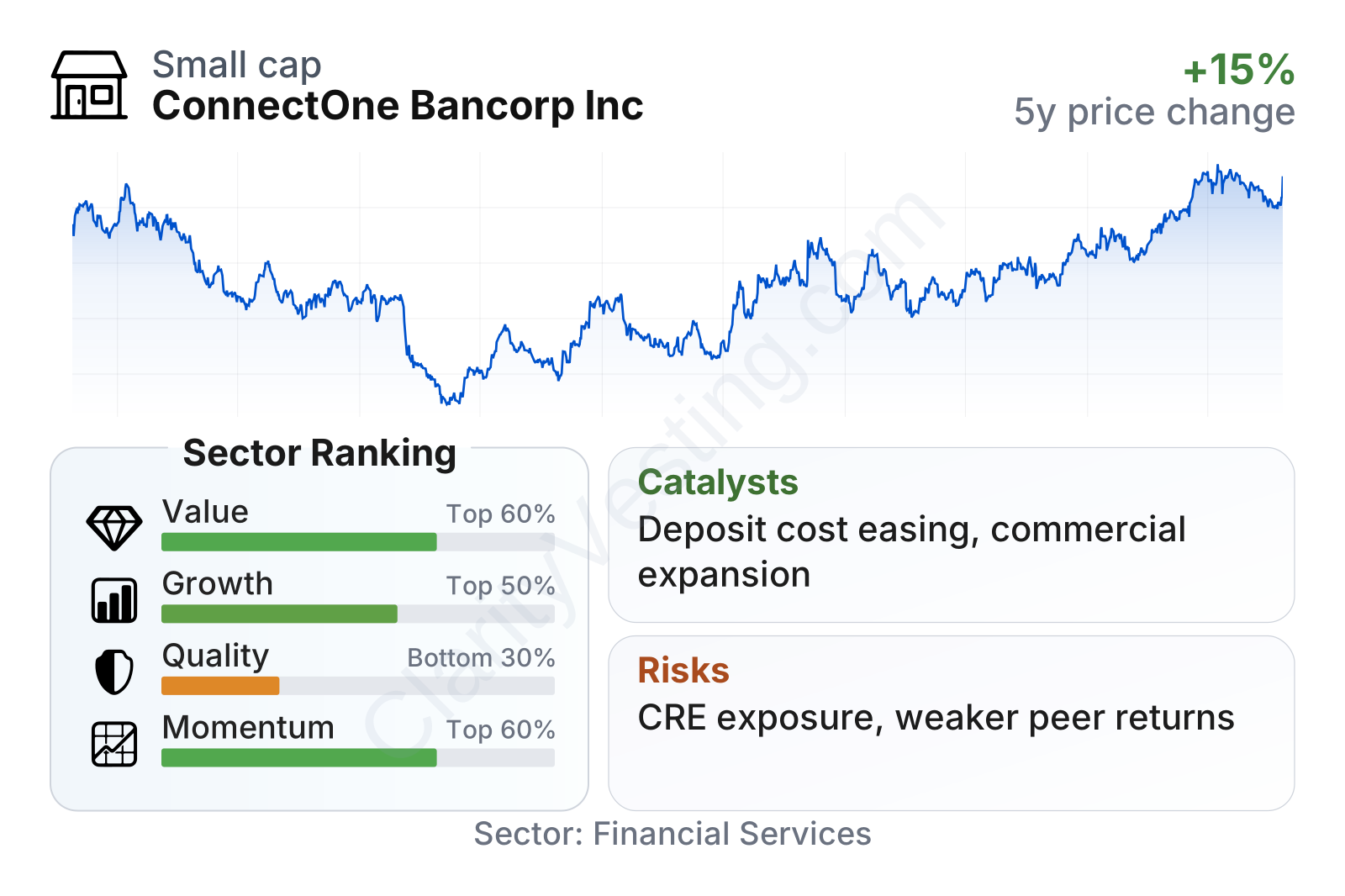
ConnectOne is a mid-sized regional bank with a share price that has recovered strongly from the 2023 banking stress period. On valuation, it trades below the sector median on both earnings and book value, which suggests the market is still assigning some caution to its franchise. Growth metrics are mixed: recent year-over-year revenue growth is strong, but longer-term earnings growth and margin trends remain weaker than many peers. Quality measures also trail the sector median, especially on return on equity and return on assets, even though balance-sheet leverage looks conservative by simple debt-to-equity measures and profit margin remains solid.
Growth
ConnectOne operates in regional banking, a sector that is mature rather than structurally high-growth. That said, growth can still come from share gains in attractive local markets, expansion of commercial relationships, specialty lending, and better deposit gathering. The bank’s footprint in affluent and economically active markets such as New York, New Jersey, and South Florida gives it access to business formation, professional services firms, and commercial real estate borrowers that can support long-term balance-sheet growth.
The strategy broadly makes sense for future growth because it is built around relationship banking in dense markets where local decision-making still matters. For a bank like ConnectOne, future progress depends less on disruptive technology and more on loan quality, deposit stability, cross-selling treasury and payment services, and disciplined pricing. If interest rates stabilize or decline moderately, margin pressure could ease, which would support earnings recovery even without very fast loan growth.
Earnings per share show why the market remains careful. Profitability fell materially from 2021 through 2024 before improving in 2025. That suggests the bank has already gone through a difficult adjustment period tied to funding costs, but it has not yet re-established a clear multiyear earnings uptrend.
Book value per share has generally moved upward over the last five years, although it softened after 2024. For banks, book value is an important sign of balance-sheet resilience. A rising long-term trend here indicates that, despite earnings pressure, the franchise has continued to build capital over time.
A meaningful catalyst is the potential normalization of deposit costs. Many regional banks saw margins squeezed as they had to pay more to retain deposits. If that pressure eases while loan yields remain relatively healthy, ConnectOne could see a better spread between what it earns and what it pays. Another potential catalyst is continued expansion in commercial banking and fee-based treasury services, which can deepen client relationships and improve revenue quality.
Recent company filings and investor materials also point to continued emphasis on disciplined loan production, deposit mix improvement, and relationship-driven commercial banking. Those are not dramatic short-term events, but they are the kind of operational drivers that matter most for a regional bank over time.
Risks
This article is for informational purposes only and does not constitute financial advice. Some content is AI-generated. See Disclaimer


