Stock Analysis · Collective Mining Ltd. Common Shares (CNL)
Overview
Collective Mining Ltd. is a mineral exploration company focused on discovering and advancing gold, silver, copper, and tungsten deposits in Colombia. It is not yet a producing miner, which is the most important point for long-term readers to understand: the company is currently spending money to drill, define resources, and de-risk its projects rather than generating operating revenue from selling metals.
Its main asset is the Guayabales Project in Caldas, Colombia, where the Apollo system has become the centerpiece of the company’s growth profile. Collective Mining also has the nearby San Antonio Project. The investment case is therefore tied less to current profits and more to whether the company can keep expanding its mineral inventory, publish stronger technical studies, and eventually move one or more deposits toward development or a broader strategic transaction.
Because Collective Mining is still in the exploration stage, its revenue mix is unusually simple.
- Mineral sales revenue: approximately 0%. The company has not yet reached commercial production, so it does not have recurring revenue from gold or copper sales.
- Other operating revenue: no meaningful recurring operating revenue disclosed as a core business line.
- Financing and treasury-related inflows: these can support operations, but they are not revenue from the underlying mining business and should not be treated as a durable operating source.
This business model means valuation depends heavily on exploration success, resource growth, and confidence in eventual mine economics rather than on present-day cash earnings. The financial flow also shows a company with essentially no revenue and steadily rising operating spending as drilling activity and corporate costs have expanded over time.
Key Figures
| Metric | Value | Sector ⓘ |
|---|---|---|
| Date | Oct 17, 2026 | |
| Context | ||
| Sector | Basic Materials | |
| Industry | Gold | |
| Market Cap ⓘ | $1.07B | |
| Beta ⓘ | 1.01 | |
Value (Cheapness) | ||
| P/E Ratio ⓘ | N/A | 16.90 |
| P/B Ratio ⓘ | 8.68 | 1.65 |
| FCF Yield ⓘ | -5.83% | 5.76% |
| Dividend Yield ⓘ | N/A | 2.13% |
| EBIT / EV ⓘ | -4.82% | 6.30% |
| PEG ⓘ | N/A | |
Growth (Business expansion) | ||
| Revenue Growth ⓘ | N/A | 11.10% |
| RPS Growth (5Y CAGR) ⓘ | N/A | 4.49% |
| EPS Growth (5Y CAGR) ⓘ | -0.30% | -13.47% |
| BVPS Growth (5Y CAGR) ⓘ | 41.27% | 5.51% |
| Margin Growth (5Y Trend) ⓘ | N/A | -1.54% |
| FCF Growth (5Y CAGR) ⓘ | N/A | 0.37% |
| DPS Growth (5Y CAGR) ⓘ | N/A | 6.08% |
Quality (Business durability) | ||
| ROIC (Latest) ⓘ | -37.44% | 9.26% |
| ROA (Latest) ⓘ | -46.01% | 4.91% |
| ROIC (5Y Median) ⓘ | N/A | 7.70% |
| ROA (5Y Median) ⓘ | -126.02% | 3.86% |
| Net Debt / EBIT (Latest) ⓘ | N/A | 1.40 |
| Net Debt / EBIT (5Y Median) ⓘ | N/A | 1.70 |
| Net Debt / EBITDA (Latest) ⓘ | N/A | 0.95 |
| Net Debt / Assets ⓘ | -47.73% | 13.69% |
| EBITDA / Interest ⓘ | N/A | 12.34 |
| Operating Margin (Latest) ⓘ | N/A | 13.20% |
| Operating Margin (5Y Median) ⓘ | N/A | 11.80% |
| Debt to Equity (Latest) ⓘ | 11.33% | 40.56% |
| Profit Margin (Latest) ⓘ | N/A | 6.43% |
| Free Cash Flow (Latest) ⓘ | -$62.65M | |
Momentum (Price trend) | ||
| 3Y Return ⓘ | +194.58% | +68.89% |
| 12M Return (excl. last month) ⓘ | -3.55% | +30.21% |
| 6M Return ⓘ | -44.23% | -4.16% |
| Price vs. 200-Day MA ⓘ | -29.80% | -1.27% |
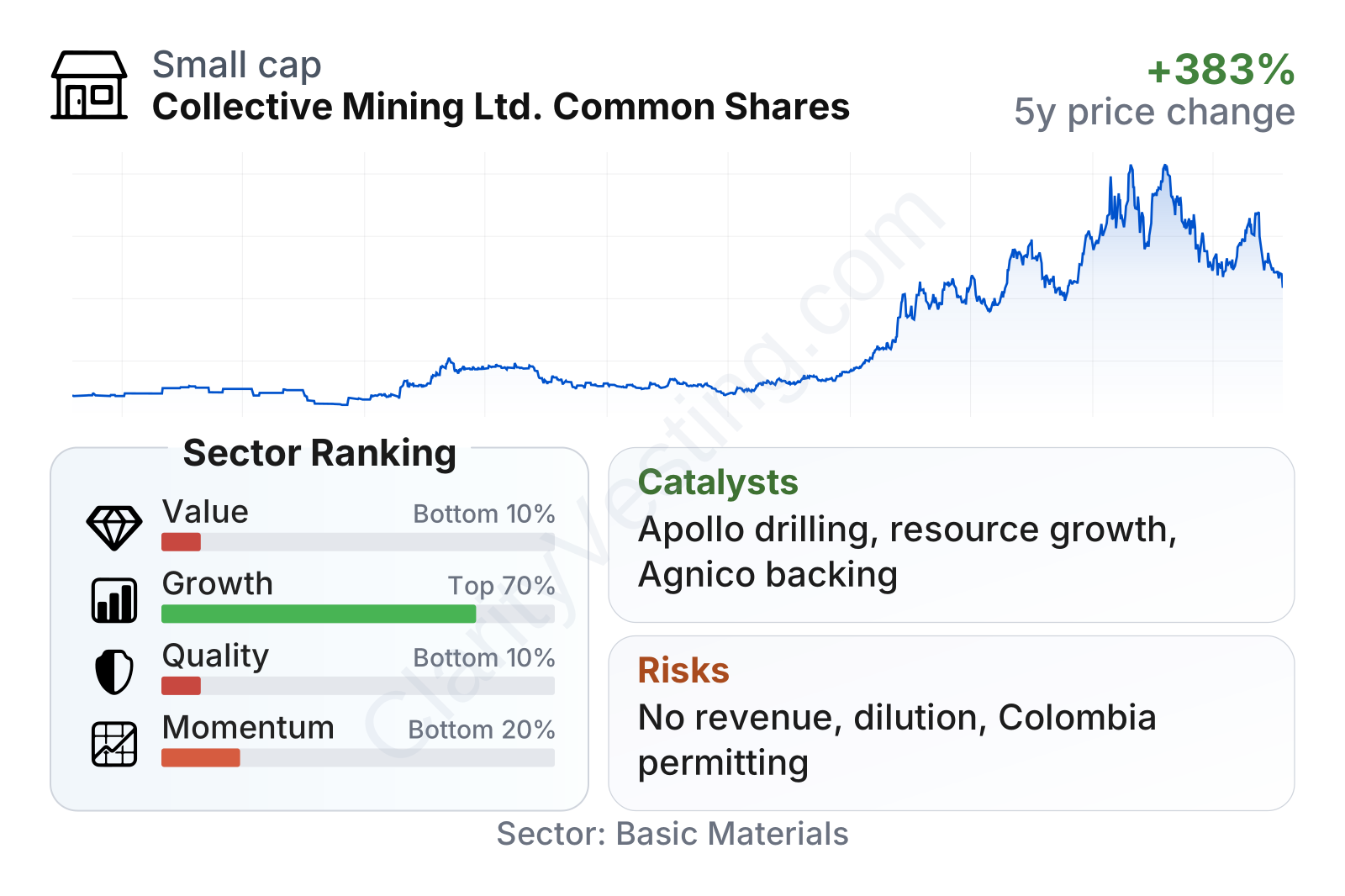
Collective Mining is a mid-sized exploration company by market value, with share-price behavior that has been strong over a three-year period but much more volatile in recent months. That pattern fits a company whose market value is driven by drill results, updated geological interpretation, and changes in sentiment toward precious-metals explorers.
The metrics table is unusual because it mixes a very strong balance-sheet profile with very weak current profitability. Value ranks near the bottom of the sector because traditional measures such as price-to-book are elevated and free cash flow is negative. Quality also ranks near the bottom, but that is mostly a function of the company’s stage: return on capital, return on assets, margins, and profit measures are poor because there is no producing mine yet. By contrast, balance-sheet risk looks much lighter than most peers, with debt-to-equity well below the sector median and net cash rather than net debt pressure.
Growth signals are better than the headline revenue line suggests. Reported revenue growth is effectively zero because there is no production, but book value per share has compounded far faster than the sector median, which reflects repeated capital raising and asset advancement. Momentum is more mixed: the stock has delivered a very large gain over several years, yet shorter-term trading has cooled materially, with the shares sitting below their long-term moving average.
Growth
Collective Mining operates in a part of the mining sector that can attract strong long-term interest when discoveries are large enough. Gold remains strategically important as a store of value and reserve asset, while copper is central to electrification and grid investment. A project that contains meaningful amounts of both precious and industrial metals can draw attention from larger mining companies looking for future development pipelines.
The company’s strategy is coherent for an exploration-stage business. It is concentrating capital on a district-scale land package in a known mining region, using repeated drilling to expand the size and continuity of mineralized zones, and advancing technical work as more information becomes available. That is generally the right sequence for a company that aims to move from discovery to resource definition and, later, economic studies.
The main catalyst is the Apollo deposit at Guayabales. Public company updates during 2026 have continued to point to broad mineralized intervals, step-out drilling, and additional work intended to refine scale and geometry. In practical terms, the market is watching for three things: whether the deposit keeps growing, whether grades remain attractive as drilling expands outward, and whether future technical studies suggest the system could support a mine of meaningful size.
Another positive element is strategic validation from established industry participants. Collective Mining has previously highlighted a relationship with Agnico Eagle through an equity investment, which matters because it signals third-party interest from a major gold producer with deep technical experience. That does not guarantee an eventual transaction, but it does add credibility to the geological case.
The weak point in the growth profile is cash burn. Free cash flow has remained negative and has worsened recently, which is normal for an explorer that is accelerating drilling, but it also means growth depends on continued access to capital markets. For a non-producing miner, expansion is attractive only if new capital keeps translating into higher-quality ounces and a more valuable project rather than simply higher spending.
Risks
This article is for informational purposes only and does not constitute financial advice. Some content is AI-generated. See Disclaimer


