Stock Analysis · CNH Industrial N.V (CNH)
Overview
CNH Industrial N.V. is a global machinery and equipment company focused mainly on agriculture and construction. Its best-known brands include Case IH and New Holland in farm equipment, CASE Construction Equipment in construction machinery, and FPT Industrial in powertrain and engines. The company also operates a financial services arm that helps dealers and customers finance equipment purchases.
For a long-term reader, the business is relatively easy to understand: CNH sells large machines that are essential for food production, land preparation, road work, and other infrastructure activity. That gives it exposure to two large real-economy markets, but also means results can be cyclical because farmers and contractors often delay equipment purchases when commodity prices, interest rates, or confidence weaken.
Based on the company’s recent reporting structure, revenue is mainly generated from the following sources:
- Agriculture: approximately 75% to 80% of industrial activities revenue. This includes tractors, combines, harvesting equipment, crop production tools, precision agriculture systems, aftermarket parts, and related services.
- Construction: approximately 10% to 15% of industrial activities revenue. This includes excavators, loaders, backhoes, road-building machinery, and parts and service support.
- Financial Services: approximately 8% to 12% of total revenue depending on the period. This segment provides retail and wholesale financing, leasing, and other support activities tied to equipment sales.
Geographically, CNH has a broad footprint across North America, Europe, Latin America, and other international markets. North America has generally been its most important profit driver, especially through large agricultural equipment, while Latin America is also meaningful in tractors and harvesting machinery.
The longer-term financial picture shows a company that expanded strongly through 2023, then entered a downturn. Revenue rose from roughly $19.5 billion in 2021 to about $24.7 billion in 2023 before falling to around $19.8 billion in 2024 and about $18.1 billion in 2025. Operating income followed the same pattern, and net income fell much more sharply as interest expense remained heavy.
The business mix highlights an important point: CNH still produces solid gross profit, but weaker end-market demand and high financing costs have recently put much more pressure on earnings than on revenue alone.
Key Figures
| Metric | Value | Sector ⓘ |
|---|---|---|
| Date | Oct 17, 2026 | |
| Context | ||
| Sector | Industrials | |
| Industry | Farm & Heavy Construction Machinery | |
| Market Cap ⓘ | $19.57B | |
| Beta ⓘ | 1.26 | |
Value (Cheapness) | ||
| P/E Ratio ⓘ | 48.68 | 22.10 |
| P/B Ratio ⓘ | 1.94 | 1.97 |
| FCF Yield ⓘ | 6.09% | 6.38% |
| Dividend Yield ⓘ | 0.86% | 1.94% |
| EBIT / EV ⓘ | 4.14% | 4.79% |
| PEG ⓘ | 0.38 | |
Growth (Business expansion) | ||
| Revenue Growth ⓘ | 2.00% | 9.30% |
| RPS Growth (5Y CAGR) ⓘ | 0.25% | 7.81% |
| EPS Growth (5Y CAGR) ⓘ | -46.70% | -13.06% |
| BVPS Growth (5Y CAGR) ⓘ | 5.21% | 6.14% |
| Margin Growth (5Y Trend) ⓘ | -0.54% | 0.88% |
| FCF Growth (5Y CAGR) ⓘ | -10.87% | 11.01% |
| DPS Growth (5Y CAGR) ⓘ | 17.82% | 9.48% |
Quality (Business durability) | ||
| ROIC (Latest) ⓘ | 5.06% | 10.84% |
| ROA (Latest) ⓘ | 0.73% | 5.41% |
| ROIC (5Y Median) ⓘ | N/A | 9.38% |
| ROA (5Y Median) ⓘ | 3.51% | 4.95% |
| Net Debt / EBIT (Latest) ⓘ | 12.68 | 2.08 |
| Net Debt / EBIT (5Y Median) ⓘ | 7.81 | 2.27 |
| Net Debt / EBITDA (Latest) ⓘ | 9.46 | 1.39 |
| Net Debt / Assets ⓘ | 57.83% | 19.28% |
| EBITDA / Interest ⓘ | 1.70 | 9.58 |
| Operating Margin (Latest) ⓘ | 10.57% | 10.50% |
| Operating Margin (5Y Median) ⓘ | 14.19% | 10.29% |
| Debt to Equity (Latest) ⓘ | 338.51% | 65.48% |
| Profit Margin (Latest) ⓘ | 1.71% | 6.67% |
| Free Cash Flow (Latest) ⓘ | $1.19B | |
Momentum (Price trend) | ||
| 3Y Return ⓘ | +9.21% | +61.68% |
| 12M Return (excl. last month) ⓘ | +26.55% | +12.58% |
| 6M Return ⓘ | +5.27% | 0.00% |
| Price vs. 200-Day MA ⓘ | +7.17% | +0.02% |
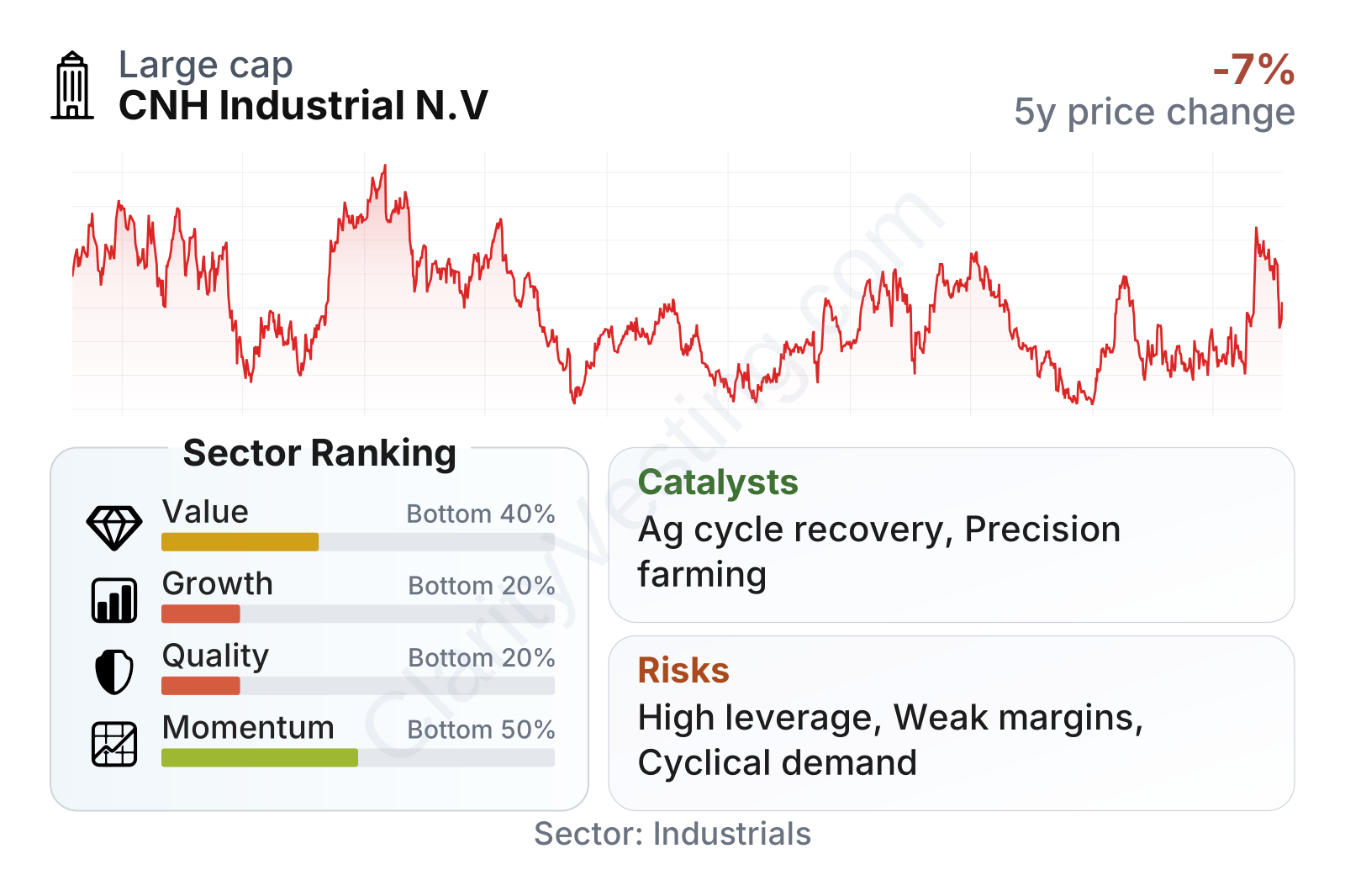
CNH is a large industrial company with a market value around the low-$20 billion range and a share price that has been volatile over the past several years. The stock has moved through strong and weak phases rather than a steady upward trend, which fits the cyclical nature of agricultural and construction equipment.
The latest metrics suggest a mixed profile. On valuation measures, the company does not screen as especially cheap relative to the broader industrial sector because the earnings multiple has moved well above the sector median. At the same time, price-to-book is close to sector norms, and free cash flow yield is not far from the median. That combination usually means the market is looking past temporarily depressed earnings but is not giving the company a full premium either.
Quality and growth metrics are less favorable. Returns on capital and assets are below sector medians, leverage is much higher than average, and recent growth trails the broader industrial group. Momentum is also mixed: shorter-term trading strength has improved, but the longer multi-year stock performance still lags many peers.
Growth
CNH operates in sectors that should remain relevant for decades. Agriculture benefits from long-term demand for food, replacement cycles for machinery, labor shortages on farms, and the push for better yields from each acre. Construction has structural support from infrastructure investment, urbanization in some regions, and fleet replacement needs. These are attractive end-markets over long periods, even if yearly demand can swing sharply.
The company’s strategy for future growth is centered less on pure volume expansion and more on improving the value of each machine sold. In agriculture, that means precision farming, automation, connected equipment, software-enabled tools, and a stronger parts-and-service relationship with customers. These offerings can improve farm productivity and can also make CNH’s revenue less dependent on new equipment cycles over time.
Recent revenue trends show how cyclical the company is. After a strong period through 2022 and 2023, growth turned negative through much of 2024 and 2025 as dealer inventories adjusted and customer demand weakened, especially in agriculture. More recently, the pace of decline has moderated, with growth around flat to slightly positive in the latest periods. That does not prove a full recovery, but it does suggest the downturn may be becoming less severe.
Cash generation is one of the more encouraging points. Free cash flow was negative during part of the downturn but has recovered to a positive level of roughly $1.8 billion on a trailing basis. For a machinery company, that matters because cash flow often improves before reported earnings fully recover, especially when working capital normalizes and inventories become more balanced.
Recent company updates have also emphasized operational simplification, product platform efficiencies, and disciplined dealer inventory management. Another notable development has been portfolio focus after the separation of the Iveco business in prior years, which made CNH more concentrated on agricultural and construction equipment. That narrower focus can help management direct capital and engineering resources toward the company’s strongest franchises.
A meaningful catalyst is any eventual normalization in the agricultural equipment cycle. If farm income, crop prices, and financing conditions stabilize, replacement demand for tractors and harvesters could improve. Precision technology adoption is another important opportunity because it can deepen customer relationships and support margins beyond the initial machine sale.
Risks
This article is for informational purposes only and does not constitute financial advice. Some content is AI-generated. See Disclaimer


