Stock Analysis · Centene Corp (CNC)
Overview
Centene Corporation is a large managed care company focused mainly on government-sponsored health coverage in the United States. In simple terms, it works with states and the federal government to organize health insurance benefits for people covered by Medicaid, Medicare, and the Health Insurance Marketplace. It also provides related services such as pharmacy benefits, behavioral health, care management, and other healthcare support functions.
The business is built around collecting premiums and then managing medical costs, provider networks, and administrative expenses. That makes scale important: a larger membership base gives Centene more negotiating power with providers, more data to manage care, and broader reach across multiple states.
Based on the company’s recent filings, revenue is heavily concentrated in premiums, with a smaller contribution from service revenue. Within premiums, Centene’s mix is primarily tied to Medicaid, followed by Marketplace plans and then Medicare. The exact mix moves from year to year because Medicaid redeterminations, state contracts, and enrollment changes can shift membership materially.
- Medicaid: approximately 55% to 60% of total revenue. This is Centene’s largest activity and includes managed care plans for low-income individuals, families, children, seniors, and people with disabilities under state programs.
- Health Insurance Marketplace: approximately 25% to 30% of total revenue. These are individual plans sold on the Affordable Care Act exchanges, where Centene has built a large national presence through its Ambetter brand.
- Medicare: approximately 10% to 15% of total revenue. This includes Medicare Advantage and Medicare prescription drug plans for seniors and certain disabled members.
- Other services: generally less than 5% of total revenue. This area includes pharmacy-related services and healthcare support offerings outside the premium base.
That revenue mix matters because Centene is not a broad healthcare conglomerate; it is mostly a government-program insurer. This gives it meaningful scale in a specialized part of healthcare, but it also ties results closely to public policy, reimbursement rates, and medical cost trends.
Over the last several years, Centene’s revenue base has expanded strongly, but profitability has been much more uneven. The business has shown an ability to generate very large revenue and cash flow, yet the path from premiums collected to final earnings has recently become less stable, which is a central issue for long-term analysis.
Key Figures
| Metric | Value | Sector ⓘ |
|---|---|---|
| Date | Oct 24, 2026 | |
| Context | ||
| Sector | Healthcare | |
| Industry | Healthcare Plans | |
| Market Cap ⓘ | $34.70B | |
| Beta ⓘ | 1.13 | |
Value (Cheapness) | ||
| P/E Ratio ⓘ | N/A | 25.42 |
| P/B Ratio ⓘ | 1.58 | 3.08 |
| FCF Yield ⓘ | 25.85% | 3.12% |
| Dividend Yield ⓘ | N/A | 1.85% |
| EBIT / EV ⓘ | -20.17% | 0.56% |
| PEG ⓘ | 0.75 | |
Growth (Business expansion) | ||
| Revenue Growth ⓘ | 4.60% | 7.50% |
| RPS Growth (5Y CAGR) ⓘ | 16.77% | 8.60% |
| EPS Growth (5Y CAGR) ⓘ | 0.55% | -17.73% |
| BVPS Growth (5Y CAGR) ⓘ | -2.72% | 3.72% |
| Margin Growth (5Y Trend) ⓘ | -5.26% | -0.57% |
| FCF Growth (5Y CAGR) ⓘ | 7.01% | 0.96% |
| DPS Growth (5Y CAGR) ⓘ | N/A | 6.69% |
Quality (Business durability) | ||
| ROIC (Latest) ⓘ | -8.63% | 3.17% |
| ROA (Latest) ⓘ | -6.18% | 2.98% |
| ROIC (5Y Median) ⓘ | 4.14% | 4.56% |
| ROA (5Y Median) ⓘ | 1.83% | 1.87% |
| Net Debt / EBIT (Latest) ⓘ | N/A | 1.34 |
| Net Debt / EBIT (5Y Median) ⓘ | 2.30 | 1.86 |
| Net Debt / EBITDA (Latest) ⓘ | N/A | 1.00 |
| Net Debt / Assets ⓘ | -9.69% | 5.06% |
| EBITDA / Interest ⓘ | N/A | 9.55 |
| Operating Margin (Latest) ⓘ | -2.05% | 9.25% |
| Operating Margin (5Y Median) ⓘ | 1.90% | 7.33% |
| Debt to Equity (Latest) ⓘ | 71.38% | 26.68% |
| Profit Margin (Latest) ⓘ | -2.83% | 3.34% |
| Free Cash Flow (Latest) ⓘ | $8.97B | |
Momentum (Price trend) | ||
| 3Y Return ⓘ | +0.54% | +51.61% |
| 12M Return (excl. last month) ⓘ | +93.58% | +19.90% |
| 6M Return ⓘ | +83.00% | +10.10% |
| Price vs. 200-Day MA ⓘ | +30.27% | +6.44% |
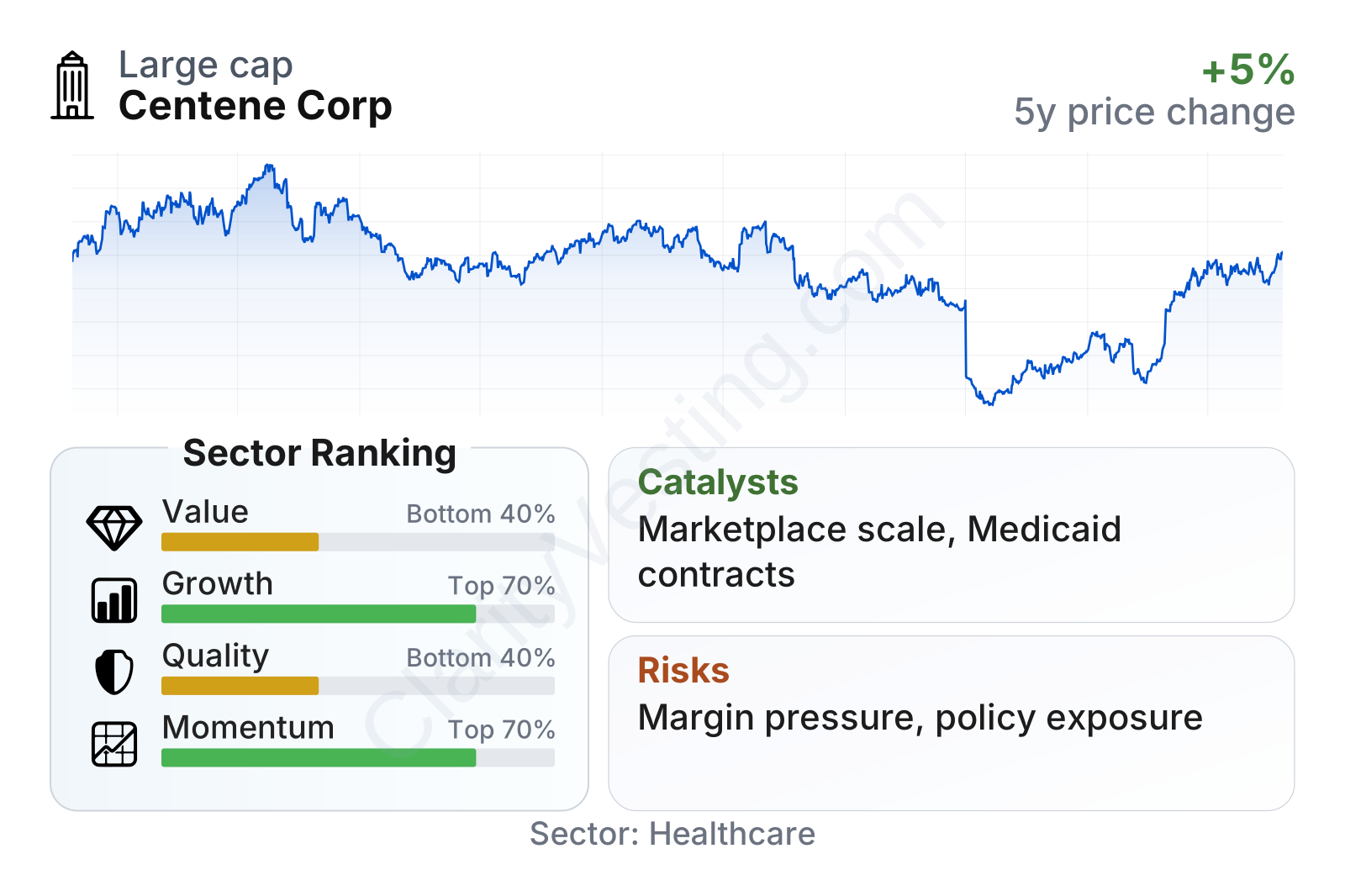
Centene is a large healthcare company with market value in the tens of billions of dollars, so it has meaningful scale but is still smaller than the biggest diversified managed-care groups. The overall factor picture is mixed. Growth and recent price momentum rank better than much of the healthcare sector, while quality and value rank weaker. One unusual feature is very strong free cash flow generation relative to market value, but that sits next to weak recent profitability measures, which means the headline cheapness signals need careful interpretation rather than a simple conclusion.
The stock price history also shows how sentiment has shifted sharply. After trading much higher earlier in the period, the shares fell heavily in 2025 before rebounding strongly into 2026. That pattern usually reflects a business facing a major reset in expectations rather than a steady, predictable operating profile.
Growth
Centene operates in a part of healthcare with durable long-term demand. Medicaid remains a critical safety-net program, Medicare continues to benefit from an aging U.S. population, and Marketplace enrollment has expanded meaningfully in recent years. Those are supportive industry drivers because they are tied less to discretionary consumer spending and more to structural healthcare coverage needs.
Centene’s strategy also has a clear logic. The company has built a strong national position in Medicaid managed care and has become one of the most important players in Affordable Care Act Marketplace coverage. That combination can be powerful: Medicaid gives broad state-level scale, while Marketplace plans provide growth opportunities in counties where the company already has provider relationships and operational infrastructure.
Revenue growth has been positive for most of the recent period, with several quarters showing strong double-digit expansion before moderating and then turning negative in the latest quarter shown. That slowdown is important, but it does not automatically mean the core franchise is shrinking permanently. In Centene’s case, enrollment changes, contract timing, premium rate updates, and program redeterminations can all create short-term volatility around an industry that still has favorable long-term demand drivers.
One of the more important growth catalysts is Centene’s scale in the Marketplace business. The company has been one of the largest participants in that segment, and continued demand for subsidized exchange coverage can support membership and premium growth. Another catalyst is the ongoing outsourcing of Medicaid administration to managed-care organizations by states seeking cost control and predictable service delivery.
Cash generation remains a notable positive. Free cash flow has been volatile, but the latest trailing level is far above the weaker points seen in the last few years. For a health insurer, cash flow matters because earnings can be affected by reserve changes and one-time charges, while cash gives a clearer sense of the company’s ability to fund operations, repay debt, and absorb periods of pressure.
Recent company disclosures in 2026 also point to active portfolio management and contract discipline as part of the growth equation. For a company like Centene, growth is not only about adding members; it is also about choosing the right states, pricing accurately, and exiting business where returns no longer make sense. If that discipline improves margins over time, slower top-line growth could still translate into a healthier business mix.
Risks
This article is for informational purposes only and does not constitute financial advice. Some content is AI-generated. See Disclaimer


