Stock Analysis · Computershare Ltd (CMSQY)
Overview
Computershare Ltd is a financial administration and technology services company best known for managing shareholder records for public companies. In simple terms, it handles the behind-the-scenes work that helps listed companies keep track of who owns their shares, pay dividends, run annual meetings, execute corporate actions, and communicate with investors. Beyond that core role, it also operates in employee equity plans, corporate trust, mortgage servicing and related administration, bankruptcy and class action administration, and other specialized business services.
The business is spread across several service lines, but the largest earnings driver in recent years has been issuer services, especially share registry activity. A second important contributor has been the company’s interest earned on client balances, which rose materially during the higher-rate period. Based on the latest annual disclosures and segment commentary, the revenue mix can be described approximately as follows:
- Issuer Services: about 45% to 55% of group management revenue. This includes share registry, corporate actions, proxy and stakeholder communications, and related services for listed companies.
- Employee Share Plans and related workplace services: about 15% to 20%. This covers administration of stock plans for employees, trading, recordkeeping, and participant support.
- Business Services and Corporate Trust: about 10% to 15%. These activities include bankruptcy, class action and settlement administration, and trustee or agency services.
- Mortgage Services and Property Rental Services: about 10% to 15%. This area mainly reflects U.S. mortgage servicing and related operations.
- Margin income / interest earned on client balances: roughly 10% to 20%, depending on interest rates and client cash levels. This has been an especially meaningful profit source since rates increased.
One important point for long-term readers is that Computershare is not a typical bank or trading platform. Much of its work is recurring, operational, and compliance-heavy. That tends to make the business steadier than many market-facing financial companies, although some divisions still depend on transaction volumes, interest rates, and corporate activity.
The operating profile has improved notably over the past few years. Revenue has climbed from roughly $2.6 billion in fiscal 2022 to more than $3.2 billion in fiscal 2026, while operating income and net income have expanded even faster. That suggests a favorable mix shift, disciplined costs, and support from interest income on client funds.
The business mix shows a company that has become more profitable over time. Revenue, operating income, and net income have all moved higher across the period, with a particularly strong improvement in fiscal 2026. The key takeaway is that profit growth has outpaced sales growth, pointing to operating leverage and a more favorable earnings mix.
Key Figures
| Metric | Value | Sector ⓘ |
|---|---|---|
| Date | Oct 17, 2026 | |
| Context | ||
| Sector | Financial Services | |
| Industry | Capital Markets | |
| Market Cap ⓘ | $16.37B | |
| Beta ⓘ | 0.01 | |
Value (Cheapness) | ||
| P/E Ratio ⓘ | 26.71 | 12.26 |
| P/B Ratio ⓘ | 7.28 | 1.23 |
| FCF Yield ⓘ | 9.68% | 10.40% |
| Dividend Yield ⓘ | 3.24% | 3.02% |
| EBIT / EV ⓘ | N/A | 8.14% |
| PEG ⓘ | 1.43 | |
Growth (Business expansion) | ||
| Revenue Growth ⓘ | 4.40% | 9.35% |
| RPS Growth (5Y CAGR) ⓘ | 7.15% | 12.19% |
| EPS Growth (5Y CAGR) ⓘ | 5.53% | -9.53% |
| BVPS Growth (5Y CAGR) ⓘ | 2.10% | 4.99% |
| Margin Growth (5Y Trend) ⓘ | 17.73% | -3.86% |
| FCF Growth (5Y CAGR) ⓘ | 20.16% | 4.81% |
| DPS Growth (5Y CAGR) ⓘ | 21.99% | 8.79% |
Quality (Business durability) | ||
| ROIC (Latest) ⓘ | N/A | 9.49% |
| ROE (Latest) ⓘ | 49.97% | 13.90% |
| ROA (Latest) ⓘ | 20.96% | 1.55% |
| ROIC (5Y Median) ⓘ | 11.62% | 7.86% |
| ROE (5Y Median) ⓘ | 20.54% | 12.17% |
| ROA (5Y Median) ⓘ | 5.49% | 1.30% |
| Net Debt / EBIT (Latest) ⓘ | N/A | 0.96 |
| Net Debt / EBIT (5Y Median) ⓘ | 1.00 | 0.73 |
| Net Debt / EBITDA (Latest) ⓘ | 0.13 | 0.92 |
| Operating Margin (Latest) ⓘ | N/A | 22.30% |
| Operating Margin (5Y Median) ⓘ | 20.97% | 24.63% |
| Debt to Equity (Latest) ⓘ | 59.34% | 58.56% |
| Profit Margin (Latest) ⓘ | 18.93% | 26.57% |
| Free Cash Flow (Latest) ⓘ | $1.59B | |
Momentum (Price trend) | ||
| 3Y Return ⓘ | +98.73% | +88.33% |
| 12M Return (excl. last month) ⓘ | +22.14% | +19.38% |
| 6M Return ⓘ | +37.47% | +4.75% |
| Price vs. 200-Day MA ⓘ | +18.57% | +3.50% |
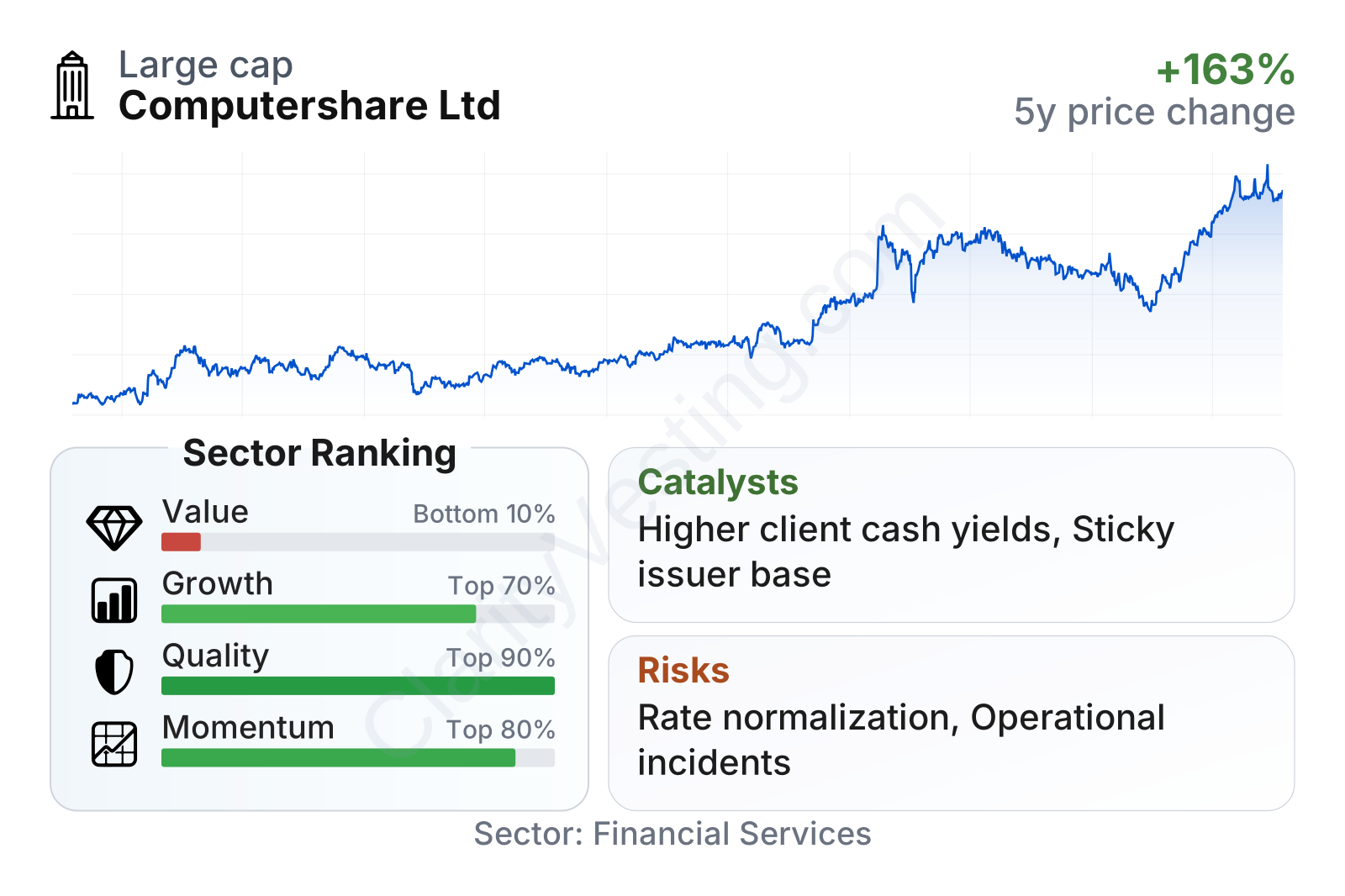
Computershare currently sits in a mixed but interesting position. Quality metrics are strong relative to the broader financial sector, helped by high returns on equity and assets and modest net debt versus EBITDA. Growth metrics are more middle-of-the-pack overall, but long-term earnings, free cash flow, and dividend growth have been clearly positive. The main weak point is valuation: multiples stand well above sector medians, which means the market is already recognizing much of the recent improvement.
The share price trend has been strong over the last several years, with a particularly sharp move higher from 2025 into 2026. That momentum reflects better profitability and confidence in the business model, but it also raises the bar for future execution.
Growth
Computershare operates in service categories that are not flashy but remain essential. Public companies still need shareholder recordkeeping, corporate action processing, proxy support, and employee plan administration regardless of market fashion. That gives the company exposure to structural demand tied to regulation, listed-company complexity, and outsourcing. These are stable areas with room for growth as clients seek global platforms and cost efficiency.
The company’s strategy also makes sense for long-term expansion. Computershare benefits from scale, long client relationships, and operational infrastructure that can be reused across markets. Once a company entrusts a provider with shareholder records or employee stock plan administration, switching can be disruptive. That creates a sticky customer base and supports recurring revenue. Management has also spent years reshaping the group through acquisitions, disposals, and productivity efforts to focus on stronger-return activities.
A major growth catalyst has been the earnings lift from client balances invested in higher-rate environments. This source is inherently cyclical, but it has shown how much incremental profit the business can generate when rates are supportive. At the same time, the core operating businesses have also remained resilient, which matters because it suggests recent strength is not only a rate effect.
Earnings progression has been favorable over the medium term. Five-year EPS growth is positive, and recent profit expansion has been faster than revenue growth, indicating improving efficiency rather than pure volume expansion alone.
Book value per share has increased over time, although the pace has been more modest than earnings growth. That is consistent with a service business where value creation often shows up more clearly in profitability and cash generation than in large balance-sheet expansion.
Recent company updates also support the growth case. Computershare has continued to highlight resilient issuer services activity, ongoing demand in employee equity administration, and continued technology investment to improve service delivery. Another medium-term opportunity is consolidation: many of its niches reward scale, trusted processes, and regulatory know-how, all of which can favor larger incumbents.
Risks
This article is for informational purposes only and does not constitute financial advice. Some content is AI-generated. See Disclaimer


