Stock Analysis · CMS Energy Corporation (CMS)
Overview
CMS Energy Corporation is a regulated utility holding company centered on Michigan. Its main business is delivering electricity and natural gas to homes and businesses through its principal subsidiary, Consumers Energy. For a long-term reader, the simplest way to view CMS is as an essential infrastructure company: it owns wires, pipes, generation resources, and related systems that are difficult to replicate and operate under state regulation.
The company’s revenue base is mainly tied to regulated utility operations, which generally makes demand more stable than in many other industries. Based on recent annual reporting, CMS is overwhelmingly driven by Consumers Energy, while smaller activities include NorthStar Clean Energy and corporate-level items.
Main sources of revenue can be summarized as follows:
- Electric utility operations: approximately 60% to 70% of total revenue. This includes power generation, transmission, and distribution service to Michigan customers.
- Natural gas utility operations: approximately 25% to 35% of total revenue. This includes gas distribution, storage, and related customer service.
- Independent energy and other activities: generally below 10% of total revenue. This mainly includes NorthStar Clean Energy and corporate or miscellaneous items.
That mix matters because regulated electric and gas operations usually provide clearer earnings visibility than merchant power businesses. It also means CMS depends heavily on regulatory decisions, approved capital plans, and its ability to recover investment costs through customer rates.
Over the last several years, revenue has been fairly steady overall, but profit flow has improved as operating income expanded. The business has also shown rising interest expense, which is important for a capital-intensive utility. Net income recovered from the weaker 2022 period and has trended upward again more recently, reflecting the underlying resilience of the regulated model.
The broad pattern shows a utility with relatively stable sales, improving operating profit over time, and growing financing costs as it continues to invest heavily in the system.
Key Figures
| Metric | Value | Sector ⓘ |
|---|---|---|
| Date | Oct 17, 2026 | |
| Context | ||
| Sector | Utilities | |
| Industry | Utilities - Regulated Electric | |
| Market Cap ⓘ | $20.79B | |
| Beta ⓘ | 0.31 | |
Value (Cheapness) | ||
| P/E Ratio ⓘ | 19.91 | 17.28 |
| P/B Ratio ⓘ | 2.20 | 1.51 |
| FCF Yield ⓘ | -9.19% | 0.65% |
| Dividend Yield ⓘ | 3.38% | 3.77% |
| EBIT / EV ⓘ | 4.97% | 5.01% |
| PEG ⓘ | 2.28 | |
Growth (Business expansion) | ||
| Revenue Growth ⓘ | -0.50% | 6.10% |
| RPS Growth (5Y CAGR) ⓘ | 2.92% | 3.87% |
| EPS Growth (5Y CAGR) ⓘ | -16.05% | -11.30% |
| BVPS Growth (5Y CAGR) ⓘ | 5.65% | 4.23% |
| Margin Growth (5Y Trend) ⓘ | 5.80% | 3.57% |
| FCF Growth (5Y CAGR) ⓘ | N/A | -8.84% |
| DPS Growth (5Y CAGR) ⓘ | 5.83% | 4.84% |
Quality (Business durability) | ||
| ROIC (Latest) ⓘ | 5.50% | 6.53% |
| ROA (Latest) ⓘ | 2.59% | 3.20% |
| ROIC (5Y Median) ⓘ | 6.27% | 5.95% |
| ROA (5Y Median) ⓘ | 2.81% | 2.75% |
| Net Debt / EBIT (Latest) ⓘ | 9.81 | 7.13 |
| Net Debt / EBIT (5Y Median) ⓘ | 9.11 | 7.23 |
| Net Debt / EBITDA (Latest) ⓘ | 6.10 | 4.31 |
| Net Debt / Assets ⓘ | 46.37% | 38.42% |
| EBITDA / Interest ⓘ | 3.83 | 4.58 |
| Operating Margin (Latest) ⓘ | 22.04% | 20.83% |
| Operating Margin (5Y Median) ⓘ | 21.40% | 20.08% |
| Debt to Equity (Latest) ⓘ | 197.47% | 137.69% |
| Profit Margin (Latest) ⓘ | 11.64% | 11.37% |
| Free Cash Flow (Latest) ⓘ | -$1.91B | |
Momentum (Price trend) | ||
| 3Y Return ⓘ | +36.04% | +52.37% |
| 12M Return (excl. last month) ⓘ | -3.87% | +8.84% |
| 6M Return ⓘ | -13.88% | -3.95% |
| Price vs. 200-Day MA ⓘ | -7.01% | -0.79% |
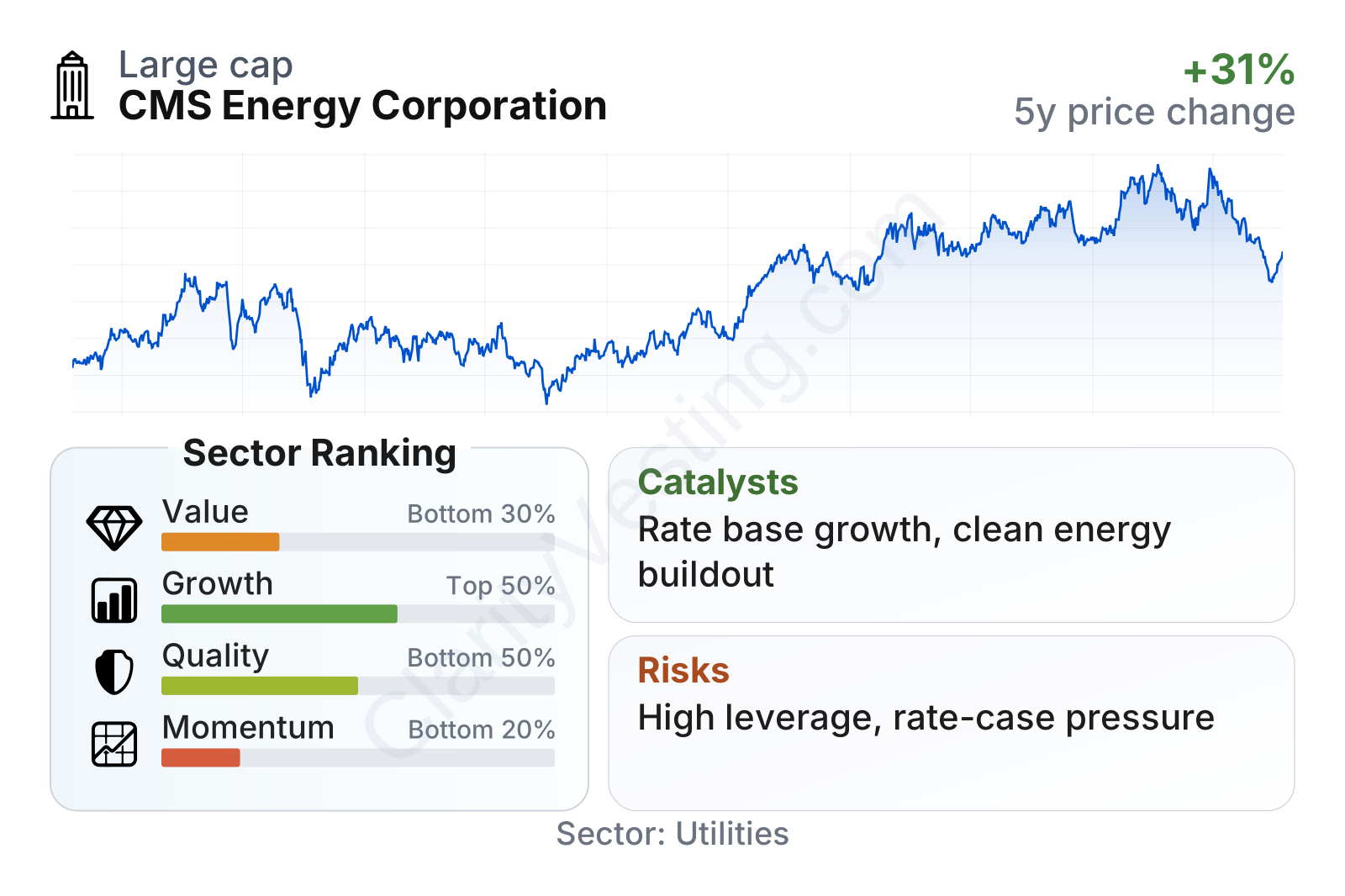
CMS is a large regulated utility with a low beta of about 0.33, which suggests its share price has historically moved much less than the broader equity market. On valuation, it sits in the weaker part of the sector ranking, with earnings and book-value multiples somewhat above the utility median while free cash flow yield is pressured by heavy capital spending. Growth metrics are mixed rather than weak across the board: revenue growth has been soft recently, but book value growth, dividend growth, and margin progression have been more favorable. Quality is held back mainly by leverage and negative free cash flow, even though profitability margins themselves remain close to or slightly above sector norms. Momentum is clearly the softest area, with recent share performance trailing much of the utility group.
Growth
CMS operates in a sector that is not fast-growing in the way technology or biotech can be, but it does benefit from long-duration structural demand. Electric grid modernization, reliability upgrades, natural gas system replacement, renewable generation, storage, and potential load growth from electrification and data infrastructure all support continued investment across regulated utilities. For companies like CMS, growth is often less about selling dramatically more electricity each year and more about expanding the regulated asset base on which returns are allowed.
The company’s strategy broadly fits that model. CMS has continued investing in cleaner generation, grid reliability, and distribution infrastructure in Michigan. That can support earnings growth if regulators approve spending and allow cost recovery. This is one of the most important points for long-term analysis: utility growth often comes from capital deployment that later feeds into rates, rather than from rapid volume expansion alone.
Revenue per share has been somewhat uneven year to year, which is normal for utilities because weather, fuel-cost pass-throughs, and timing effects can affect reported sales. Even so, the multi-year trend has been modestly positive rather than stagnant, showing that the company has still grown its business base over time.
Free cash flow is the main area that needs careful interpretation. It has remained negative, and recently more deeply negative, but that is not unusual for a utility in an intensive investment cycle. The key question is whether those outlays are building regulated assets that can support future earnings and dividends. In CMS’s case, management’s long-term plan has been built around exactly that logic.
Another important catalyst is the broader transition of U.S. utilities toward cleaner and more modern systems. If CMS executes well on generation replacement, transmission and distribution upgrades, and customer growth in its service territory, that can create a durable earnings runway. Company communications in 2026 have continued to emphasize long-term investment planning, reliability, and customer affordability, which suggests strategic consistency rather than a major change in direction.
Risks
This article is for informational purposes only and does not constitute financial advice. Some content is AI-generated. See Disclaimer


