Stock Analysis · CIM Real Estate Finance Trust Inc (CMRF)
Overview
CIM Real Estate Finance Trust Inc. is a real estate investment trust focused primarily on credit rather than owning large portfolios of traditional rental properties. In simple terms, it provides financing backed by real estate and earns income from the loans and related investments it holds. The company has historically invested across senior secured loans, mezzanine loans, other real estate credit positions, and certain real estate-related assets managed within the broader CIM platform.
That business model means results depend heavily on loan performance, interest income, financing costs, and property market conditions. Compared with an equity REIT that mainly collects rent, CMRF is more exposed to credit spreads, borrower health, refinancing conditions, and the value of collateral behind its loans.
Based on recent annual reporting, revenue is mainly tied to interest and other income from real estate credit investments, with additional contributions from loan-related fees, gains or losses tied to investments and asset resolutions, and a smaller amount from other real estate-related activities. Precise segment percentages are not always presented in a simple retail-friendly split, but the revenue mix can be summarized as follows:
- Interest income from real estate loans and credit investments: the largest source, generally the clear majority of recurring revenue. This includes income from mortgage loans and other lending positions secured by real estate.
- Other investment-related income and fee income: a smaller but meaningful contribution, including origination-related economics, modifications, and other loan activity.
- Realized and unrealized investment gains, recoveries, and other items: variable from year to year and capable of materially affecting reported results.
The company is relatively small by public REIT standards, which can make results more volatile from one year to the next. Its financial flow over the last several years also shows a business that can generate strong gross profitability, but where interest expense and valuation-related swings have had a major impact on bottom-line outcomes.
One clear pattern is that revenue expanded meaningfully through 2024 before easing in 2025, while interest expense remained heavy throughout the period. That helps explain why reported earnings have been uneven even when top-line activity looked solid.
Key Figures
| Metric | Value | Sector ⓘ |
|---|---|---|
| Date | Oct 17, 2026 | |
| Context | ||
| Sector | Real Estate | |
| Industry | REIT - Diversified | |
| Market Cap ⓘ | $914.31M | |
| Beta ⓘ | 1,862.35 | |
Value (Cheapness) | ||
| P/E Ratio ⓘ | N/A | 17.38 |
| P/B Ratio ⓘ | 1.48 | 0.85 |
| FCF Yield ⓘ | 2.59% | 7.38% |
| Dividend Yield ⓘ | 14.41% | 4.85% |
| EBIT / EV ⓘ | 3.32% | 3.78% |
| PEG ⓘ | N/A | |
Growth (Business expansion) | ||
| Revenue Growth ⓘ | -18.30% | 5.30% |
| RPS Growth (5Y CAGR) ⓘ | -1.21% | 6.02% |
| EPS Growth (5Y CAGR) ⓘ | -45.06% | -11.37% |
| BVPS Growth (5Y CAGR) ⓘ | -12.77% | 0.45% |
| Margin Growth (5Y Trend) ⓘ | 6.12% | -0.22% |
| FCF Growth (5Y CAGR) ⓘ | -43.91% | 5.40% |
| DPS Growth (5Y CAGR) ⓘ | -1.06% | 5.02% |
Quality (Business durability) | ||
| ROIC (Latest) ⓘ | N/A | 5.69% |
| ROE (Latest) ⓘ | 6.28% | 7.56% |
| ROA (Latest) ⓘ | 1.28% | 2.85% |
| ROIC (5Y Median) ⓘ | 1.69% | 4.22% |
| ROE (5Y Median) ⓘ | 2.97% | 6.03% |
| ROA (5Y Median) ⓘ | -0.00% | 2.44% |
| Net Debt / EBIT (Latest) ⓘ | 16.19 | 7.59 |
| Net Debt / EBIT (5Y Median) ⓘ | 15.16 | 8.40 |
| Net Debt / EBITDA (Latest) ⓘ | 13.81 | 5.27 |
| Net Debt / Assets ⓘ | 43.54% | 37.76% |
| EBITDA / Interest ⓘ | 1.57 | 4.10 |
| Operating Margin (Latest) ⓘ | 42.33% | 35.29% |
| Operating Margin (5Y Median) ⓘ | 50.69% | 37.31% |
| Debt to Equity (Latest) ⓘ | 535.22% | 88.87% |
| Profit Margin (Latest) ⓘ | 5.76% | 19.61% |
| Free Cash Flow (Latest) ⓘ | $23.65M | |
Momentum (Price trend) | ||
| 3Y Return ⓘ | +7.28% | +30.75% |
| 12M Return (excl. last month) ⓘ | -7.02% | +4.36% |
| 6M Return ⓘ | -18.34% | -2.52% |
| Price vs. 200-Day MA ⓘ | -11.13% | -2.34% |
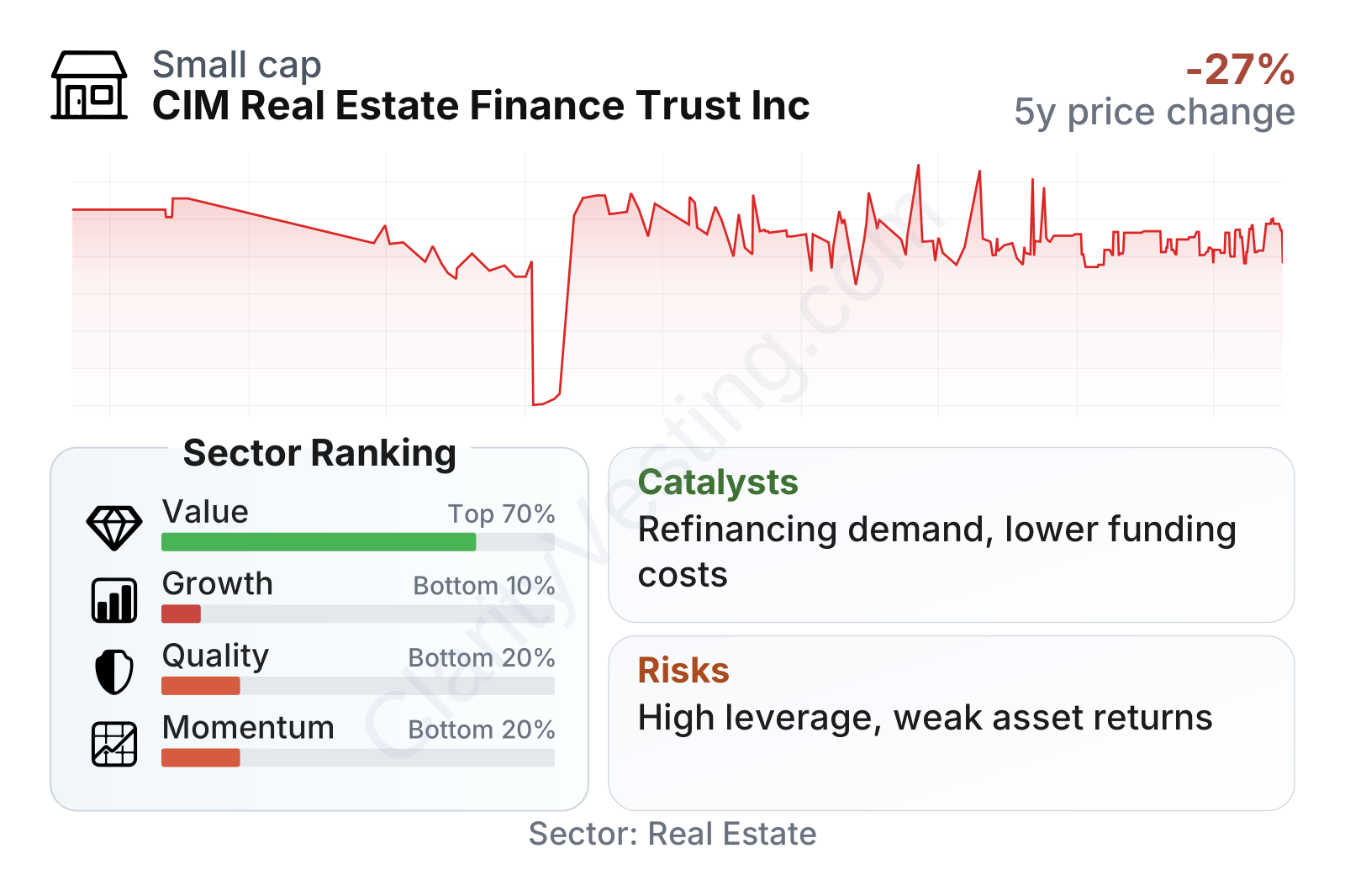
The overall profile is mixed. On value measures, the stock does not screen as especially cheap relative to the broader REIT group when compared on book value, even though income yield remains unusually high. Quality and growth metrics are much weaker: leverage is elevated, returns on assets are below sector norms, and multi-year growth trends have been negative. Momentum has also lagged the sector, showing that the market has been cautious about the company’s outlook.
Growth
CMRF operates in a part of real estate that can benefit when banks pull back from lending. In that environment, alternative real estate lenders can sometimes negotiate better loan terms, stronger collateral packages, and higher yields. That is the main long-term growth logic for the company: if traditional credit remains constrained, private and non-bank lenders may see more opportunities.
Its strategy also makes sense in another way. Senior secured real estate lending can offer more downside protection than common equity ownership because debt sits higher in the capital stack. If underwriting is disciplined, that can create a more resilient model than owning weaker property assets outright. For a company like CMRF, future growth depends less on rapid expansion and more on originating and managing loans profitably while controlling credit losses and funding costs.
Revenue per share improved through 2023, then moved lower in 2024 and 2025. That pattern suggests the company has not yet established a steady upward growth path. The broader opportunity in real estate credit may still be attractive, but recent company-level execution has been uneven.
The dividend history is also not a clean growth signal. It rose into 2024 and then dropped in 2025, which points to a payout profile that is more variable than what many income-focused REIT shareholders typically expect. The current yield is very high, but the multi-year trend does not show consistent dividend expansion.
A practical catalyst is any improvement in real estate transaction activity and refinancing markets. If borrowers return and distressed refinancing needs remain elevated, lenders with available capital may find more opportunities. Another positive catalyst would be a sustained reduction in funding pressure, since lower interest expense can have a meaningful effect on earnings in this business model.
Recent company disclosures also matter more than headlines here. The most relevant developments have been portfolio management actions, financing activity, and quarterly updates around loan resolutions, book value, and distributions. For CMRF, future upside is closely tied to whether management can convert its credit platform into steadier earnings rather than just episodic gains.
Risks
This article is for informational purposes only and does not constitute financial advice. Some content is AI-generated. See Disclaimer


