Stock Analysis · Costamare Inc (CMRE)
Overview
Costamare Inc is a marine shipping company focused mainly on moving containers around the world. In simple terms, it owns and operates ships that are hired by major liner companies under charter agreements. Over time, the company has also expanded into dry bulk shipping, which transports unpackaged commodities such as iron ore, coal, and grain. This gives Costamare exposure to two different parts of global seaborne trade.
The business is built around long-lived assets: vessels. Revenue depends on how many ships the company has on hire, the charter rates it can secure, and the strength of global trade flows. Container shipping has historically been the core activity, while dry bulk has become an additional growth platform through vessel ownership and related commercial operations.
Based on the company’s recent structure and disclosures, Costamare’s revenue mix is broadly split as follows:
- Container vessel chartering: approximately 55% to 70% of revenue in recent periods. This is the traditional core business and includes long-term charters of containerships to liner operators.
- Dry bulk shipping: approximately 30% to 45% of revenue in recent periods. This includes earnings from owned dry bulk vessels and the company’s expanding dry bulk platform.
That mix can move meaningfully from quarter to quarter because freight markets are cyclical, vessel deliveries change the fleet profile, and charter renewals can reset pricing. What stands out is that Costamare is no longer only a container lessor; it is increasingly a diversified shipping owner with exposure to multiple cargo categories.
The business has scaled up sharply over the last several years, with revenue rising much faster than operating costs at first, then normalizing as shipping markets cooled from unusually high levels. Even after that normalization, the company still produces very high operating profitability for its industry.
The long-term picture shows a company that expanded its revenue base substantially from 2021 through 2024, while preserving a large profit pool. More recently, the revenue base has become more volatile, which is normal in shipping but important for long-term readers to keep in mind.
Key Figures
| Metric | Value | Sector ⓘ |
|---|---|---|
| Date | Oct 17, 2026 | |
| Context | ||
| Sector | Industrials | |
| Industry | Marine Shipping | |
| Market Cap ⓘ | $1.79B | |
| Beta ⓘ | 0.97 | |
Value (Cheapness) | ||
| P/E Ratio ⓘ | 5.60 | 22.10 |
| P/B Ratio ⓘ | 0.83 | 1.97 |
| FCF Yield ⓘ | -7.46% | 6.38% |
| Dividend Yield ⓘ | 3.04% | 1.94% |
| EBIT / EV ⓘ | 14.22% | 4.79% |
| PEG ⓘ | 2.40 | |
Growth (Business expansion) | ||
| Revenue Growth ⓘ | -4.00% | 9.30% |
| RPS Growth (5Y CAGR) ⓘ | 3.16% | 7.81% |
| EPS Growth (5Y CAGR) ⓘ | -22.69% | -13.06% |
| BVPS Growth (5Y CAGR) ⓘ | 4.54% | 6.14% |
| Margin Growth (5Y Trend) ⓘ | -8.30% | 0.88% |
| FCF Growth (5Y CAGR) ⓘ | N/A | 11.01% |
| DPS Growth (5Y CAGR) ⓘ | 3.31% | 9.48% |
Quality (Business durability) | ||
| ROIC (Latest) ⓘ | 8.66% | 10.84% |
| ROA (Latest) ⓘ | 8.61% | 5.41% |
| ROIC (5Y Median) ⓘ | 11.42% | 9.38% |
| ROA (5Y Median) ⓘ | 8.09% | 4.95% |
| Net Debt / EBIT (Latest) ⓘ | 2.82 | 2.08 |
| Net Debt / EBIT (5Y Median) ⓘ | 3.57 | 2.27 |
| Net Debt / EBITDA (Latest) ⓘ | 2.11 | 1.39 |
| Net Debt / Assets ⓘ | 28.53% | 19.28% |
| EBITDA / Interest ⓘ | 7.02 | 9.58 |
| Operating Margin (Latest) ⓘ | 48.22% | 10.50% |
| Operating Margin (5Y Median) ⓘ | 55.58% | 10.29% |
| Debt to Equity (Latest) ⓘ | 67.78% | 65.48% |
| Profit Margin (Latest) ⓘ | 39.52% | 6.67% |
| Free Cash Flow (Latest) ⓘ | -$133.33M | |
Momentum (Price trend) | ||
| 3Y Return ⓘ | +133.16% | +61.68% |
| 12M Return (excl. last month) ⓘ | +27.14% | +12.58% |
| 6M Return ⓘ | -13.71% | 0.00% |
| Price vs. 200-Day MA ⓘ | -6.50% | +0.02% |
Costamare sits in the mid-cap range, so it is large enough to access capital markets and manage a sizable fleet, but still small compared with the largest global shipping groups. The stock’s beta is below 1, which suggests its share price has not been more volatile than the broad market on average, although shipping stocks can still swing sharply when freight conditions change.
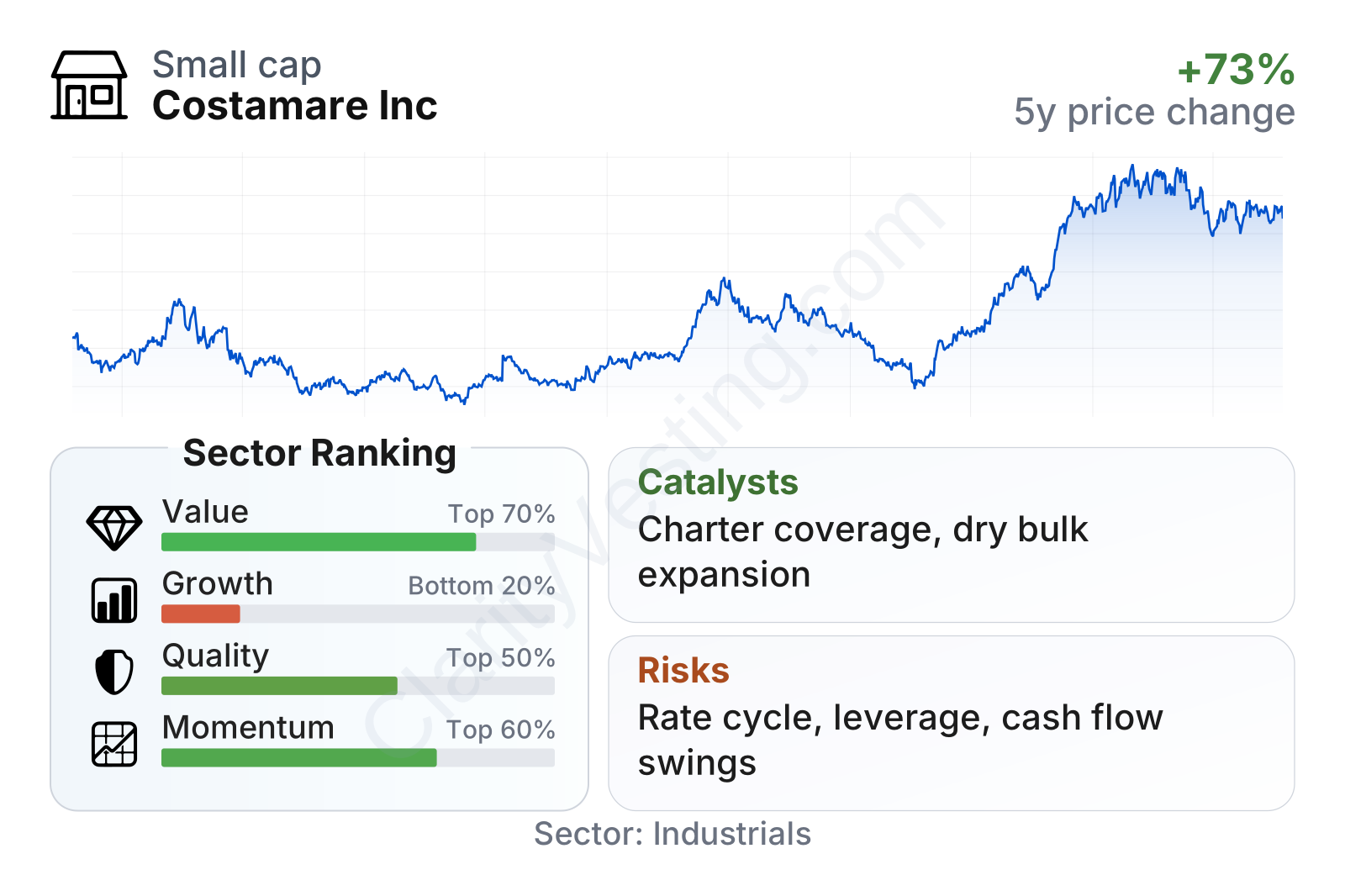
On valuation measures, the company screens cheaply relative to its sector. Its earnings multiple is far below the sector median, and its price-to-book ratio is also below typical industrial peers. At the same time, growth measures are weak versus the broader sector, reflecting the cooling of shipping markets after an exceptional period. Quality is mixed: profitability is very strong, but leverage and cash conversion are less comfortable. Momentum has been decent over a multi-year view, helped by the stock’s strong rebound since 2024.
Growth
Costamare operates in sectors that are essential to the global economy. Container shipping depends on manufactured goods trade, while dry bulk depends on industrial production, infrastructure demand, energy flows, and agricultural trade. These are not smooth growth markets year after year, but over long periods they remain structurally important because the world still relies heavily on maritime transport.
The company’s strategy makes sense in that context. Container chartering can provide visibility through contracted revenue, while dry bulk adds market exposure and fleet flexibility. That combination can help reduce reliance on a single shipping segment, although it does not eliminate cyclicality. Costamare has also continued fleet renewal and expansion through vessel acquisitions and newbuilding activity, which can support earnings if assets are bought at disciplined prices and employment remains strong.
Revenue growth has been highly uneven. There were periods of extremely strong expansion during the shipping upcycle, followed by steep declines as conditions normalized. The latest year-over-year reading remains negative, and the company’s growth profile now ranks near the lower end of the sector. That does not necessarily mean the business model is weakening; in shipping, it often reflects where the industry is in the rate cycle.
Cash generation has also been uneven, but the broader pattern suggests that Costamare can produce substantial cash when charter conditions and vessel monetization are favorable. One of the more encouraging recent points is that trailing free cash flow had turned strongly positive by early 2026 after previous swings. That matters because shipping is capital-intensive, and healthy cash generation supports debt reduction, fleet investment, and shareholder distributions.
A practical catalyst for future growth is charter coverage. When a shipping company has a meaningful share of its fleet contracted for future periods, it gains visibility on revenue. Another catalyst is the dry bulk platform, which broadens the company’s addressable market. If global trade volumes remain resilient and vessel supply stays reasonably controlled, Costamare has room to keep generating solid earnings even without a return to peak freight rates.
Recent company communications have also highlighted continued fleet activity, financing actions, and capital allocation discipline. For a long-term view, the most significant opportunity is not explosive growth, but the possibility that the company converts its fleet scale and diversified shipping exposure into steadier earnings than a pure-play shipping operator.
Risks
This article is for informational purposes only and does not constitute financial advice. Some content is AI-generated. See Disclaimer


