Stock Analysis · Compass Pathways Plc (CMPS)
Overview
Compass Pathways Plc is a clinical-stage mental health company focused on developing psychedelic-assisted therapies, with its lead program built around a proprietary synthetic psilocybin formulation called COMP360. The company is primarily targeting treatment-resistant depression, a severe form of depression in which patients do not respond adequately to standard treatments. Compass is also studying related uses in post-traumatic stress disorder and anorexia nervosa, but the business remains centered on advancing COMP360 through late-stage clinical development and, if successful, toward commercialization.
At this stage, Compass is not a conventional operating healthcare company with recurring product sales. Its economics are still shaped by research spending rather than commercial revenue. Based on recent filings and financial statements, revenue remains effectively 0% from marketed products, while operating activity is overwhelmingly tied to drug development.
The company’s economic focus can be understood through spending rather than revenue mix:
- Research and development: about 66% of 2025 operating expenses. This includes clinical trials, manufacturing development, regulatory work, and scientific staff supporting COMP360 and earlier pipeline programs.
- Selling, general and administrative: about 34% of 2025 operating expenses. This covers corporate overhead, public-company costs, legal and professional fees, and preparation for a larger operating platform.
- Product revenue: 0%. Compass has not yet launched an approved therapy, so current value depends on pipeline progress rather than sales execution.
This makes Compass a biotechnology company whose future depends mainly on whether its lead therapy proves safe, effective, and commercially workable in regulated healthcare settings.
The long-term pattern is clear: operating losses have widened as clinical development has expanded, and research spending has become the dominant use of capital. That is typical for a late-stage biotech, but it also means the business case is still built on future potential rather than present earnings.
Key Figures
| Metric | Value | Sector ⓘ |
|---|---|---|
| Date | Oct 17, 2026 | |
| Context | ||
| Sector | Healthcare | |
| Industry | Medical Care Facilities | |
| Market Cap ⓘ | $1.55B | |
| Beta ⓘ | 2.56 | |
Value (Cheapness) | ||
| P/E Ratio ⓘ | N/A | 24.79 |
| P/B Ratio ⓘ | 12.87 | 3.08 |
| FCF Yield ⓘ | -10.41% | 3.15% |
| Dividend Yield ⓘ | N/A | 1.94% |
| EBIT / EV ⓘ | -25.68% | 0.57% |
| PEG ⓘ | N/A | |
Growth (Business expansion) | ||
| Revenue Growth ⓘ | N/A | 7.45% |
| RPS Growth (5Y CAGR) ⓘ | N/A | 8.61% |
| EPS Growth (5Y CAGR) ⓘ | -27.12% | -17.81% |
| BVPS Growth (5Y CAGR) ⓘ | N/A | 3.72% |
| Margin Growth (5Y Trend) ⓘ | N/A | -0.62% |
| FCF Growth (5Y CAGR) ⓘ | N/A | 1.04% |
| DPS Growth (5Y CAGR) ⓘ | N/A | 6.77% |
Quality (Business durability) | ||
| ROIC (Latest) ⓘ | -203.61% | 3.24% |
| ROA (Latest) ⓘ | -103.71% | 3.01% |
| ROIC (5Y Median) ⓘ | -41.34% | 4.60% |
| ROA (5Y Median) ⓘ | -50.06% | 1.89% |
| Net Debt / EBIT (Latest) ⓘ | N/A | 1.34 |
| Net Debt / EBIT (5Y Median) ⓘ | N/A | 1.84 |
| Net Debt / EBITDA (Latest) ⓘ | N/A | 1.00 |
| Net Debt / Assets ⓘ | -75.05% | 5.45% |
| EBITDA / Interest ⓘ | N/A | 9.64 |
| Operating Margin (Latest) ⓘ | N/A | 9.27% |
| Operating Margin (5Y Median) ⓘ | N/A | 7.38% |
| Debt to Equity (Latest) ⓘ | 64.62% | 28.58% |
| Profit Margin (Latest) ⓘ | N/A | 3.59% |
| Free Cash Flow (Latest) ⓘ | -$161.14M | |
Momentum (Price trend) | ||
| 3Y Return ⓘ | +85.92% | +42.80% |
| 12M Return (excl. last month) ⓘ | +168.68% | +18.50% |
| 6M Return ⓘ | +94.97% | +7.57% |
| Price vs. 200-Day MA ⓘ | +14.42% | +5.12% |
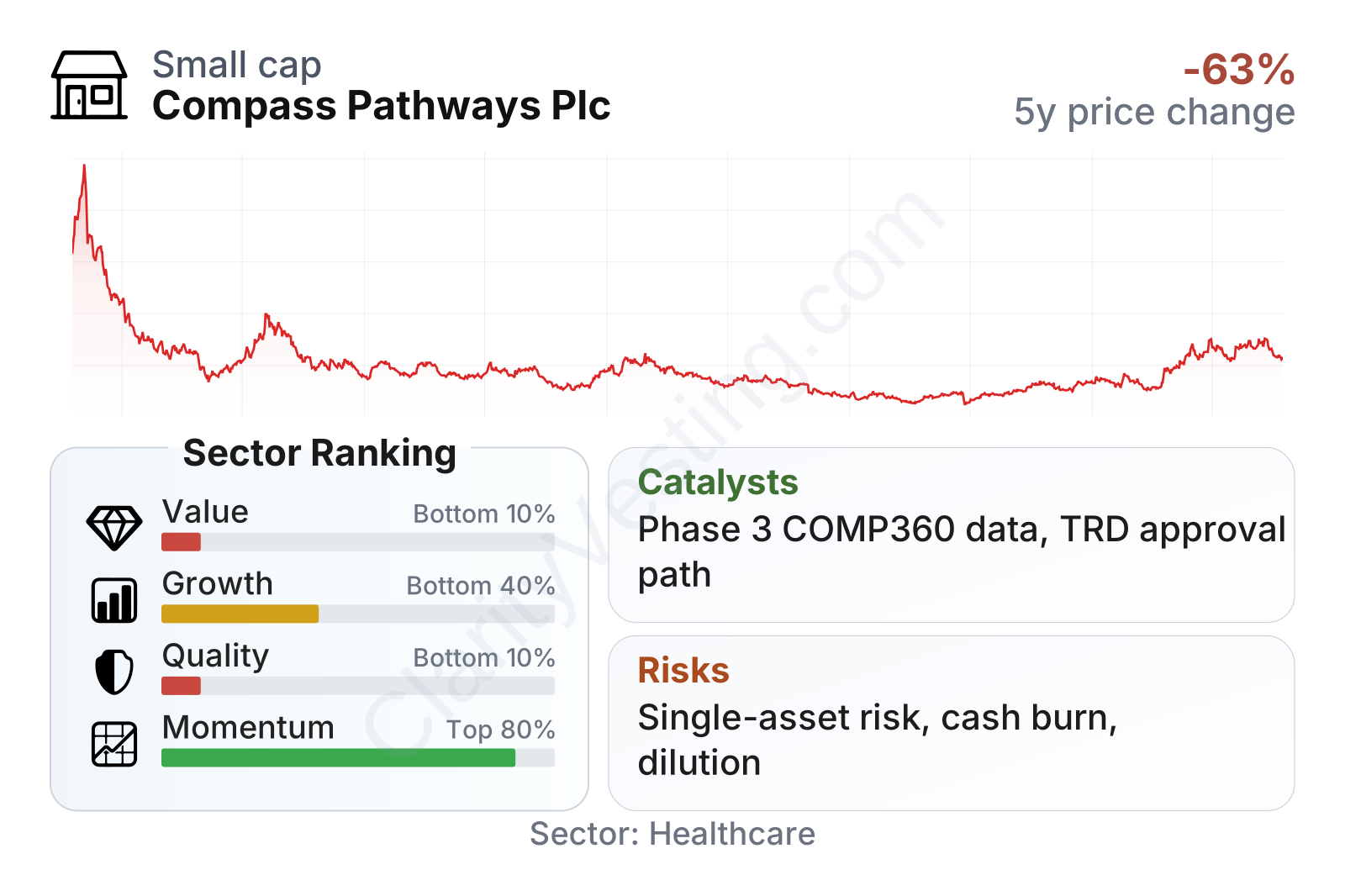
Compass is a mid-sized clinical-stage biotech by market value, but its financial profile is much weaker than the typical healthcare company because it has no meaningful revenue, negative cash flow, and deeply negative returns on capital. The strongest area in the metrics table is market momentum: the stock has rebounded sharply over the past year and over multi-year periods relative to much of the sector. By contrast, value, quality, and growth rankings remain near the bottom of the healthcare group, which reflects the reality that the company is still in a pre-commercial phase and is being valued mostly on trial expectations rather than operating fundamentals.
The stock price history also shows how event-driven this company is. Shares fell heavily after the 2021 listing period, then recovered strongly in 2026. That kind of move is common in biotechnology when investor expectations shift around clinical data, regulatory timing, or financing outlook.
Growth
Compass operates in a part of healthcare that is attracting growing attention: mental health treatments for patients who do not respond well to current options. Depression remains a very large global burden, and treatment-resistant depression is one of the hardest segments to address. That creates a sizable opportunity if a new therapy can show durable benefits and fit into real clinical practice. Interest in psychedelic-based medicine has also increased because many standard antidepressants can take weeks to work and often do not help the sickest patients enough.
Compass’s strategy is coherent for long-term growth because it is focused on one lead asset with a large unmet need, supported by a defined therapeutic model and intellectual property around formulation, protocol, and delivery approach. Instead of trying to build a broad commercial portfolio too early, the company has concentrated resources on advancing COMP360 through Phase 3 development. For a company of this size, that focus reduces operational sprawl, even though it increases dependence on one program.
A major catalyst is the ongoing late-stage clinical program for COMP360 in treatment-resistant depression. Positive Phase 3 results could materially change how the market views the company because they would move Compass closer to regulatory submissions and eventual commercialization. In biotechnology, the value gap between a promising mid-stage program and a successful late-stage program can be very large.
Another important growth angle is that Compass is not trying to compete only on the chemical compound itself. The company has been building a treatment model around therapist support, clinic procedures, and scalable delivery standards. If regulators and providers accept that model, it could help the company create a more defensible market position than a simple drug-only approach.
Cash generation remains the weak point in the growth profile. Free cash flow has stayed deeply negative and has worsened over time, which is normal for a company funding large trials but also shows that growth currently requires ongoing cash consumption. In practical terms, the growth case depends much more on clinical milestones than on near-term business expansion.
Recent company updates have continued to highlight progress in the Phase 3 COMP005 and COMP006 trials and broader efforts to prepare for potential regulatory and commercial pathways. For a business with no approved product yet, those development milestones are the clearest indicators of significant future opportunity.
Risks
This article is for informational purposes only and does not constitute financial advice. Some content is AI-generated. See Disclaimer


