Stock Analysis · Champion Real Estate Investment Trust (CMPNF)
Overview
Champion Real Estate Investment Trust is a Hong Kong-focused real estate investment trust. Its portfolio is concentrated in income-producing commercial property, with its two core assets being Three Garden Road, a premium office tower in Central, and Langham Place, a large mixed retail and office complex in Mong Kok. In simple terms, the trust collects rent from tenants that use these buildings, and it distributes a large part of its cash earnings to unitholders, which is a common REIT model.
The business is driven mainly by recurring rental income. Based on the trust’s asset mix and reporting structure, the main revenue sources are approximately:
- Office rental income: about 55% to 65% of revenue. This comes primarily from office leasing at Three Garden Road and the office portion of Langham Place.
- Retail rental income: about 30% to 40% of revenue. This is mainly generated by shops and retail tenants at Langham Place Mall.
- Other property income: usually a small residual share. This can include management and ancillary property-related income.
That revenue mix matters because it gives Champion exposure to two different parts of Hong Kong commercial real estate: premium central office space and urban retail traffic. The office side is tied more closely to corporate leasing demand and financial-sector activity, while the retail side depends more on consumer spending, tourism, and tenant sales productivity.
Over the last several years, revenue has drifted down from the 2021 level, while financing costs became a heavier burden. Gross profit stayed sizable, but net results turned volatile because property valuation changes and interest expense had a strong effect on reported earnings. That pattern is common in real estate, but it is especially important here because the trust operates with a concentrated portfolio and meaningful debt.
Key Figures
| Metric | Value | Sector ⓘ |
|---|---|---|
| Date | Oct 17, 2026 | |
| Context | ||
| Sector | Real Estate | |
| Industry | REIT - Retail | |
| Market Cap ⓘ | $1.91B | |
| Beta ⓘ | 0.82 | |
Value (Cheapness) | ||
| P/E Ratio ⓘ | N/A | 17.38 |
| P/B Ratio ⓘ | 0.01 | 0.85 |
| FCF Yield ⓘ | 58.00% | 7.38% |
| Dividend Yield ⓘ | 38.71% | 4.85% |
| EBIT / EV ⓘ | N/A | 3.78% |
| PEG ⓘ | 0.23 | |
Growth (Business expansion) | ||
| Revenue Growth ⓘ | -5.90% | 5.30% |
| RPS Growth (5Y CAGR) ⓘ | 57.87% | 6.02% |
| EPS Growth (5Y CAGR) ⓘ | N/A | -11.37% |
| BVPS Growth (5Y CAGR) ⓘ | 57.15% | 0.45% |
| Margin Growth (5Y Trend) ⓘ | -181.49% | -0.22% |
| FCF Growth (5Y CAGR) ⓘ | -17.57% | 5.40% |
| DPS Growth (5Y CAGR) ⓘ | 42.70% | 5.02% |
Quality (Business durability) | ||
| ROIC (Latest) ⓘ | N/A | 5.69% |
| ROE (Latest) ⓘ | -8.88% | 7.56% |
| ROA (Latest) ⓘ | -6.22% | 2.85% |
| ROIC (5Y Median) ⓘ | -0.26% | 4.22% |
| ROE (5Y Median) ⓘ | -1.67% | 6.03% |
| ROA (5Y Median) ⓘ | -1.19% | 2.44% |
| Net Debt / EBIT (Latest) ⓘ | N/A | 7.59 |
| Net Debt / EBIT (5Y Median) ⓘ | N/A | 8.40 |
| Net Debt / EBITDA (Latest) ⓘ | 12.04 | 5.27 |
| Net Debt / Assets ⓘ | 23.69% | 37.76% |
| EBITDA / Interest ⓘ | 1.27 | 4.10 |
| Operating Margin (Latest) ⓘ | N/A | 35.29% |
| Operating Margin (5Y Median) ⓘ | 40.79% | 37.31% |
| Debt to Equity (Latest) ⓘ | 36.43% | 88.87% |
| Profit Margin (Latest) ⓘ | -48.97% | 19.61% |
| Free Cash Flow (Latest) ⓘ | $1.11B | |
Momentum (Price trend) | ||
| 3Y Return ⓘ | +4.37% | +30.75% |
| 12M Return (excl. last month) ⓘ | +40.21% | +4.36% |
| 6M Return ⓘ | -9.03% | -2.52% |
| Price vs. 200-Day MA ⓘ | -0.91% | -2.34% |
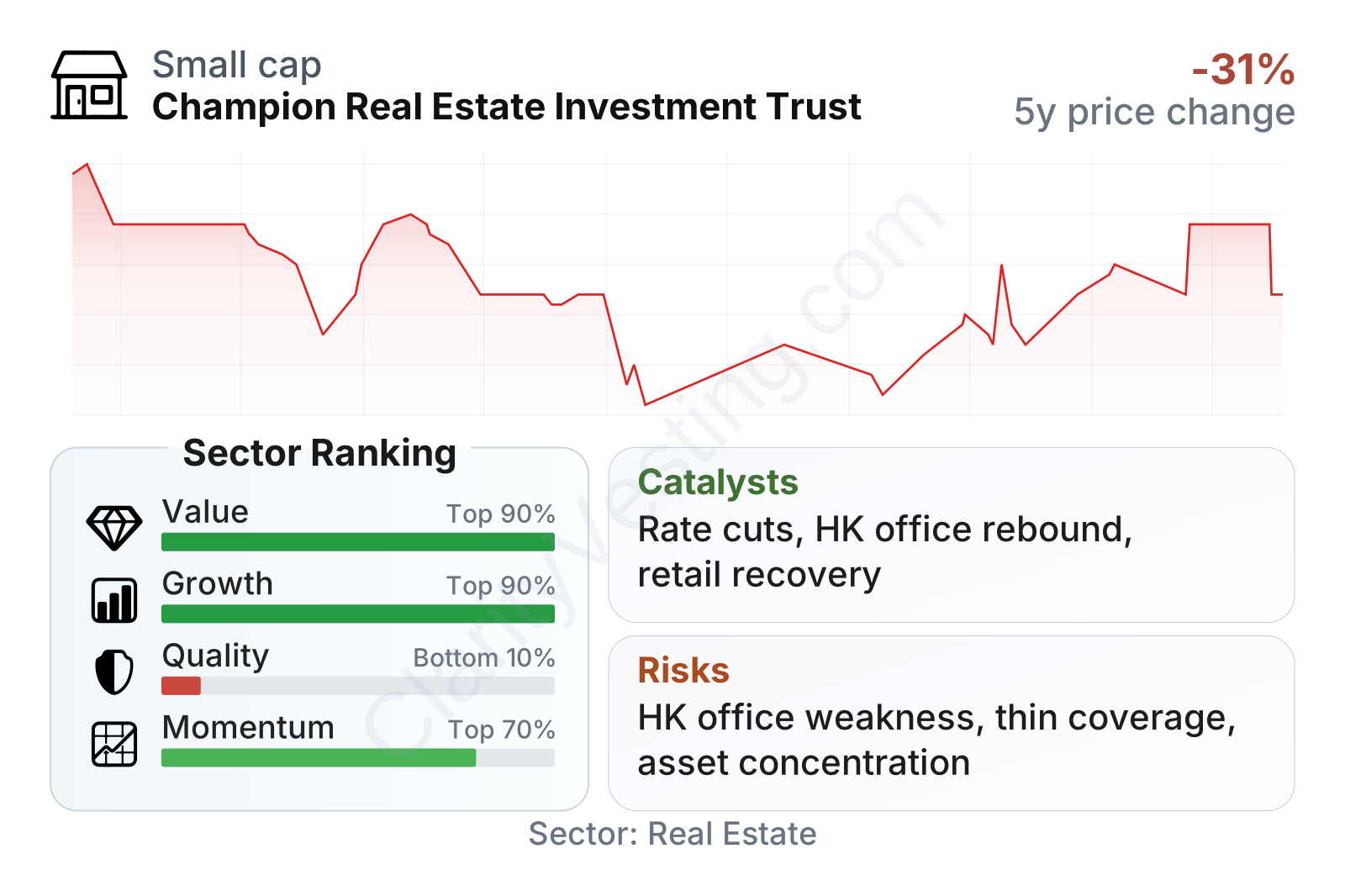
Champion is a mid-sized listed property trust with relatively low share-price volatility, as shown by a beta below 1. On valuation measures, it screens as extremely cheap versus the broader real estate sector, with a price-to-book ratio far below the sector median and a very high trailing free cash flow yield and dividend yield. However, those apparently attractive figures need to be read carefully alongside weak profitability measures. Returns on equity and assets are negative, net debt to EBITDA is elevated, and interest coverage is thin, which points to a balance sheet that is manageable only if rental cash flow remains resilient and financing conditions do not worsen materially.
The table also shows an unusual split between long-term growth metrics and recent operating performance. Multi-year revenue per share, book value per share, and dividend-per-share trends look very strong, but recent year-over-year revenue growth is negative and margins have deteriorated sharply. That combination suggests the headline valuation is being shaped not just by stable rent collection, but also by market skepticism around asset values, earnings quality, and leverage.
Growth
Champion operates in a sector that can grow over long periods, but its near-term outlook depends less on broad global real estate trends and more on the recovery path of Hong Kong commercial property. The two most important drivers are office leasing demand in Central and retail performance at Langham Place. If tenant demand improves, a REIT like Champion can benefit through higher occupancy, better rental reversions on renewals, and stronger distributable income.
The strategy itself is straightforward and sensible for a landlord with a concentrated premium portfolio: preserve occupancy, retain major tenants, manage lease renewals carefully, and protect cash generation from prime assets. The trust’s assets are well known in Hong Kong, and that gives it a clear identity in the market. Three Garden Road is positioned in one of the city’s most established office districts, while Langham Place is linked to a dense urban shopping area and transit flows. Those characteristics create a practical foundation for recovery if market conditions improve.
The revenue-per-share trend deserves extra context. Reported figures show a large jump in the latest period after several years of decline. Because that move is unusually large compared with the earlier pattern, it is more useful to focus on the broader takeaway: Champion’s underlying business has not shown a smooth upward path in recent years, and any recovery case depends on whether leasing momentum can stabilize and then rebuild from a lower base.
Distributions are another important part of the long-term picture. The chart indicates earlier declines followed by a sharp rebound in the latest period. For a REIT, that means payout capacity can move significantly with property income, financing costs, and accounting effects. A sustained improvement would likely require better rental conditions and tighter control of interest burden rather than one strong period alone.
Potential catalysts are visible. Lower interest rates would help directly by easing debt servicing pressure. Any broad recovery in Hong Kong office demand, including reduced vacancy in core business districts, could support rents and occupancy at Three Garden Road. On the retail side, stronger tourism and consumer activity could lift leasing demand and tenant sales at Langham Place. In short, Champion does not need a major strategic reinvention; it mainly needs a healthier property cycle in the market where it is already deeply positioned.
Risks
This article is for informational purposes only and does not constitute financial advice. Some content is AI-generated. See Disclaimer


