Stock Analysis · Cosmo Pharmaceuticals N.V (CMOPF)
Overview
Cosmo Pharmaceuticals N.V. is a specialty healthcare company focused mainly on gastrointestinal diseases, endoscopy, and selected dermatology applications. In simple terms, it develops products for bowel preparation, inflammatory bowel disease, infections in the digestive tract, and technologies used by doctors during colonoscopy procedures. The company combines traditional pharmaceutical assets with medical technology, especially artificial intelligence tools that help detect suspicious lesions during endoscopy.
Its business model is a mix of product sales, licensing income, royalties, and milestone payments from partners. That makes Cosmo different from a classic drugmaker that depends only on selling its own medicines. Revenue can therefore be uneven from year to year, especially when a large licensing or milestone event is booked.
Based on the company’s recent annual reporting, the main revenue sources are broadly structured as follows:
- Licensing, milestone, and other non-recurring collaboration income: this appears to have been the largest driver in stronger years, and in 2024 it represented a very large majority of revenue, likely above 60%. This category can include upfront payments, development milestones, and commercial arrangements with partners.
- Product sales and supply revenue: medicines and related commercial sales contributed a meaningful but smaller share; in 2025 this category appears to have become much more prominent and likely represented roughly 40% to 60% of revenue depending on the exact classification used in the annual report.
- Royalties: recurring payments tied to partner sales of Cosmo-related products form another layer of income, generally smaller than the two categories above but still strategically important because royalties are usually high-margin.
- Medical device and AI-enabled endoscopy solutions: this includes technologies linked to colonoscopy support and visualization. It is still not the largest contributor, but it is important because it gives Cosmo exposure to a growing digital-health niche.
The financial flow over the last five years shows an important pattern: revenue and profit were highly volatile, with an exceptional surge in 2024 followed by a much weaker 2025. That suggests the business is capable of generating large value from deals, but it also shows that reported results can swing sharply when milestone income is absent or development spending rises.
The multi-year picture highlights a company with strong gross margins but uneven earnings quality. Research spending jumped again in 2025 while operating profit turned negative, reinforcing that Cosmo is still partly shaped by product launches, partnerships, and development timing rather than by a smooth, fully recurring revenue base.
Key Figures
| Metric | Value | Sector ⓘ |
|---|---|---|
| Date | Oct 17, 2026 | |
| Context | ||
| Sector | Healthcare | |
| Industry | Drug Manufacturers - General | |
| Market Cap ⓘ | $1.01B | |
| Beta ⓘ | 1.45 | |
Value (Cheapness) | ||
| P/E Ratio ⓘ | N/A | 24.79 |
| P/B Ratio ⓘ | 1.93 | 3.08 |
| FCF Yield ⓘ | 3.30% | 3.15% |
| Dividend Yield ⓘ | 3.41% | 1.94% |
| EBIT / EV ⓘ | N/A | 0.57% |
| PEG ⓘ | N/A | |
Growth (Business expansion) | ||
| Revenue Growth ⓘ | -2.90% | 7.45% |
| RPS Growth (5Y CAGR) ⓘ | 14.27% | 8.61% |
| EPS Growth (5Y CAGR) ⓘ | -49.67% | -17.81% |
| BVPS Growth (5Y CAGR) ⓘ | -0.13% | 3.72% |
| Margin Growth (5Y Trend) ⓘ | -27.06% | -0.62% |
| FCF Growth (5Y CAGR) ⓘ | N/A | 1.04% |
| DPS Growth (5Y CAGR) ⓘ | 240.82% | 6.77% |
Quality (Business durability) | ||
| ROIC (Latest) ⓘ | N/A | 3.24% |
| ROA (Latest) ⓘ | 7.31% | 3.01% |
| ROIC (5Y Median) ⓘ | -0.02% | 4.60% |
| ROA (5Y Median) ⓘ | 2.20% | 1.89% |
| Net Debt / EBIT (Latest) ⓘ | -0.51 | 1.34 |
| Net Debt / EBIT (5Y Median) ⓘ | -2.58 | 1.84 |
| Net Debt / EBITDA (Latest) ⓘ | -0.35 | 1.00 |
| Net Debt / Assets ⓘ | -3.82% | 5.45% |
| EBITDA / Interest ⓘ | N/A | 9.64 |
| Operating Margin (Latest) ⓘ | 18.05% | 9.27% |
| Operating Margin (5Y Median) ⓘ | 17.06% | 7.38% |
| Debt to Equity (Latest) ⓘ | 0.76% | 28.58% |
| Profit Margin (Latest) ⓘ | -6.19% | 3.59% |
| Free Cash Flow (Latest) ⓘ | $33.52M | |
Momentum (Price trend) | ||
| 3Y Return ⓘ | +72.44% | +42.80% |
| 12M Return (excl. last month) ⓘ | -13.50% | +18.50% |
| 6M Return ⓘ | -52.18% | +7.57% |
| Price vs. 200-Day MA ⓘ | -37.52% | +5.12% |
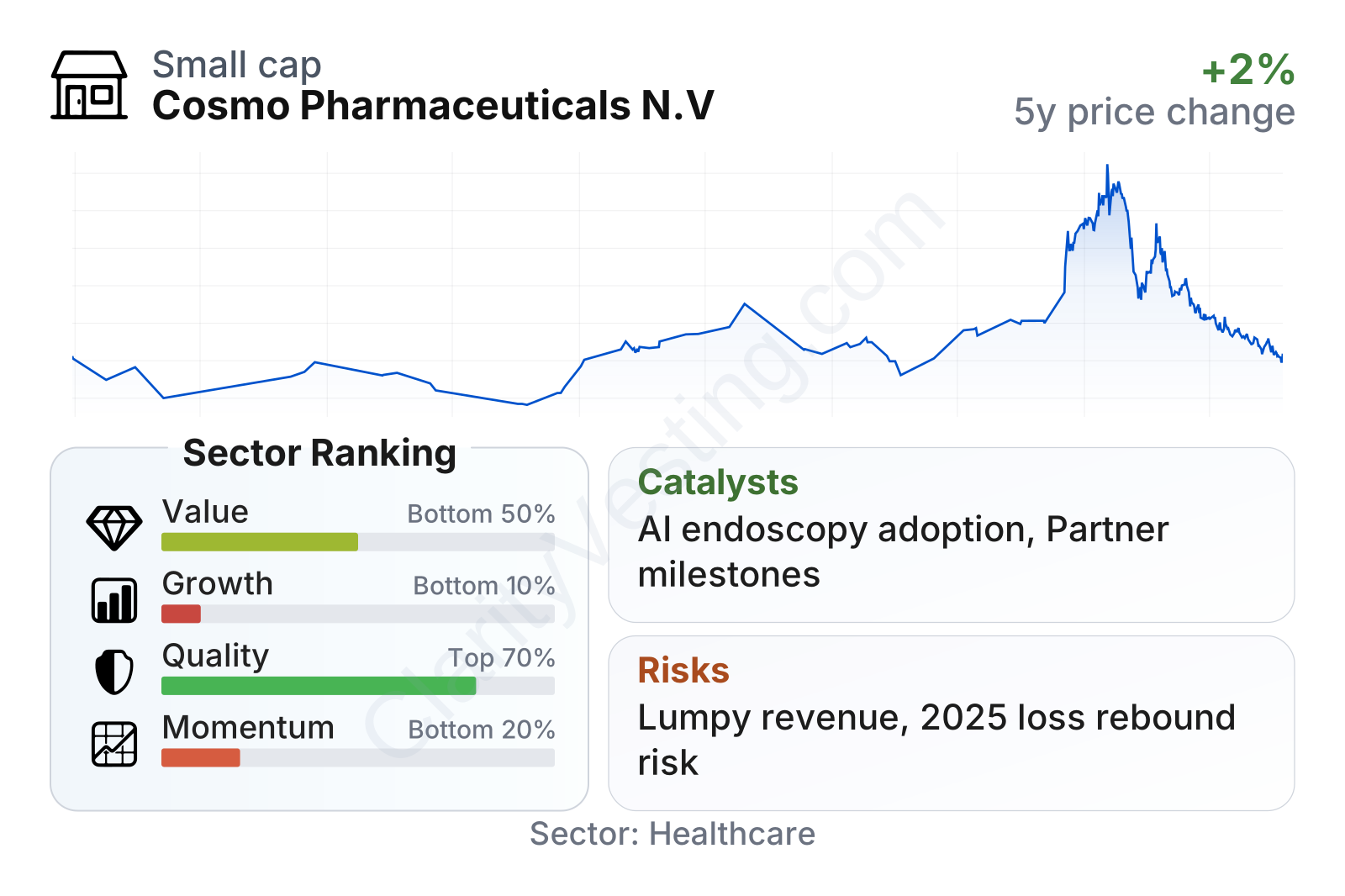
Cosmo is a small-to-mid-sized healthcare company with a stock that has been volatile. The share price rose strongly over a three-year period but has fallen sharply more recently, including a drop of roughly one-third over the last six months. That weak recent trend usually signals that the market is reassessing near-term growth expectations after a particularly strong prior period.
On valuation, the picture is mixed rather than clearly cheap or expensive. The price-to-book ratio sits below the sector median, free cash flow yield is close to the sector norm, and the dividend yield is above the sector median at a little above 3%. That points to a share price that is not demanding on balance-sheet terms, but it is also not obviously discounted enough to ignore execution risk.
On business quality, Cosmo stands out more positively. Operating margin is well above the healthcare sector median, debt is extremely low, and net cash metrics are stronger than many peers. In practice, that means the balance sheet is a real strength. However, the latest net profit margin was negative, showing that strong operating economics do not automatically translate into steady bottom-line earnings every year.
The weakest area is growth consistency. Recent year-over-year revenue slipped by about 3% while the sector median still showed growth. Longer term, revenue per share has grown at a solid pace over five years, but earnings per share and margin trends have deteriorated. This combination fits a company with valuable assets but lumpy monetization.
Growth
Cosmo operates in segments of healthcare that still have attractive long-term demand drivers. Gastrointestinal disorders remain widespread, colorectal cancer screening is a major public-health priority, and hospitals continue to adopt tools that can improve lesion detection and workflow efficiency during endoscopy. Those are supportive markets, especially for a company that sits at the intersection of pharmaceuticals and procedure-enhancing technology.
The strategy also makes sense in principle. Cosmo is not trying to compete head-on with the largest global pharmaceutical groups across many disease areas. Instead, it focuses on narrower fields where specialized expertise, intellectual property, and partnerships can matter more. That can be a rational path for a company of this size, particularly when it can license assets rather than build a massive global sales force on its own.
A major growth catalyst is the endoscopy technology platform, including AI-assisted detection solutions. If hospitals and physicians continue to adopt computer-aided tools in colonoscopy, Cosmo could benefit from a market that is still developing and where clinical utility matters more than consumer branding. This part of the business could also diversify revenue away from one-off pharmaceutical deal income over time.
Another catalyst is the company’s ability to sign or expand partnerships around its existing products and pipeline. Cosmo has historically used collaborations as a core value-creation tool. For a smaller healthcare company, that can accelerate commercialization while limiting the cost of building infrastructure in every region.
Recent company updates have continued to point toward pipeline and commercial execution as the central opportunity set. The broad takeaway is that Cosmo still has multiple ways to create value: direct product sales, royalties, licensing, and technology adoption. That optionality is attractive, but the timing of when it appears in reported results remains difficult to predict.
Risks
This article is for informational purposes only and does not constitute financial advice. Some content is AI-generated. See Disclaimer


