Stock Analysis · China Merchants Port Holdings Co Ltd (CMHHY)
Overview
China Merchants Port Holdings Co Ltd is a port operator and port-related infrastructure company focused on container terminals, bulk cargo handling, and logistics assets. The group is part of the broader China Merchants network and has a portfolio that spans mainland China as well as overseas ports. In simple terms, it makes money by owning, operating, and investing in ports where ships load and unload goods, and by providing related services around those trade flows.
Its business is closely tied to global trade volumes, Chinese import and export activity, and the long-term need for efficient port infrastructure. Ports are difficult assets to replicate because they require prime locations, government approvals, high capital spending, and strong shipping-line relationships. That gives established operators a durable role in trade networks, even if year-to-year results can move with the economy.
Based on the company’s annual reporting structure, revenue mainly comes from port-related operations and associated logistics activities. Exact mix can vary by year, but the business can be understood through the following main sources:
- Container terminal operations — the largest contributor, generally estimated at well over 50% of operating activity. This includes loading, unloading, storage, and terminal handling for containerized cargo.
- Bulk and break-bulk cargo operations — a meaningful secondary source, tied to commodities and industrial cargo such as ore, grain, and energy-related products.
- Port logistics and related services — a smaller but strategically important stream, including warehousing, transportation links, and other supply-chain services connected to the ports.
- Contributions from associates and joint ventures — economically very important for profit, because the group owns stakes in multiple port assets that may not be fully consolidated into reported revenue.
One important point for readers is that this is not a simple one-port company. It is better viewed as a portfolio of port interests, where earnings can come both from directly operated terminals and from stakes in other port businesses. That structure helps diversify geography and cargo exposure, but it can also make the accounts less intuitive than those of a single-asset operator.
The business has shown fairly stable revenue over the past several years, with a clear pickup in 2025. Profitability has remained strong, although reported net income has moved more than revenue, which is common when associate income, financing costs, and asset revaluation effects matter.
Key Figures
| Metric | Value | Sector ⓘ |
|---|---|---|
| Date | Oct 17, 2026 | |
| Context | ||
| Sector | Industrials | |
| Industry | Marine Shipping | |
| Market Cap ⓘ | $10.26B | |
| Beta ⓘ | 0.71 | |
Value (Cheapness) | ||
| P/E Ratio ⓘ | 11.99 | 22.10 |
| P/B Ratio ⓘ | 0.09 | 1.97 |
| FCF Yield ⓘ | 118.93% | 6.38% |
| Dividend Yield ⓘ | 3.86% | 1.94% |
| EBIT / EV ⓘ | N/A | 4.79% |
| PEG ⓘ | 4.51 | |
Growth (Business expansion) | ||
| Revenue Growth ⓘ | 13.00% | 9.30% |
| RPS Growth (5Y CAGR) ⓘ | -0.19% | 7.81% |
| EPS Growth (5Y CAGR) ⓘ | 27.95% | -13.06% |
| BVPS Growth (5Y CAGR) ⓘ | -4.21% | 6.14% |
| Margin Growth (5Y Trend) ⓘ | 5.09% | 0.88% |
| FCF Growth (5Y CAGR) ⓘ | 10.65% | 11.01% |
| DPS Growth (5Y CAGR) ⓘ | 28.75% | 9.48% |
Quality (Business durability) | ||
| ROIC (Latest) ⓘ | N/A | 10.84% |
| ROA (Latest) ⓘ | 7.78% | 5.41% |
| ROIC (5Y Median) ⓘ | 6.42% | 9.38% |
| ROA (5Y Median) ⓘ | 4.57% | 4.95% |
| Net Debt / EBIT (Latest) ⓘ | 1.29 | 2.08 |
| Net Debt / EBIT (5Y Median) ⓘ | 2.43 | 2.27 |
| Net Debt / EBITDA (Latest) ⓘ | 1.01 | 1.39 |
| Net Debt / Assets ⓘ | 11.66% | 19.28% |
| EBITDA / Interest ⓘ | N/A | 9.58 |
| Operating Margin (Latest) ⓘ | 63.16% | 10.50% |
| Operating Margin (5Y Median) ⓘ | 37.21% | 10.29% |
| Debt to Equity (Latest) ⓘ | 30.11% | 65.48% |
| Profit Margin (Latest) ⓘ | 47.36% | 6.67% |
| Free Cash Flow (Latest) ⓘ | $12.21B | |
Momentum (Price trend) | ||
| 3Y Return ⓘ | +148.67% | +61.68% |
| 12M Return (excl. last month) ⓘ | +11.00% | +12.58% |
| 6M Return ⓘ | +27.45% | 0.00% |
| Price vs. 200-Day MA ⓘ | +81.99% | +0.02% |
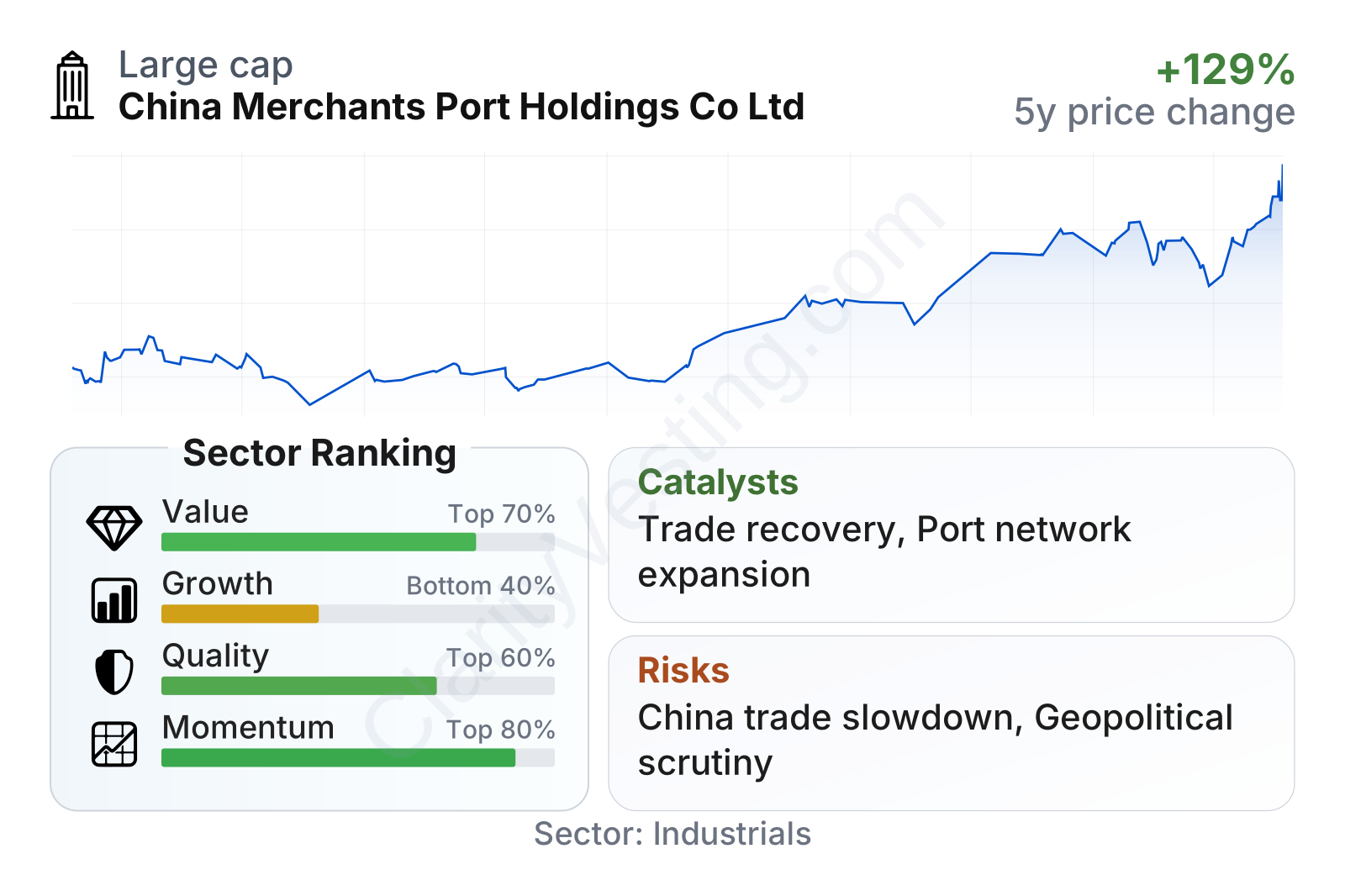
China Merchants Port stands out as a large infrastructure operator with a relatively low-volatility profile, as suggested by a beta below 1. On valuation, it screens cheaply versus the broader sector on earnings and especially on book value, while also showing a dividend yield above the sector median. On quality, margins and balance-sheet leverage look strong for the industry. The weaker area is long-term top-line growth, which helps explain why the market does not value it like a faster-growing transport name.
The share price has risen strongly over the last three years, even though the stock still appears inexpensive on traditional multiples. That combination usually means the market has re-rated the company from a very depressed base but still sees limits to its growth profile or remains cautious about the underlying risks.
Growth
Port infrastructure is not a high-growth sector in the way software or semiconductors can be, but it is a sector with long economic life, strategic value, and barriers to entry. Over long periods, growth tends to follow trade volumes, industrial production, containerization trends, and the buildout of logistics corridors. For a company like China Merchants Port, growth does not only come from handling more cargo; it can also come from improving asset utilization, adding capacity, increasing higher-margin logistics services, and investing in new port projects domestically and abroad.
The company’s strategy broadly makes sense for that environment. Its combination of Chinese gateway exposure and overseas port investments gives it access to multiple trade routes. It also fits with long-running regional infrastructure themes, including port modernization, deeper integration of sea and land logistics, and trade connectivity projects linked to Asia, the Middle East, and other emerging regions.
Recent financial trends suggest a mixed but still constructive growth picture. Year-over-year revenue growth has been ahead of the sector median, which signals that the business has recently regained momentum. At the same time, the longer five-year revenue-per-share trend has been roughly flat, so this is not a business that has consistently compounded sales at a high rate. The more encouraging sign is that earnings per share and dividend per share have grown much faster than revenue over five years, pointing to better efficiency, stronger asset contributions, or more disciplined capital allocation rather than pure volume expansion.
A meaningful catalyst is the continued recovery and normalization of port throughput across major trade routes, especially if Chinese exports remain resilient and regional transshipment activity stays firm. Another catalyst is the company’s ability to extract more value from its network through logistics integration and operational upgrades rather than relying only on building entirely new capacity. Because ports are network businesses, even moderate throughput growth can produce healthy earnings gains when fixed assets are already in place.
Recent company communications have also emphasized continued port development, asset management, and operational efficiency. For long-term analysis, that matters because mature infrastructure groups often create value less through rapid sales expansion and more through disciplined portfolio management, selective projects, and stable cash generation.
Risks
This article is for informational purposes only and does not constitute financial advice. Some content is AI-generated. See Disclaimer


