Stock Analysis · Commercial Metals Company (CMC)
Overview
Commercial Metals Company is a steel and metal products producer focused mainly on long steel. In simple terms, it takes scrap metal, melts it in electric arc furnaces, and turns it into products used in construction and infrastructure. Its core output includes rebar, merchant bar, wire rod, and fabricated products used to reinforce concrete in buildings, roads, bridges, data centers, industrial sites, and other large projects. The company operates primarily in North America and also has operations in Europe through Poland.
CMC’s business model is tied closely to the construction cycle, especially non-residential, infrastructure, and public works spending. A major part of its positioning comes from vertical integration: it is not only a steel mill operator, but also a fabricator and recycler. That means it can collect scrap, produce steel, and then sell higher-value finished or semi-finished products into construction markets.
Based on recent company reporting, revenue is concentrated in a few operating segments, with the Americas remaining by far the largest contributor.
- North America Steel Group: about 70% to 75% of revenue. This segment includes electric arc furnace mini mills and downstream operations producing rebar, merchant bar, wire rod, special bar quality products, and related steel items.
- Europe Steel Group: about 15% to 20% of revenue. This mainly reflects the company’s Polish operations, including steelmaking, rolling, and downstream products for European construction markets.
- Emerging Businesses Group: about 8% to 12% of revenue. This includes construction-related fabrication, processing, and technologies that extend CMC’s presence deeper into end markets.
- Recycling and Other: a smaller share embedded across the system. Scrap processing is strategically important because it supports raw material supply, even when it is not the largest standalone revenue source.
The revenue mix also matters by product. Reinforcing steel and related downstream fabrication appear to be the largest earnings driver, which makes sense because these products are essential in highways, bridges, commercial buildings, warehouses, and energy infrastructure. That exposure gives CMC a clearer identity than more diversified steelmakers that are spread across autos, appliances, and commodity sheet steel.
The recent financial flow also shows how cyclical this business can be. Revenue and profits weakened sharply in 2024 and especially 2025, then rebounded in 2026. The recovery is visible not only in sales but also in operating income, which suggests that better utilization and pricing have started to repair profitability after a much weaker period.
Key Figures
| Metric | Value | Sector ⓘ |
|---|---|---|
| Date | Oct 19, 2026 | |
| Context | ||
| Sector | Industrials | |
| Industry | Metal Fabrication | |
| Market Cap ⓘ | $7.19B | |
| Beta ⓘ | 1.53 | |
Value (Cheapness) | ||
| P/E Ratio ⓘ | 11.09 | 22.10 |
| P/B Ratio ⓘ | 1.54 | 1.97 |
| FCF Yield ⓘ | 6.67% | 6.42% |
| Dividend Yield ⓘ | 1.16% | 1.94% |
| EBIT / EV ⓘ | 8.55% | 4.79% |
| PEG ⓘ | 12.25 | |
Growth (Business expansion) | ||
| Revenue Growth ⓘ | 25.70% | 9.30% |
| RPS Growth (5Y CAGR) ⓘ | 3.62% | 7.81% |
| EPS Growth (5Y CAGR) ⓘ | -4.53% | -13.06% |
| BVPS Growth (5Y CAGR) ⓘ | 11.82% | 6.14% |
| Margin Growth (5Y Trend) ⓘ | -8.47% | 0.88% |
| FCF Growth (5Y CAGR) ⓘ | 17.62% | 11.01% |
| DPS Growth (5Y CAGR) ⓘ | 8.00% | 9.41% |
Quality (Business durability) | ||
| ROIC (Latest) ⓘ | 9.69% | 10.84% |
| ROA (Latest) ⓘ | 6.73% | 5.41% |
| ROIC (5Y Median) ⓘ | 11.69% | 9.38% |
| ROA (5Y Median) ⓘ | 7.53% | 4.95% |
| Net Debt / EBIT (Latest) ⓘ | 3.05 | 2.08 |
| Net Debt / EBIT (5Y Median) ⓘ | 0.53 | 2.27 |
| Net Debt / EBITDA (Latest) ⓘ | 2.08 | 1.40 |
| Net Debt / Assets ⓘ | 25.40% | 19.29% |
| EBITDA / Interest ⓘ | 8.72 | 9.56 |
| Operating Margin (Latest) ⓘ | 9.09% | 10.50% |
| Operating Margin (5Y Median) ⓘ | 9.09% | 10.29% |
| Debt to Equity (Latest) ⓘ | 71.98% | 65.48% |
| Profit Margin (Latest) ⓘ | 6.98% | 6.67% |
| Free Cash Flow (Latest) ⓘ | $479.12M | |
Momentum (Price trend) | ||
| 3Y Return ⓘ | +58.38% | +61.68% |
| 12M Return (excl. last month) ⓘ | +14.44% | +12.58% |
| 6M Return ⓘ | +1.80% | 0.00% |
| Price vs. 200-Day MA ⓘ | -6.29% | 0.00% |
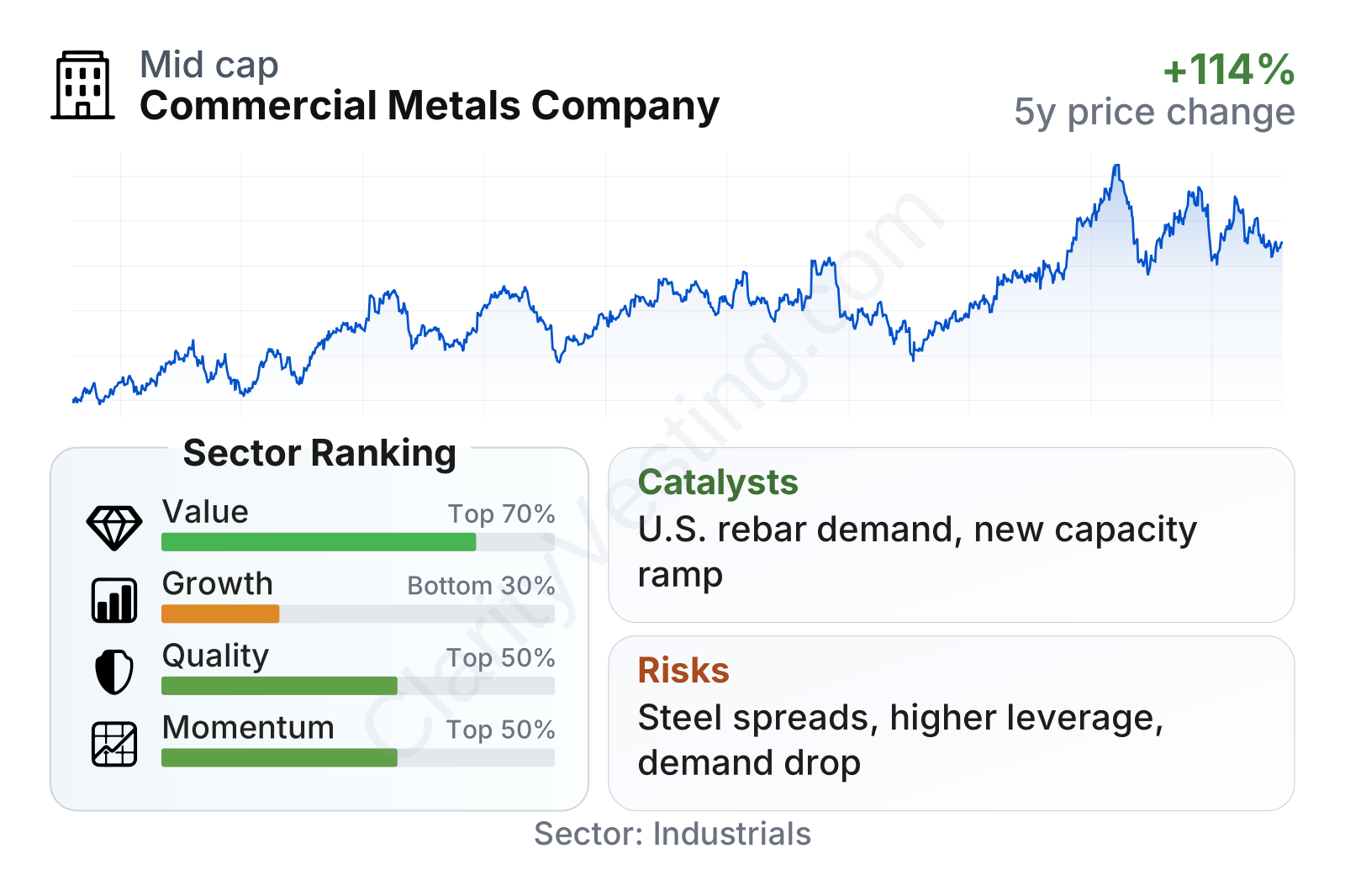
CMC is a mid-sized industrial company with above-average share price volatility, which is common for cyclical steel names. The overall profile is mixed but understandable: valuation looks relatively modest compared with much of the industrial sector, quality is around the middle of the pack, and growth metrics are uneven because results have moved through a sharp downturn and rebound. Profitability and returns remain respectable, but balance-sheet leverage is no longer as conservative as it was two years ago.
The stock’s recent history reflects that cyclicality. Shares have climbed strongly over the last several years, but the path has not been smooth, with large swings as earnings expectations changed. In the factor breakdown, CMC looks stronger on value and acceptable on quality, while its long-term growth record appears weaker than the sector despite a much better near-term sales rebound.
Growth
CMC operates in a sector with real long-term demand, but not a straight-line growth pattern. Steel tied to infrastructure and construction benefits from public works programs, grid upgrades, reshoring of manufacturing, warehouse expansion, and heavy civil projects. These are durable demand drivers, especially for rebar and related products, which are core to CMC’s portfolio. That gives the company exposure to parts of steel demand that are generally more structural than consumer-driven sheet steel markets.
The company’s strategy is coherent for this backdrop. CMC has continued building around electric arc furnace production, downstream fabrication, and geographic density in key construction markets. This model can be attractive over time because scrap-based production is typically more flexible and less carbon-intensive than traditional blast furnace steelmaking. In an industry increasingly shaped by cost discipline and emissions pressure, that operating model is a practical advantage.
Recent sales momentum has improved materially. After a period of contraction through much of 2023 and 2024, year-over-year revenue growth turned positive again and accelerated in 2026 into the mid-20% range. That kind of rebound usually points to a combination of better volumes, stronger pricing, contribution from newer assets, or all three. It does not erase the cyclical nature of the business, but it does show that CMC can recover meaningfully when market conditions improve.
Cash generation has also remained important to the long-term case. Free cash flow has stayed positive in recent years after a weak 2022 base, although it has come down from earlier highs. Even with that moderation, the company is still producing substantial cash for an industrial business of its size. That supports capital spending, dividends, debt management, and selective expansion without relying entirely on external financing.
A notable catalyst is the company’s investment in new capacity and downstream capabilities, particularly around rebar and steel products serving U.S. construction markets. Newer facilities can improve regional coverage and logistics while raising the share of value-added products. Another supportive factor is the broader push for domestic infrastructure and industrial construction, where CMC’s product set is directly relevant.
Recent company updates have also pointed to stronger operating conditions compared with the low point of the downturn. The recovery in revenue and earnings suggests the business is moving out of an unusually weak phase rather than simply treading water. For a cyclical manufacturer, that shift in direction often matters more than one isolated quarter.
Risks
This article is for informational purposes only and does not constitute financial advice. Some content is AI-generated. See Disclaimer


