Stock Analysis · Clariant AG (CLZNF)
Overview
Clariant AG is a Swiss specialty chemicals company that makes ingredients and chemical formulations used in everyday industrial and consumer products. Rather than selling basic bulk chemicals, it focuses on more customized products designed to improve performance, efficiency, or sustainability. Its materials are used in areas such as personal care, crop solutions, industrial lubricants, coatings, plastics, mining, and catalyst applications.
The company’s revenue is mainly generated from three operating businesses. Based on the latest annual reporting structure, the mix is approximately:
- Care Chemicals: about 40% of revenue — ingredients and solutions for personal care, home care, crop solutions, industrial applications, and base chemicals.
- Catalysts: about 30% of revenue — catalysts used in chemical production, syngas, fuels, and other industrial conversion processes.
- Adsorbents & Additives: about 30% of revenue — products used in purification, plastics, coatings, packaging, and industrial performance applications.
This structure gives Clariant exposure to both cyclical industrial demand and more resilient end markets such as personal care and crop-related applications. Geographically, the company is broadly diversified, with business spread across Europe, the Americas, Asia-Pacific, and the Middle East and Africa.
The profit flow over the last several years shows a business that has kept gross profit relatively steady even as revenue declined from the 2022 peak. Operating profit remained positive through 2025, but net income turned negative because interest expense rose sharply. That distinction matters: the core operations are still profitable, yet financing costs and below-the-line items became a much larger burden.
Key Figures
| Metric | Value | Sector ⓘ |
|---|---|---|
| Date | Oct 17, 2026 | |
| Context | ||
| Sector | Basic Materials | |
| Industry | Specialty Chemicals | |
| Market Cap ⓘ | $4.15B | |
| Beta ⓘ | 0.48 | |
Value (Cheapness) | ||
| P/E Ratio ⓘ | N/A | 16.90 |
| P/B Ratio ⓘ | 2.21 | 1.65 |
| FCF Yield ⓘ | 12.17% | 5.76% |
| Dividend Yield ⓘ | 3.41% | 2.13% |
| EBIT / EV ⓘ | N/A | 6.30% |
| PEG ⓘ | 0.91 | |
Growth (Business expansion) | ||
| Revenue Growth ⓘ | -6.10% | 11.10% |
| RPS Growth (5Y CAGR) ⓘ | -2.32% | 4.49% |
| EPS Growth (5Y CAGR) ⓘ | -40.93% | -13.47% |
| BVPS Growth (5Y CAGR) ⓘ | -5.29% | 5.51% |
| Margin Growth (5Y Trend) ⓘ | -0.17% | -1.54% |
| FCF Growth (5Y CAGR) ⓘ | 197.22% | 0.37% |
| DPS Growth (5Y CAGR) ⓘ | -11.62% | 6.08% |
Quality (Business durability) | ||
| ROIC (Latest) ⓘ | 10.10% | 9.26% |
| ROA (Latest) ⓘ | 1.33% | 4.91% |
| ROIC (5Y Median) ⓘ | -0.35% | 7.70% |
| ROA (5Y Median) ⓘ | 2.32% | 3.86% |
| Net Debt / EBIT (Latest) ⓘ | 2.90 | 1.40 |
| Net Debt / EBIT (5Y Median) ⓘ | 3.36 | 1.70 |
| Net Debt / EBITDA (Latest) ⓘ | 1.56 | 0.95 |
| Net Debt / Assets ⓘ | 28.30% | 13.69% |
| EBITDA / Interest ⓘ | 2.40 | 12.34 |
| Operating Margin (Latest) ⓘ | 7.48% | 13.20% |
| Operating Margin (5Y Median) ⓘ | 10.34% | 11.80% |
| Debt to Equity (Latest) ⓘ | 105.46% | 40.56% |
| Profit Margin (Latest) ⓘ | -0.82% | 6.43% |
| Free Cash Flow (Latest) ⓘ | $504.63M | |
Momentum (Price trend) | ||
| 3Y Return ⓘ | -9.51% | +68.89% |
| 12M Return (excl. last month) ⓘ | +9.21% | +30.21% |
| 6M Return ⓘ | +20.76% | -4.16% |
| Price vs. 200-Day MA ⓘ | +16.37% | -1.27% |
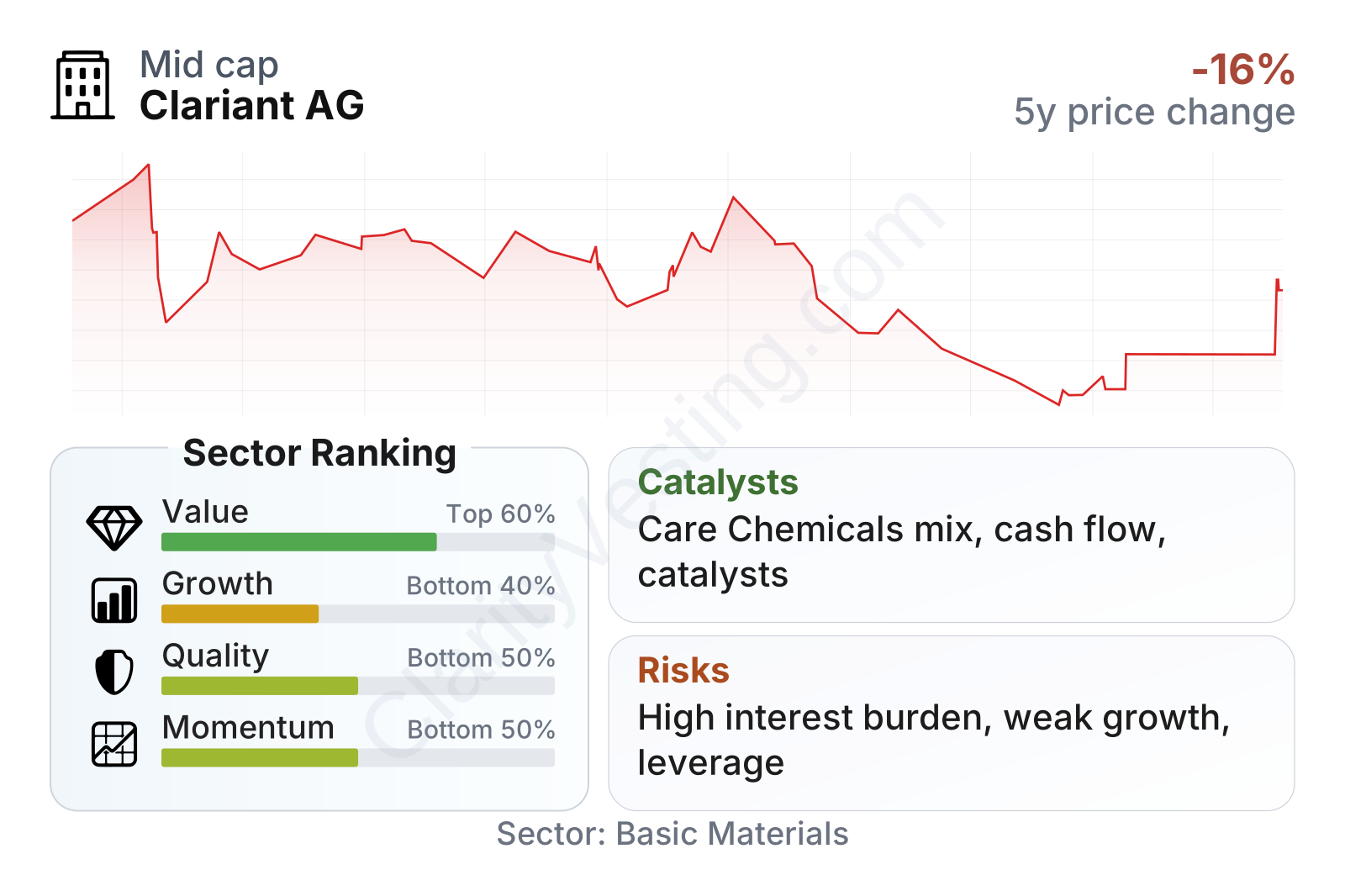
Clariant stands in the mid-sized range for public chemicals companies and its share price has been notably less volatile than the broader materials sector, with a beta below 0.50. The table points to a mixed profile. On valuation-related measures, free cash flow yield and dividend yield are stronger than the sector median, and the PEG ratio suggests the market is not attaching an aggressive growth premium.
At the same time, the quality and growth readings are weaker. Recent revenue has been shrinking, long-term earnings trends are poor, and profitability is below sector norms. Leverage is also elevated: debt-to-equity is above 100%, net debt relative to earnings is clearly higher than the sector median, and interest coverage is thin. In other words, the stock does not look expensive on cash generation, but that lower valuation comes with meaningful balance-sheet and earnings pressure.
Price performance also reflects this tension. The shares remain well below their 2021 level, although shorter-term momentum has improved, with gains over the last six months and the stock trading above its 200-day average. That suggests sentiment has stabilized, but not fully reset the longer-term underperformance.
Growth
Clariant operates in specialty chemicals, a sector with attractive long-term characteristics because customers often need performance-enhancing formulations, regulatory compliance support, and products that can help reduce energy use, emissions, or waste. These are not fast-growing markets every year, but many niches inside specialty chemicals benefit from durable demand and high switching costs once a product is qualified in a customer’s process.
The company’s strategy is broadly aligned with those favorable areas. Management has spent recent years simplifying the portfolio and concentrating on businesses where technical know-how, formulation expertise, and sustainability-linked products can support margins. Care Chemicals is especially important here because it gives Clariant exposure to personal care, consumer-related ingredients, and crop solutions, all of which can provide steadier demand than more commodity-like chemical categories.
Catalysts are another potentially important growth driver. This business can benefit from long investment cycles in refining, chemical processing, and cleaner industrial processes. Demand in catalysts is often uneven from year to year because large customer orders can shift across periods, but the segment can still be strategically valuable because it is technically specialized and tied to industrial efficiency.
A major medium-term catalyst is execution on portfolio focus and margin improvement. If Clariant can keep costs under control, strengthen the mix toward higher-value products, and protect gross profit despite soft volumes, earnings quality could improve even without strong top-line growth. The company also has visible cash generation, which gives it room to support restructuring, investment, or balance-sheet repair.
Recent corporate developments have centered more on operational improvement and portfolio discipline than on transformative expansion. That does not create the excitement of a major acquisition cycle, but for a specialty chemicals company coming out of a weaker earnings phase, steadier execution can be more important than aggressive dealmaking.
Risks
This article is for informational purposes only and does not constitute financial advice. Some content is AI-generated. See Disclaimer


