Stock Analysis · The Clorox Company (CLX)
Overview
The Clorox Company is a consumer products company focused on everyday household and lifestyle categories. Its portfolio includes cleaning and disinfecting products, charcoal, trash bags, food products, water filtration, cat litter, and personal care items. The business is built around well-known brands that are sold primarily through grocery stores, mass retailers, club stores, e-commerce channels, and other retail outlets. Because many of its products are used regularly in the home, Clorox operates in a generally defensive part of the consumer market.
Revenue is spread across several business segments rather than coming from a single product line. Based on the company’s recent annual reporting structure, the largest sources of sales are approximately:
- Health and Wellness: about 31% — cleaning, disinfecting, professional products, vitamins, minerals, and supplements.
- Household: about 30% — trash bags, food wraps, cat litter, grilling products, and related home-use items.
- Lifestyle: about 17% — water filtration, natural personal care, and fragrance-related products.
- International: about 15% — sales outside the United States across several product categories.
- Better Health VMS: about 7% — vitamins, minerals, and supplements sold in markets where the company reports that activity separately.
This mix shows a company with broad exposure to staple categories. It also shows why pricing, shelf space, retailer relationships, and brand strength matter so much: Clorox is not driven by one breakthrough product, but by the steady performance of many repeat-purchase brands.
Over the last several years, the business has shown fairly stable revenue but less stable profitability. Sales stayed around the same general range, while gross profit and operating income moved more sharply as input costs, marketing spend, and operating efficiency changed. More recently, revenue eased while profits remained above the weaker period seen in 2023, suggesting that margin recovery has mattered more than top-line expansion.
Key Figures
| Metric | Value | Sector ⓘ |
|---|---|---|
| Date | Oct 17, 2026 | |
| Context | ||
| Sector | Consumer Defensive | |
| Industry | Household & Personal Products | |
| Market Cap ⓘ | $10.20B | |
| Beta ⓘ | 0.57 | |
Value (Cheapness) | ||
| P/E Ratio ⓘ | 17.54 | 17.88 |
| P/B Ratio ⓘ | 113.72 | 1.29 |
| FCF Yield ⓘ | 3.97% | 12.39% |
| Dividend Yield ⓘ | 5.93% | 2.85% |
| EBIT / EV ⓘ | 5.93% | 6.43% |
| PEG ⓘ | 1.09 | |
Growth (Business expansion) | ||
| Revenue Growth ⓘ | -2.00% | 4.10% |
| RPS Growth (5Y CAGR) ⓘ | -1.03% | 6.18% |
| EPS Growth (5Y CAGR) ⓘ | 7.75% | -13.59% |
| BVPS Growth (5Y CAGR) ⓘ | -36.34% | 3.20% |
| Margin Growth (5Y Trend) ⓘ | 3.67% | -0.15% |
| FCF Growth (5Y CAGR) ⓘ | -6.72% | 4.10% |
| DPS Growth (5Y CAGR) ⓘ | 1.70% | 6.79% |
Quality (Business durability) | ||
| ROIC (Latest) ⓘ | 19.30% | 12.34% |
| ROA (Latest) ⓘ | 8.81% | 6.30% |
| ROIC (5Y Median) ⓘ | 17.12% | 10.49% |
| ROA (5Y Median) ⓘ | 7.40% | 5.44% |
| Net Debt / EBIT (Latest) ⓘ | 5.84 | 1.96 |
| Net Debt / EBIT (5Y Median) ⓘ | 5.53 | 2.35 |
| Net Debt / EBITDA (Latest) ⓘ | 4.60 | 1.38 |
| Net Debt / Assets ⓘ | 68.99% | 21.51% |
| EBITDA / Interest ⓘ | 8.98 | 9.46 |
| Operating Margin (Latest) ⓘ | 13.71% | 8.87% |
| Operating Margin (5Y Median) ⓘ | 10.03% | 9.53% |
| Debt to Equity (Latest) ⓘ | 6133.33% | 72.35% |
| Profit Margin (Latest) ⓘ | 8.73% | 5.40% |
| Free Cash Flow (Latest) ⓘ | $405.00M | |
Momentum (Price trend) | ||
| 3Y Return ⓘ | -22.64% | +20.92% |
| 12M Return (excl. last month) ⓘ | -25.63% | +2.13% |
| 6M Return ⓘ | -16.32% | +1.26% |
| Price vs. 200-Day MA ⓘ | -14.91% | +1.39% |
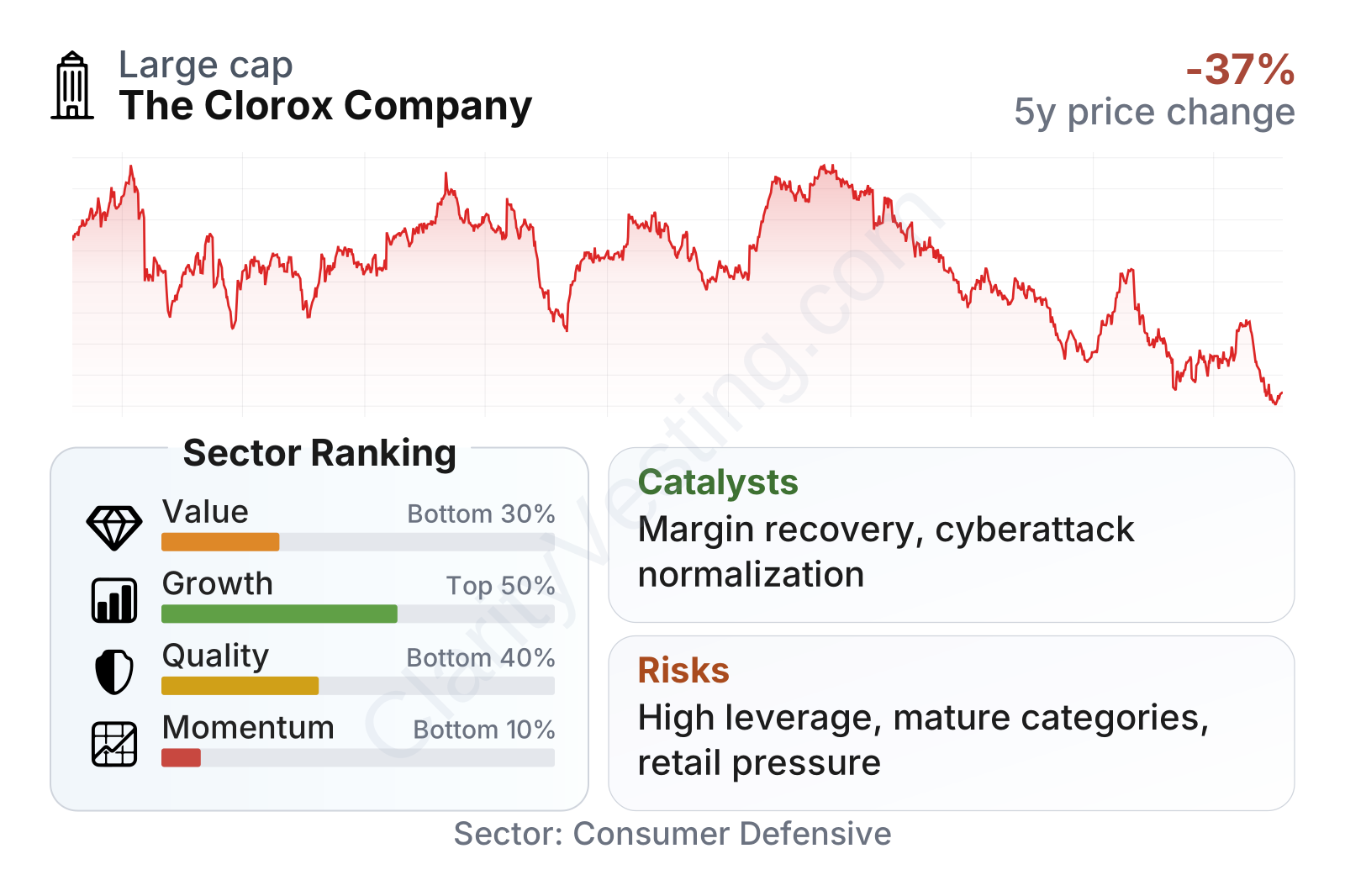
Clorox is a large but not mega-cap consumer defensive company, and its shares have been notably less volatile than the broader market, as reflected by a beta well below 1. In the factor breakdown, growth looks middling, quality is mixed, momentum is weak, and value is not clearly cheap despite the stock’s decline. Profitability metrics such as return on invested capital and operating margin remain better than many sector peers, but leverage is much heavier than normal for the group, which distorts balance-sheet measures like price-to-book.
The stock price has trended down materially from its 2024-2025 levels, while the dividend yield has moved higher as a result. That makes the income profile stand out, but it also reflects a market that has become more cautious about the company’s growth outlook and balance-sheet pressure.
Growth
Clorox operates in categories that are mature rather than fast-growing. Household cleaning, trash bags, charcoal, and similar staples tend to offer dependable demand, but they usually do not deliver rapid expansion unless a company wins market share, launches successful premium products, or expands internationally. That means long-term growth depends more on execution than on a booming end market.
The company’s strategy still makes economic sense for future growth. Management has emphasized margin rebuilding, supply chain efficiency, innovation, digital commerce, and stronger brand investment. For a business like Clorox, this is the practical path forward: defend category leadership where it already has strong positions, improve product mix, and convert stable demand into better earnings and cash generation.
Revenue growth has been uneven, with several quarters of decline interrupted by occasional rebounds. The latest year-over-year reading is slightly negative, and the five-year revenue-per-share trend is also below the sector median. That suggests Clorox is not currently in a broad-based expansion phase. The more encouraging point is that earnings growth over five years has been better than much of the sector, helped by margin recovery after earlier pressure.
Cash generation has also been inconsistent. Free cash flow recovered strongly at times but has recently pulled back to a much lower level than prior peaks. For Clorox, this matters because cash supports dividends, debt service, advertising, and product innovation. A sustained recovery in free cash flow would be one of the clearest signs that the operating plan is working.
A realistic catalyst for the business is further normalization after the disruption tied to the cyberattack the company experienced in fiscal 2024. As production and distribution stabilized, profitability improved from unusually weak levels. Another potential support factor is continued cost discipline: if Clorox can protect pricing while keeping manufacturing and logistics under control, earnings can improve even without much revenue growth. Product renovation and premium offerings in cleaning, litter, grilling, and wellness may also support a better sales mix over time.
Recent company updates have pointed to ongoing efforts around portfolio strength, digital capabilities, and margin management rather than any transformational event. That reinforces the view that the central opportunity is operational improvement, not explosive market growth.
Risks
This article is for informational purposes only and does not constitute financial advice. Some content is AI-generated. See Disclaimer


