Stock Analysis · CLUS (CLUS)
Overview
CLUS is categorized as a shell company in the financial services sector. In simple terms, that means it does not currently operate a substantial underlying business that generates recurring sales from products or services. Companies in this category are often created to complete a merger, acquisition, or other corporate transaction that could later turn the listed entity into an operating business.
Based on recent public filings and reported financials, CLUS currently appears to have no meaningful operating revenue. Its recent results show operating expenses without corresponding sales, which indicates that the company is still in a pre-operating or transitional phase rather than functioning as a mature business.
Because of that structure, CLUS does not have the usual revenue mix that long-term investors would expect from an established company. The available information suggests the following current revenue profile:
- Operating revenue: approximately 0% from an ongoing business activity.
- Other income or balance-sheet-related items: not meaningful enough in recent filings to describe as a stable revenue source.
This is an important starting point for any long-term analysis: at the moment, the investment case is tied much more to a future transaction or corporate development than to a proven business model already producing sales and profits.
The income flow highlights a very early-stage corporate structure: no revenue has been recorded in recent years, while expenses have mainly come from general and administrative costs. Those costs rose sharply in 2024 and remained elevated in 2025, which shows the company has continued to spend cash without yet building an operating income base.
Key Figures
| Metric | Value | Sector ⓘ |
|---|---|---|
| Date | Oct 03, 2026 | |
| Context | ||
| Sector | Financial Services | |
| Industry | Shell Companies | |
| Market Cap ⓘ | $8.00B | |
| Beta ⓘ | 1.02 | |
Value (Cheapness) | ||
| P/E Ratio ⓘ | N/A | 12.60 |
| P/B Ratio ⓘ | N/A | 1.23 |
| FCF Yield ⓘ | -0.00% | 10.16% |
| Dividend Yield ⓘ | N/A | 2.96% |
| EBIT / EV ⓘ | -5.70% | 7.77% |
| PEG ⓘ | N/A | |
Growth (Business expansion) | ||
| Revenue Growth ⓘ | N/A | 9.50% |
| RPS Growth (5Y CAGR) ⓘ | N/A | 12.10% |
| EPS Growth (5Y CAGR) ⓘ | N/A | -9.45% |
| BVPS Growth (5Y CAGR) ⓘ | -98.53% | 5.01% |
| Margin Growth (5Y Trend) ⓘ | N/A | -4.07% |
| FCF Growth (5Y CAGR) ⓘ | N/A | 4.96% |
| DPS Growth (5Y CAGR) ⓘ | N/A | 8.79% |
Quality (Business durability) | ||
| ROIC (Latest) ⓘ | N/A | 9.60% |
| ROE (Latest) ⓘ | N/A | 13.84% |
| ROA (Latest) ⓘ | N/A | 1.53% |
| ROIC (5Y Median) ⓘ | N/A | 7.86% |
| ROE (5Y Median) ⓘ | N/A | 12.20% |
| ROA (5Y Median) ⓘ | N/A | 1.29% |
| Net Debt / EBIT (Latest) ⓘ | N/A | 0.91 |
| Net Debt / EBIT (5Y Median) ⓘ | N/A | 0.74 |
| Net Debt / EBITDA (Latest) ⓘ | N/A | 0.97 |
| Operating Margin (Latest) ⓘ | N/A | 22.12% |
| Operating Margin (5Y Median) ⓘ | N/A | 24.39% |
| Debt to Equity (Latest) ⓘ | N/A | 60.37% |
| Profit Margin (Latest) ⓘ | N/A | 26.62% |
| Free Cash Flow (Latest) ⓘ | -$49.86K | |
Momentum (Price trend) | ||
| 3Y Return ⓘ | -61.54% | +89.23% |
| 12M Return (excl. last month) ⓘ | 0.00% | +17.35% |
| 6M Return ⓘ | 0.00% | +10.00% |
| Price vs. 200-Day MA ⓘ | 0.00% | +3.73% |
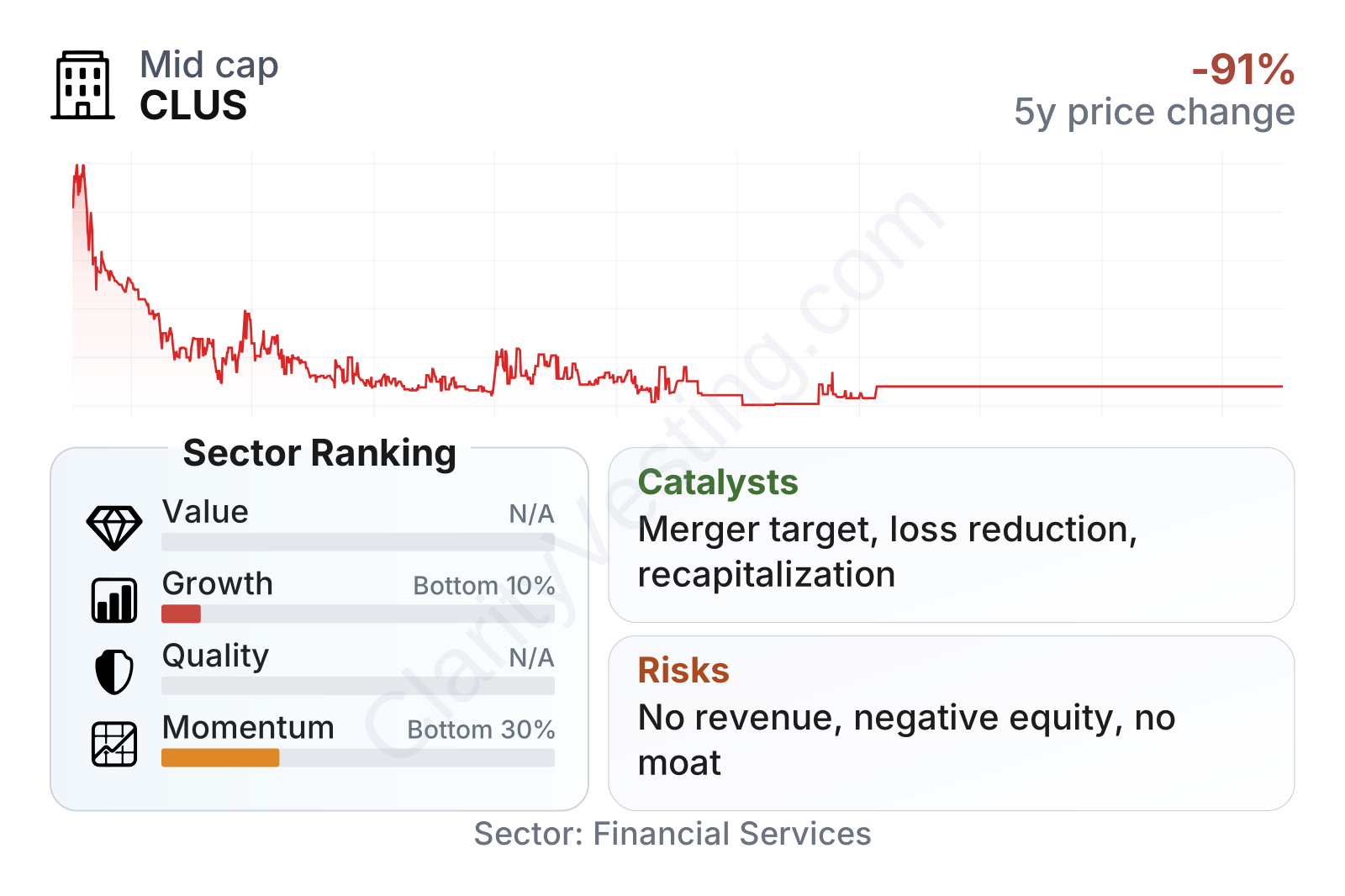
CLUS is a small public company by listed-market standards, with share-price behavior that has been unusually volatile over the past few years. The historical chart shows a dramatic collapse from very high levels to a much lower and now largely flat trading range. That kind of pattern usually reflects major uncertainty about the underlying business outlook, corporate structure, or both.
The table also points to a company that does not yet fit the normal profile of an operating financial business. Growth ranks in the bottom 10% of the sector, and momentum is also weak versus peers. Profitability measures are not meaningful in the way they would be for an established company because CLUS has no recurring revenue, a profit margin of 0%, and slightly negative free cash flow. Traditional valuation ratios such as price-to-earnings are not very useful here since earnings are absent or negligible.
In practical terms, the key figures suggest that CLUS should be viewed less as a functioning financial company and more as a corporate shell whose future value depends on what management does next.
Growth
The broader market for listed shells, special-purpose entities, and reverse-merger vehicles is not a growth sector in the same way that software, semiconductors, or digital payments are. Growth for a company like CLUS usually comes from a specific corporate event rather than from steady customer demand. That means the main question is not whether the industry itself is expanding, but whether CLUS can successfully complete a transaction that brings in an operating business with real assets, revenue, and earnings potential.
At the moment, the company’s reported fundamentals do not show organic growth. Revenue growth is 0%, and there is no visible commercial engine yet. Still, the structure of a shell company can create a catalyst if management identifies a target that is attractive enough to reshape the company’s profile. For that reason, the strategic logic depends heavily on execution: the shell must become a platform for something larger, because on its own it does not offer much operating momentum.
The earnings trend does show one improvement worth noting: losses narrowed sharply from 2024 to mid-2026. That does not mean CLUS has become profitable, but it does suggest the cost base has come down relative to earlier periods. In a shell company, shrinking losses can matter because it preserves flexibility while management searches for a transaction or strategic direction.
Book value per share has been negative in recent periods, although the most recent reading moved much closer to break-even than earlier figures. That is an improvement in financial strain, but it is still not the same as having a strong capital base. For long-term analysis, this remains a company where future growth would likely need to come from a business combination or recapitalization rather than from internally funded expansion.
As for recent developments, the most significant opportunity to watch is any filing or corporate update tied to a merger, asset acquisition, or change in control. For a shell company, that type of event can be far more important than quarterly cost fluctuations because it can completely redefine the business.
Risks
This article is for informational purposes only and does not constitute financial advice. Some content is AI-generated. See Disclaimer