Stock Analysis · Compagnie des Alpes SA (CLPIF)
Overview
Compagnie des Alpes SA is a French leisure operator focused on two activities that are easy to understand: mountain destinations and family entertainment. The group owns and runs ski resorts in the Alps and other mountain areas, and it also operates leisure parks, including theme parks, water parks, and indoor entertainment sites. In addition, it has a smaller hospitality and support activity tied to lodging, distribution, and services around its destinations.
This business model gives the company exposure to both winter tourism and year-round recreation. Ski resorts bring in revenue from lift passes and on-site services, while leisure parks broaden the seasonality profile by attracting visitors during spring, summer, and school holiday periods. That mix is important because it reduces dependence on a single format of leisure spending.
Based on recent annual reporting, revenue is mainly split between the following activities:
- Ski areas: approximately 55% to 60% of revenue. This includes lift ticket sales, mountain-related activities, and some ancillary on-site spending connected to the resorts.
- Leisure parks: approximately 35% to 40% of revenue. This includes admissions, in-park spending, and activities across amusement and water park sites.
- Distribution, hospitality, and other activities: approximately 5% to 10% of revenue. This includes accommodation-related services, travel distribution, and support operations around the main destinations.
The financial flow over the last few years points to a company that has rebuilt and expanded revenue meaningfully since the pandemic period. Sales moved from just under €1.0 billion in fiscal 2022 to about €1.4 billion in fiscal 2025, while operating income also improved. Net income has been positive throughout that recovery, although financing costs have risen, which has limited how much of the operating improvement reached the bottom line.
The broader trend is favorable: revenue and operating profit have been moving up, but interest expense has also climbed. That suggests the business recovery is real, yet part of the benefit is being absorbed by a heavier financing burden.
Key Figures
| Metric | Value | Sector ⓘ |
|---|---|---|
| Date | Nov 21, 2026 | |
| Context | ||
| Sector | Consumer Cyclical | |
| Industry | Leisure | |
| Market Cap ⓘ | $1.05B | |
| Beta ⓘ | 0.89 | |
Value (Cheapness) | ||
| P/E Ratio ⓘ | 7.74 | 17.13 |
| P/B Ratio ⓘ | N/A | 2.72 |
| FCF Yield ⓘ | 16.85% | 7.52% |
| Dividend Yield ⓘ | 5.32% | 2.43% |
| EBIT / EV ⓘ | 21.88% | 7.11% |
| PEG ⓘ | N/A | |
Growth (Business expansion) | ||
| Revenue Growth ⓘ | 3.90% | 5.30% |
| RPS Growth (5Y CAGR) ⓘ | 39.21% | 8.77% |
| EPS Growth (5Y CAGR) ⓘ | N/A | -11.05% |
| BVPS Growth (5Y CAGR) ⓘ | -5.81% | 5.47% |
| Margin Growth (5Y Trend) ⓘ | 69.07% | -0.16% |
| FCF Growth (5Y CAGR) ⓘ | N/A | 5.66% |
| DPS Growth (5Y CAGR) ⓘ | 1244.26% | 9.76% |
Quality (Business durability) | ||
| ROIC (Latest) ⓘ | N/A | 11.36% |
| ROA (Latest) ⓘ | N/A | 5.53% |
| ROIC (5Y Median) ⓘ | 6.65% | 10.58% |
| ROA (5Y Median) ⓘ | 3.39% | 5.35% |
| Net Debt / EBIT (Latest) ⓘ | 2.55 | 2.11 |
| Net Debt / EBIT (5Y Median) ⓘ | 6.85 | 2.24 |
| Net Debt / EBITDA (Latest) ⓘ | 1.48 | 1.51 |
| Net Debt / Assets ⓘ | 37.25% | 21.74% |
| EBITDA / Interest ⓘ | N/A | 9.63 |
| Operating Margin (Latest) ⓘ | 18.37% | 9.20% |
| Operating Margin (5Y Median) ⓘ | 13.24% | 9.64% |
| Debt to Equity (Latest) ⓘ | 118.42% | 74.26% |
| Profit Margin (Latest) ⓘ | 8.20% | 5.47% |
| Free Cash Flow (Latest) ⓘ | $176.92M | |
Momentum (Price trend) | ||
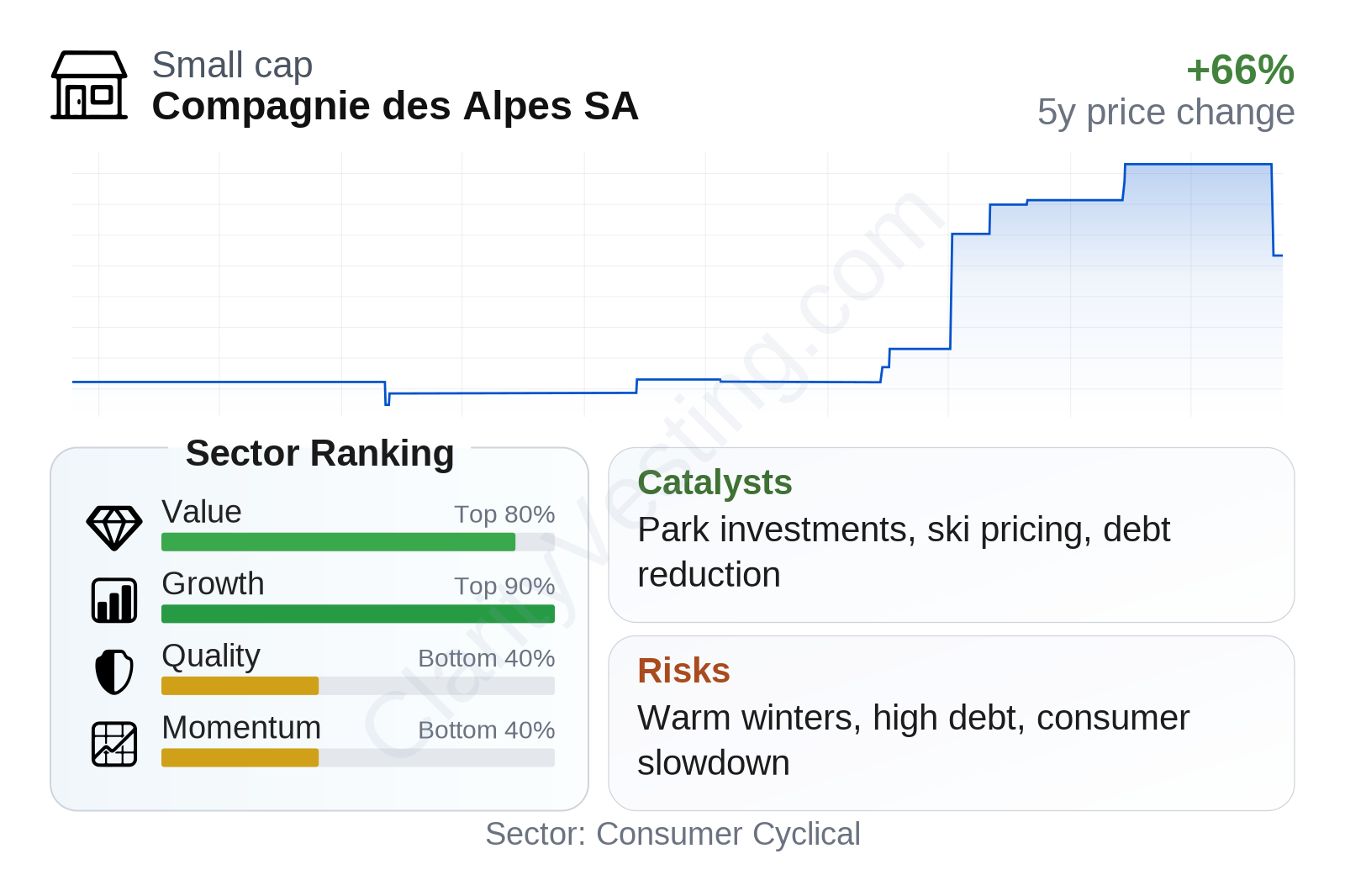
| 3Y Return ⓘ | +76.69% | +15.79% |
| 12M Return (excl. last month) ⓘ | +10.95% | -0.63% |
| 6M Return ⓘ | -22.32% | +1.17% |
| Price vs. 200-Day MA ⓘ | -20.16% | +0.36% |
The overall profile is mixed but understandable. Growth metrics stand out strongly versus the sector, helped by the post-pandemic rebound and improving operating margins. Value indicators also look solid, with earnings and book multiples below sector medians and a free cash flow yield above many peers. On the other hand, balance sheet quality is less convincing: debt levels are elevated relative to assets, equity, and operating earnings, which matters for a leisure company exposed to tourism cycles and weather conditions.
The stock’s multi-year performance has been strong, especially over the last three years, while shorter-term momentum looks more moderate. That combination often reflects a company that has already been recognized for its recovery, but is now entering a phase where execution matters more than simple reopening effects.
Growth
Compagnie des Alpes operates in parts of the leisure market that still have room for long-term expansion. Mountain tourism remains popular, particularly in premium destinations with strong infrastructure, and leisure parks benefit from demand for local and regional experiences that are easier to afford than long-haul travel. In both cases, operators with recognized sites and repeat visitors can keep growing through pricing, capacity optimization, new attractions, and cross-selling services.
The company’s strategy appears coherent for that environment. Its ski business is centered on large, established domains with high visibility and infrastructure that would be difficult to replicate. In leisure parks, management has been investing in site upgrades, new attractions, and a broader portfolio of formats, which can support attendance and spending per visitor. The combination of mountain assets and non-ski entertainment also gives the group a better chance to smooth demand across the year.
A notable positive point is margin progression. Even though revenue growth in the most recent year was not especially fast by sector standards, the company’s five-year trend in revenue per share and operating margin improvement has been much stronger than the median in the broader consumer cyclical group. That suggests growth has not come only from volume recovery, but also from operating discipline and pricing power at attractive destinations.
Another catalyst is cash generation. Free cash flow is meaningful for a company of this size, and the trailing free cash flow yield is above the sector median. If operating conditions remain stable, that leaves room for debt reduction, reinvestment in attractions, and shareholder distributions without requiring aggressive external financing.
Recent company communication has also emphasized continued investment in destination quality, customer experience, and selective development projects. For a leisure operator, these are important because attendance tends to follow the freshness of the offer, especially in parks. In ski areas, modernization of lifts and services can support capacity, pricing, and customer satisfaction over long periods.
Risks
This article is for informational purposes only and does not constitute financial advice. Some content is AI-generated. See Disclaimer