Stock Analysis · CLP Holdings (CLPHF)
Overview
CLP Holdings is one of the largest investor-owned power companies in the Asia-Pacific region. Headquartered in Hong Kong, it generates, imports, transmits, distributes, and sells electricity, and it also has a gas retail business in Australia. Its operations span Hong Kong, Mainland China, Australia, India, Taiwan Region, and Thailand, although Hong Kong remains the core of the business. For long-term readers, the company is easiest to understand as a regulated utility with a portfolio of power assets across several markets, plus a growing exposure to lower-carbon generation.
The business is centered on recurring electricity demand rather than fast-changing consumer trends. In Hong Kong, CLP operates through CLP Power Hong Kong, which supplies electricity to Kowloon, the New Territories, and most outlying islands under a regulated framework. Outside Hong Kong, the group owns stakes in generation, renewable energy, transmission, and distribution assets, with Australia being the other major earnings contributor.
Based on recent annual reporting, CLP’s revenue mix is approximately:
- Hong Kong electricity supply: about 55% to 65% of group revenue. This includes regulated electricity sales, network activities, and related services in its Hong Kong service area.
- Australia energy business: about 25% to 35%. This mainly reflects EnergyAustralia’s electricity and gas retailing, generation, and energy trading activities.
- Mainland China: about 5% to 10%. This includes nuclear, wind, solar, hydro, and coal investments as well as related power operations.
- India, Southeast Asia, and Taiwan Region: together generally below 10%. These operations include renewable and conventional generation, plus some transmission and distribution interests.
This mix matters because CLP is not purely a single-market utility. Hong Kong provides stability, while Australia and the wider Asia-Pacific portfolio add both diversification and more earnings variability.
The multiyear financial flow also shows an important pattern: revenue has been fairly resilient, but profit has been more volatile, especially around the 2022 energy market shock. Results improved strongly afterward, helped by normalization in operating conditions and stronger underlying contributions from core businesses.
Key Figures
| Metric | Value | Sector ⓘ |
|---|---|---|
| Date | Oct 17, 2026 | |
| Context | ||
| Sector | Utilities | |
| Industry | Utilities - Regulated Electric | |
| Market Cap ⓘ | $24.94B | |
| Beta ⓘ | 0.56 | |
Value (Cheapness) | ||
| P/E Ratio ⓘ | 17.95 | 17.28 |
| P/B Ratio ⓘ | 0.23 | 1.51 |
| FCF Yield ⓘ | 63.51% | 0.65% |
| Dividend Yield ⓘ | 32.42% | 3.77% |
| EBIT / EV ⓘ | N/A | 5.01% |
| PEG ⓘ | 5.82 | |
Growth (Business expansion) | ||
| Revenue Growth ⓘ | N/A | 6.10% |
| RPS Growth (5Y CAGR) ⓘ | 1.18% | 3.87% |
| EPS Growth (5Y CAGR) ⓘ | 36.34% | -11.30% |
| BVPS Growth (5Y CAGR) ⓘ | -3.44% | 4.23% |
| Margin Growth (5Y Trend) ⓘ | -0.12% | 3.57% |
| FCF Growth (5Y CAGR) ⓘ | 14.10% | -8.84% |
| DPS Growth (5Y CAGR) ⓘ | 0.40% | 4.84% |
Quality (Business durability) | ||
| ROIC (Latest) ⓘ | 14.50% | 6.53% |
| ROA (Latest) ⓘ | 8.24% | 3.20% |
| ROIC (5Y Median) ⓘ | 5.78% | 5.95% |
| ROA (5Y Median) ⓘ | 3.64% | 2.75% |
| Net Debt / EBIT (Latest) ⓘ | 2.19 | 7.13 |
| Net Debt / EBIT (5Y Median) ⓘ | 4.43 | 7.23 |
| Net Debt / EBITDA (Latest) ⓘ | 1.33 | 4.31 |
| Net Debt / Assets ⓘ | 26.95% | 38.42% |
| EBITDA / Interest ⓘ | 16.51 | 4.58 |
| Operating Margin (Latest) ⓘ | 17.04% | 20.83% |
| Operating Margin (5Y Median) ⓘ | 15.15% | 20.08% |
| Debt to Equity (Latest) ⓘ | 63.99% | 137.69% |
| Profit Margin (Latest) ⓘ | 12.56% | 11.37% |
| Free Cash Flow (Latest) ⓘ | $15.84B | |
Momentum (Price trend) | ||
| 3Y Return ⓘ | +52.37% | +52.37% |
| 12M Return (excl. last month) ⓘ | +25.08% | +8.84% |
| 6M Return ⓘ | +2.14% | -3.95% |
| Price vs. 200-Day MA ⓘ | +19.79% | -0.79% |
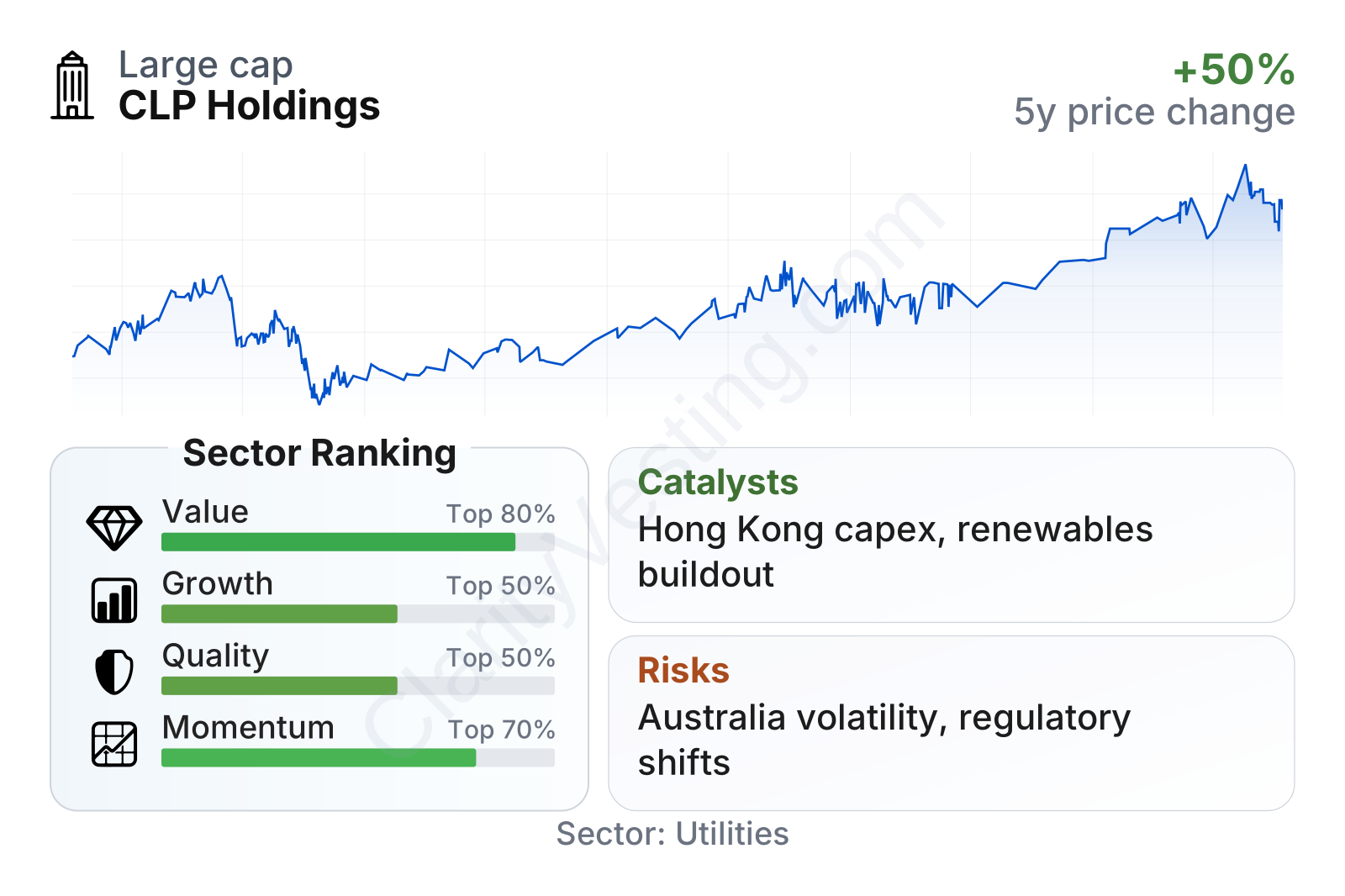
CLP is a large-cap utility with relatively low share-price volatility, as reflected in a beta well below 1. In broad terms, the metrics show a business with solid balance-sheet discipline and decent profitability, but only moderate top-line growth. Compared with many utilities, leverage looks conservative, interest coverage is strong, and returns on capital are healthy. On the other hand, revenue growth has been muted and dividend growth has been slow. Share performance has been positive over the last several years, with momentum stronger than the sector median.
Growth
CLP operates in a sector with durable long-term demand. Electricity use is supported by urbanization, data centers, transport electrification, and the broader shift from fossil fuels toward cleaner power systems. That does not make utilities high-growth businesses by default, but it does create a long runway for investment in grids, renewable generation, storage, and system reliability.
For CLP specifically, the most logical growth path is not rapid expansion in traditional retail electricity sales. It is the combination of regulated investment in Hong Kong, selective renewable development across Asia-Pacific, and the gradual reshaping of its portfolio toward lower-carbon assets. This strategy is consistent with where capital spending is going across the industry: networks and cleaner generation tend to have better long-term relevance than merchant fossil-fuel exposure.
Hong Kong is especially important because the permitted-return structure gives CLP a clearer framework for earning on approved capital investment. Large grid upgrades, decarbonization projects, and system resilience spending can support asset-base growth even when electricity demand itself grows slowly. In utilities, that kind of regulated investment can matter more than headline revenue growth.
Outside Hong Kong, the company has continued to position itself in renewable energy and energy transition projects in Mainland China, India, and other regional markets. These businesses are smaller than Hong Kong today, but they create optionality if power demand and decarbonization spending accelerate. They also reduce the company’s dependence on a single market over time.
The revenue-per-share trend points to a business that has expanded only modestly over the last five years, with some fluctuations rather than a smooth climb. That fits the profile of a mature utility: growth is present, but it is uneven and often linked to fuel prices, weather, regulation, and asset mix rather than simple volume expansion. A more encouraging sign is that earnings and free cash flow have improved faster than revenue over the same broader period, suggesting that portfolio quality and operating recovery have mattered more than raw sales growth.
A relevant recent opportunity is the region-wide push for power-system decarbonization and reliability. Utilities with established networks, permitting experience, and existing customer relationships are usually in a better position to capture this spending than new entrants. CLP’s scale, long operating history, and presence in multiple Asia-Pacific markets give it a practical platform to participate in that buildout.
Risks
This article is for informational purposes only and does not constitute financial advice. Some content is AI-generated. See Disclaimer


