Stock Analysis · Clover Health Investments Corp (CLOV)
Overview
Clover Health Investments Corp is a health insurance company focused on Medicare, the U.S. government program that mainly serves people age 65 and older. Its main business is offering Medicare Advantage plans, which are privately managed alternatives to traditional Medicare. The company has built its brand around using technology and data tools to help physicians manage care for members, with the goal of improving outcomes while controlling medical costs.
Clover Health’s business is much simpler today than it was a few years ago. After exiting its non-insurance direct care operations, the company is now primarily centered on insurance revenue. That makes the business easier to understand, but it also means performance depends heavily on how well Clover prices risk, manages medical claims, and retains members in a highly regulated market.
Based on recent company filings, revenue is overwhelmingly tied to its Medicare Advantage insurance operations. The main sources are approximately:
- Premium revenue from Medicare Advantage plans: well above 90% of total revenue. This is the monthly payment stream tied to enrolled members and includes the core insurance business.
- Other insurance-related revenue: a small share of total revenue, likely under 10%, including items such as risk adjustment-related amounts and other plan-related revenue categories disclosed in filings.
- Non-insurance operations: effectively 0% after the company’s strategic simplification and exit from earlier non-core activities.
The financial flow also shows a business that has been reshaped. Revenue has recovered strongly since 2022, gross profit improved materially through 2024, and selling and administrative expenses dropped sharply in 2025 versus earlier years. The key issue is that most of each premium dollar still goes back out through healthcare costs, leaving only a thin margin for overhead and profit.
Key Figures
| Metric | Value | Sector ⓘ |
|---|---|---|
| Date | Oct 24, 2026 | |
| Context | ||
| Sector | Healthcare | |
| Industry | Healthcare Plans | |
| Market Cap ⓘ | $2.54B | |
| Beta ⓘ | 2.46 | |
Value (Cheapness) | ||
| P/E Ratio ⓘ | N/A | 25.42 |
| P/B Ratio ⓘ | 6.86 | 3.08 |
| FCF Yield ⓘ | 2.92% | 3.12% |
| Dividend Yield ⓘ | N/A | 1.85% |
| EBIT / EV ⓘ | -0.88% | 0.56% |
| PEG ⓘ | N/A | |
Growth (Business expansion) | ||
| Revenue Growth ⓘ | 55.60% | 7.50% |
| RPS Growth (5Y CAGR) ⓘ | 4.45% | 8.60% |
| EPS Growth (5Y CAGR) ⓘ | N/A | -17.73% |
| BVPS Growth (5Y CAGR) ⓘ | -14.88% | 3.72% |
| Margin Growth (5Y Trend) ⓘ | N/A | -0.57% |
| FCF Growth (5Y CAGR) ⓘ | -29.74% | 0.96% |
| DPS Growth (5Y CAGR) ⓘ | N/A | 6.69% |
Quality (Business durability) | ||
| ROIC (Latest) ⓘ | -4.20% | 3.17% |
| ROA (Latest) ⓘ | -2.87% | 2.98% |
| ROIC (5Y Median) ⓘ | -43.74% | 4.56% |
| ROA (5Y Median) ⓘ | -30.94% | 1.87% |
| Net Debt / EBIT (Latest) ⓘ | N/A | 1.34 |
| Net Debt / EBIT (5Y Median) ⓘ | N/A | 1.86 |
| Net Debt / EBITDA (Latest) ⓘ | N/A | 1.00 |
| Net Debt / Assets ⓘ | -27.60% | 5.06% |
| EBITDA / Interest ⓘ | N/A | 9.55 |
| Operating Margin (Latest) ⓘ | -0.74% | 9.25% |
| Operating Margin (5Y Median) ⓘ | -16.67% | 7.33% |
| Debt to Equity (Latest) ⓘ | N/A | 26.68% |
| Profit Margin (Latest) ⓘ | -0.74% | 3.34% |
| Free Cash Flow (Latest) ⓘ | $74.21M | |
Momentum (Price trend) | ||
| 3Y Return ⓘ | +412.40% | +51.61% |
| 12M Return (excl. last month) ⓘ | +55.67% | +19.90% |
| 6M Return ⓘ | +89.20% | +10.10% |
| Price vs. 200-Day MA ⓘ | +35.87% | +6.44% |
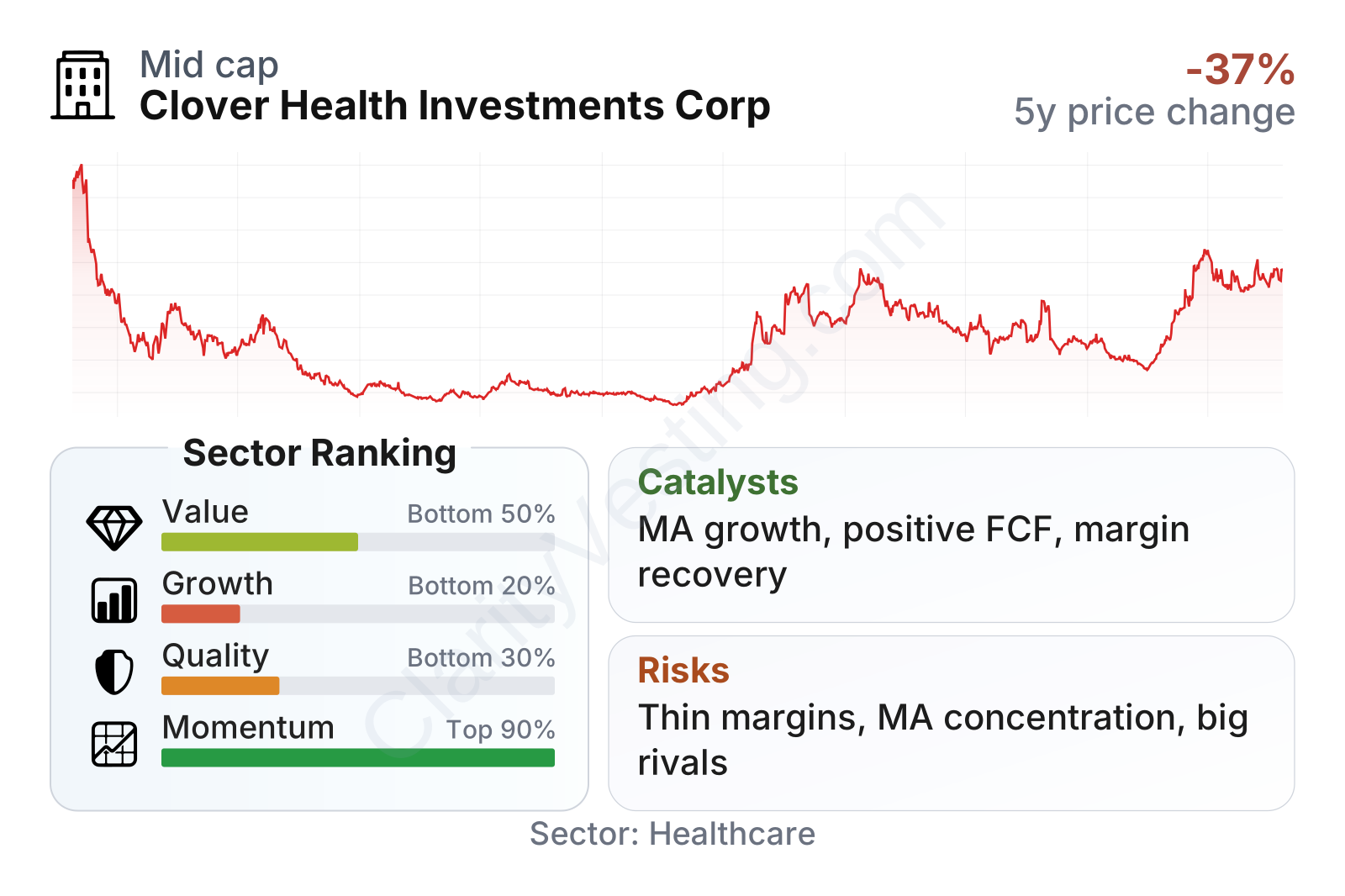
Clover Health is still a relatively small public company by healthcare standards, with a market value in the low single-digit billions. The stock has been highly volatile, which matches its elevated beta and the sharp swings visible over the past several years. Recent price momentum has been very strong compared with much of the healthcare sector, but the underlying fundamentals are more mixed.
The factor summary points to a company with weak profitability and returns on capital, modestly demanding valuation measures in some areas, and a stronger short-term market trend than its operating profile alone would suggest. Revenue growth has recently accelerated far above the sector median, but the longer five-year growth record remains less impressive, and book value and cash flow history still show the scars of the company’s earlier restructuring period.
Growth
Clover Health operates in a sector that still offers room for long-term expansion. Medicare Advantage has benefited from aging demographics, rising healthcare utilization, and continued consumer adoption of privately managed Medicare plans. That gives the company exposure to a large and growing market, even though competition is intense.
The company’s strategy for growth is centered on disciplined expansion rather than growth at any cost. In recent years Clover has narrowed its focus, reduced operating complexity, and emphasized profitability alongside membership and revenue gains. For a health insurer, that approach matters because rapid enrollment growth can destroy value if medical claims rise faster than premiums. A more selective model can be healthier if it improves the medical care ratio and reduces administrative strain.
Recent revenue trends are clearly stronger. Year-over-year growth turned negative during the company’s reset period, then returned to positive territory in 2024 and accelerated further in 2025 and into 2026. The latest pace is far above the healthcare sector median, suggesting either strong membership expansion, richer premium rates, or both. The important question is not only whether revenue rises, but whether that growth converts into durable earnings.
Cash flow is one of the more encouraging developments. Free cash flow has moved from deeply negative levels to positive territory over the trailing twelve months. That does not by itself mean the business is fully mature, but it does suggest that the company’s operating model has become more stable. In healthcare insurance, improved cash generation can be an important sign that underwriting and expense discipline are moving in the right direction.
A meaningful catalyst is Clover’s effort to use its software and care-management platform to support physicians treating Medicare patients. If this approach consistently helps doctors intervene earlier, reduce avoidable costs, and manage chronic conditions better, Clover could strengthen margins over time. Another potential catalyst is continued progress toward sustained profitability, since the market has already shown that it reacts strongly when the company demonstrates operational improvement.
Recent company updates have also highlighted continued focus on adjusted profitability, operational efficiency, and capital-light execution. For a company that once faced skepticism about its model, each quarter of cleaner execution can carry outsized importance.
Risks
This article is for informational purposes only and does not constitute financial advice. Some content is AI-generated. See Disclaimer


