Stock Analysis · Cloetta AB ser. B (CLOEF)
Overview
Cloetta is a European confectionery company focused on candy, chocolate, chewing gum, pastilles, and seasonal sweets. The group owns a portfolio of well-known local and regional brands and sells them mainly through grocery retailers, convenience stores, e-commerce, and travel retail channels. Its footprint is strongest in Northern Europe and parts of Western Europe, with operations centered on markets such as Sweden, Finland, Denmark, Norway, the Netherlands, Germany, and the United Kingdom.
The business is built around everyday treats rather than luxury products, which gives it exposure to a consumer staples category with relatively steady demand. People may trade down within sweets, but confectionery consumption usually does not move as sharply as many discretionary categories. That makes Cloetta easier to understand than many industrial or technology businesses: it manufactures branded candy products, ships them through large retail networks, and earns money from volume, pricing, and brand strength.
Based on the company’s recent reporting structure, revenue comes primarily from branded confectionery sold in Cloetta’s core European markets. Public disclosures do not always provide a single product split with exact percentages for every category, but the revenue mix can be described broadly as follows:
- Pick & mix candy and bagged sweets: a major share of sales, especially in the Nordic region and travel retail. This includes loose candy concepts, packed candy, gummies, and other sugar confectionery.
- Chocolate products: an important contributor across several markets, including bars, pralines, seasonal chocolate, and gifting formats.
- Pastilles, chewing gum, and lozenges: a meaningful category supported by heritage brands and impulse purchases.
- Seasonal confectionery: a smaller but profitable stream tied to holidays such as Easter and Christmas.
Geographically, the Nordic countries remain the core earnings base, while the Netherlands and selected export markets add diversification. The profit bridge over the last several years shows a useful pattern: revenue has climbed from a little above $600 million in 2021 to roughly $850 million in 2025, while operating income and net income improved more sharply than sales. That suggests pricing, mix, and cost discipline have recently mattered as much as pure volume growth.
Key Figures
| Metric | Value | Sector ⓘ |
|---|---|---|
| Date | Nov 21, 2026 | |
| Context | ||
| Sector | Consumer Defensive | |
| Industry | Confectioners | |
| Market Cap ⓘ | $1.44B | |
| Beta ⓘ | 0.63 | |
Value (Cheapness) | ||
| P/E Ratio ⓘ | 14.71 | 18.64 |
| P/B Ratio ⓘ | N/A | 2.51 |
| FCF Yield ⓘ | 6.08% | 7.02% |
| Dividend Yield ⓘ | N/A | 2.67% |
| EBIT / EV ⓘ | 6.30% | 7.77% |
| PEG ⓘ | N/A | |
Growth (Business expansion) | ||
| Revenue Growth ⓘ | 2.60% | 3.80% |
| RPS Growth (5Y CAGR) ⓘ | 9.15% | 6.10% |
| EPS Growth (5Y CAGR) ⓘ | -43.07% | -10.36% |
| BVPS Growth (5Y CAGR) ⓘ | 6.21% | 3.04% |
| Margin Growth (5Y Trend) ⓘ | 3.86% | -0.21% |
| FCF Growth (5Y CAGR) ⓘ | 8.61% | 5.25% |
| DPS Growth (5Y CAGR) ⓘ | 10.03% | 5.88% |
Quality (Business durability) | ||
| ROIC (Latest) ⓘ | 62.41% | 11.80% |
| ROA (Latest) ⓘ | 8.42% | 6.20% |
| ROIC (5Y Median) ⓘ | 7.56% | 10.51% |
| ROA (5Y Median) ⓘ | 4.37% | 5.41% |
| Net Debt / EBIT (Latest) ⓘ | 0.72 | 1.88 |
| Net Debt / EBIT (5Y Median) ⓘ | 2.84 | 2.32 |
| Net Debt / EBITDA (Latest) ⓘ | 0.62 | 1.29 |
| Net Debt / Assets ⓘ | 7.81% | 20.02% |
| EBITDA / Interest ⓘ | 18.69 | 9.62 |
| Operating Margin (Latest) ⓘ | 13.92% | 9.06% |
| Operating Margin (5Y Median) ⓘ | 9.78% | 9.57% |
| Debt to Equity (Latest) ⓘ | 27.09% | 67.45% |
| Profit Margin (Latest) ⓘ | 10.46% | 5.43% |
| Free Cash Flow (Latest) ⓘ | $87.38M | |
Momentum (Price trend) | ||
| 3Y Return ⓘ | +282.79% | +17.50% |
| 12M Return (excl. last month) ⓘ | +48.92% | +3.34% |
| 6M Return ⓘ | -7.03% | +2.78% |
| Price vs. 200-Day MA ⓘ | -7.50% | +3.79% |
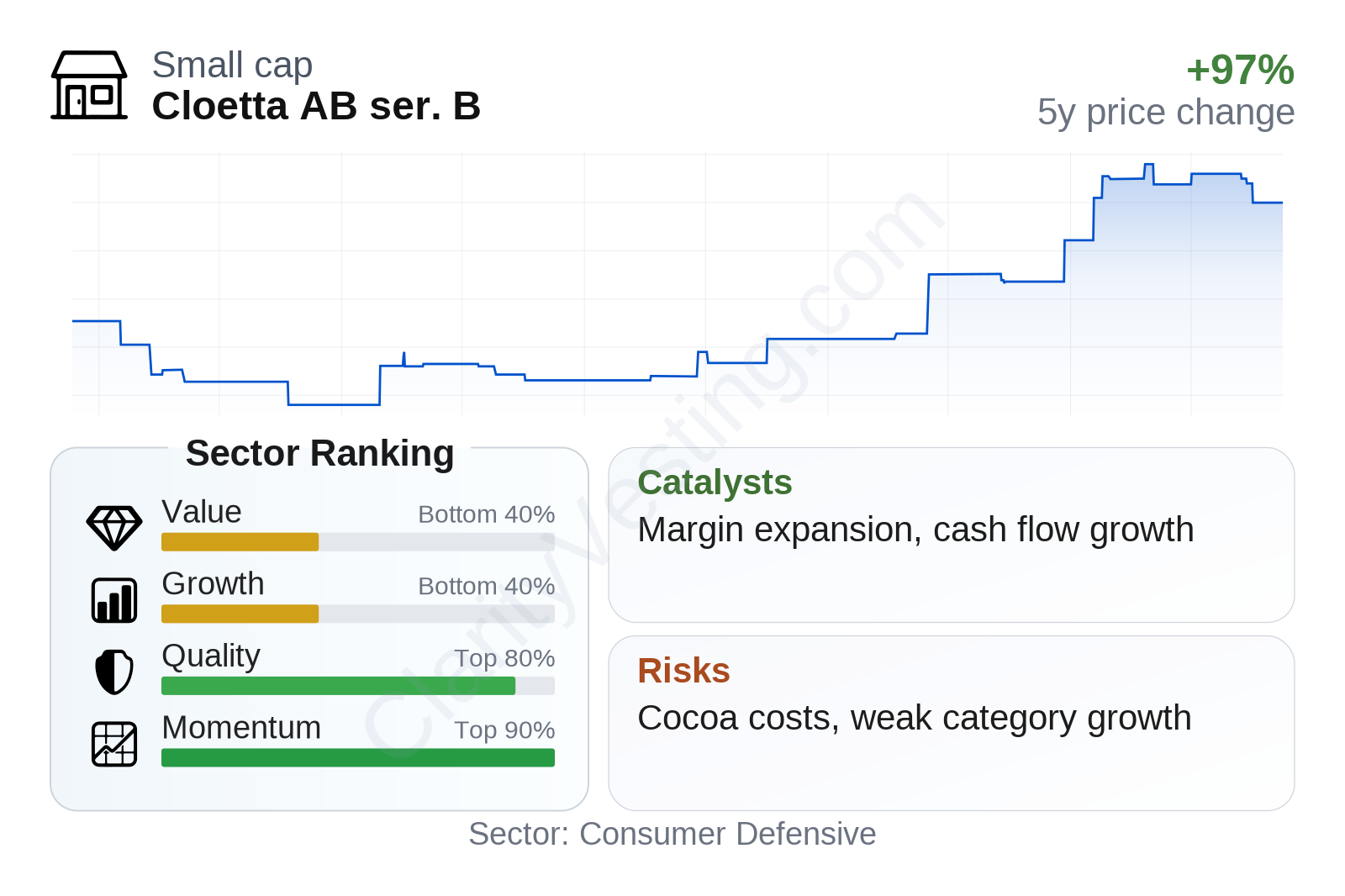
Cloetta is a mid-sized consumer defensive company with a relatively low beta, which fits the idea of a steadier staples business. The latest metrics show a mixed profile: valuation sits in the cheaper part of the sector on earnings, but not at a deep discount once cash flow and enterprise-value measures are considered. Growth ranks below many sector peers on recent year-over-year sales and longer-term earnings expansion, yet business quality looks stronger. Profitability, returns on capital, and balance-sheet leverage are all better than the sector median, while share-price momentum has been unusually strong over the last three years despite a softer short-term trend in the last six months.
Growth
Confectionery is not a high-growth industry, but it is a durable one. Long-term expansion usually comes from pricing power, brand management, product innovation, channel mix, and selective geographic gains rather than explosive demand. That matters for Cloetta: the company operates in a mature category, so the main question is not whether candy consumption will surge, but whether the business can steadily widen margins and defend shelf space while growing slightly ahead of inflation over time.
Cloetta’s recent pattern supports that framework. Revenue growth was very strong in 2022 and 2023, then slowed materially in 2024 through 2026. The latest year-over-year readings are positive again, but only in the low single digits. This suggests the company has moved beyond the big pricing reset period that many food producers experienced after ingredient inflation spiked. Future progress is therefore likely to depend more on product mix, execution in key markets, and category initiatives than on further large price increases.
One encouraging sign is cash generation. Free cash flow has trended upward over the last several years, reaching roughly the high tens of millions on a trailing basis. That provides flexibility for capital spending, debt reduction, and shareholder distributions when management chooses to resume or expand them. It also supports the view that recent profit improvement is not just an accounting effect but is being converted into real cash.
The company’s strategy appears sensible for a mature staples business. Management has emphasized stronger focus on core brands, operational efficiency, and profitable categories such as pick & mix and packaged sweets. There is also room to benefit from travel retail normalization, seasonal product launches, and continued optimization of manufacturing and sourcing. None of these is a dramatic single catalyst, but together they can support a slow-and-steady growth case.
A more specific positive driver is margin expansion. Over the last few years, operating income has improved faster than revenue, and the latest operating margin stands well above the sector median. If Cloetta can keep commodity costs under control while maintaining pricing and brand relevance, earnings growth could outpace sales growth even in a modest demand environment. That is often where mature consumer businesses create value.
Risks
This article is for informational purposes only and does not constitute financial advice. Some content is AI-generated. See Disclaimer