Stock Analysis · Clean Harbors Inc (CLH)
Overview
Clean Harbors is an environmental and industrial services company that helps businesses manage hazardous waste, clean up contaminated sites, maintain industrial facilities, and handle used motor oil and related products. Its customers include chemical companies, manufacturers, utilities, refineries, government agencies, and many other industrial operators that must comply with strict safety and environmental rules. The company operates across North America and combines service operations with a large network of disposal, recycling, re-refining, and treatment assets.
The business is mainly organized around two operating segments. Based on recent annual reporting, revenue is roughly split as follows:
- Environmental Services: about 57% of revenue. This segment includes hazardous waste collection and disposal, incineration, landfill services, wastewater treatment, emergency response, field and technical services, and parts cleaning.
- Safety-Kleen Sustainability Solutions: about 43% of revenue. This segment includes collecting used oil, re-refining and selling base oil and lubricants, selling blended and recycled oil products, and providing related containerized waste and service offerings.
That mix matters because Clean Harbors is not just a simple waste hauler. A meaningful share of its activity comes from specialized, harder-to-replicate infrastructure such as incinerators, hazardous waste landfills, wastewater treatment facilities, and used-oil re-refining plants. Those assets can create a stronger competitive position than a service-only model. Over the last several years, revenue has expanded materially, while operating profit has also improved, showing that growth has not come only from volume but also from a better earnings mix.
Revenue has risen sharply since 2021, while operating income has increased faster than overhead expenses over the full period. The broad picture is a business that scaled up meaningfully after 2021, although interest expense has also moved higher as debt costs increased.
Key Figures
| Metric | Value | Sector ⓘ |
|---|---|---|
| Date | Oct 24, 2026 | |
| Context | ||
| Sector | Industrials | |
| Industry | Waste Management | |
| Market Cap ⓘ | $16.70B | |
| Beta ⓘ | 0.88 | |
Value (Cheapness) | ||
| P/E Ratio ⓘ | 38.34 | 22.29 |
| P/B Ratio ⓘ | 5.78 | 1.98 |
| FCF Yield ⓘ | 1.17% | 6.26% |
| Dividend Yield ⓘ | N/A | 1.92% |
| EBIT / EV ⓘ | 3.98% | 4.83% |
| PEG ⓘ | 0.27 | |
Growth (Business expansion) | ||
| Revenue Growth ⓘ | 11.90% | 9.30% |
| RPS Growth (5Y CAGR) ⓘ | 12.92% | 7.76% |
| EPS Growth (5Y CAGR) ⓘ | -12.06% | -13.17% |
| BVPS Growth (5Y CAGR) ⓘ | 16.79% | 6.13% |
| Margin Growth (5Y Trend) ⓘ | 2.19% | 0.74% |
| FCF Growth (5Y CAGR) ⓘ | 9.91% | 10.79% |
| DPS Growth (5Y CAGR) ⓘ | N/A | 9.41% |
Quality (Business durability) | ||
| ROIC (Latest) ⓘ | 9.98% | 10.75% |
| ROA (Latest) ⓘ | 5.71% | 5.41% |
| ROIC (5Y Median) ⓘ | 10.47% | 9.37% |
| ROA (5Y Median) ⓘ | 5.85% | 4.95% |
| Net Debt / EBIT (Latest) ⓘ | 3.46 | 2.04 |
| Net Debt / EBIT (5Y Median) ⓘ | 3.42 | 2.27 |
| Net Debt / EBITDA (Latest) ⓘ | 2.16 | 1.39 |
| Net Debt / Assets ⓘ | 33.51% | 19.27% |
| EBITDA / Interest ⓘ | 7.07 | 9.58 |
| Operating Margin (Latest) ⓘ | 12.14% | 10.49% |
| Operating Margin (5Y Median) ⓘ | 11.53% | 10.30% |
| Debt to Equity (Latest) ⓘ | 103.62% | 64.82% |
| Profit Margin (Latest) ⓘ | 7.03% | 6.67% |
| Free Cash Flow (Latest) ⓘ | $194.52M | |
Momentum (Price trend) | ||
| 3Y Return ⓘ | +103.56% | +67.77% |
| 12M Return (excl. last month) ⓘ | +32.77% | +12.05% |
| 6M Return ⓘ | +4.74% | 0.00% |
| Price vs. 200-Day MA ⓘ | +7.86% | +0.67% |
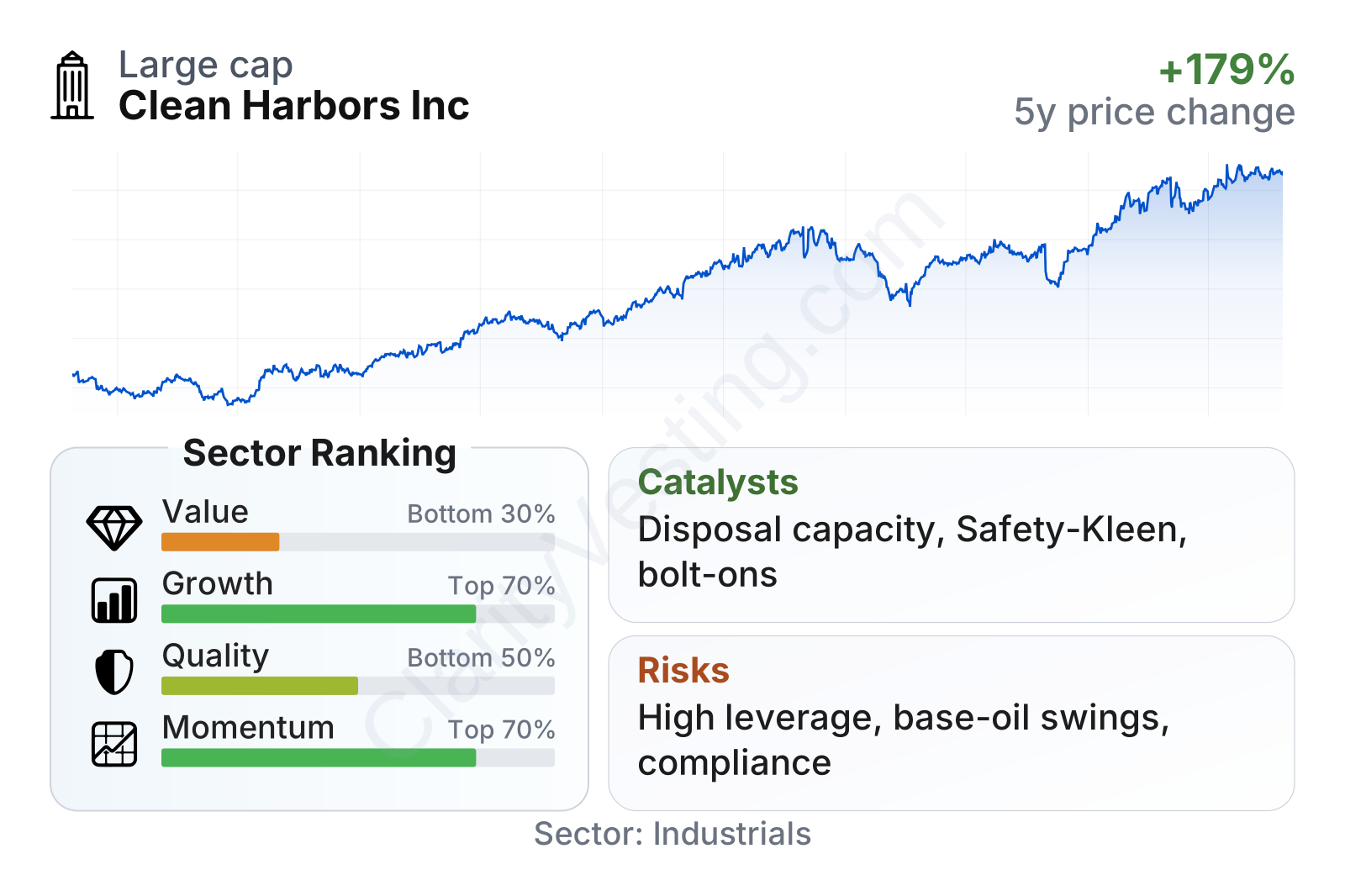
Clean Harbors sits in the large mid-cap to lower large-cap range and has shown relatively steady share-price behavior for an industrial company, with a beta below 1. On growth and momentum, it ranks better than much of its sector, supported by stronger multi-year revenue expansion and solid recent price performance. On value, however, it screens as expensive versus sector norms, and on balance-sheet quality it looks more leveraged than many peers. The combination is clear: the market is assigning a premium to a company with a good operating position, but not a low-risk or low-price profile.
Growth
Clean Harbors operates in a sector with durable long-term demand drivers. Hazardous waste handling, environmental compliance, industrial maintenance, emergency response, and used-oil recycling are all tied to regulations and ongoing industrial activity. These are not optional needs for many customers. As environmental rules become tighter, disposal capacity remains limited, and sustainability requirements rise, specialized providers can benefit from steady demand and pricing power.
The company’s strategy also makes sense for future growth because it combines recurring service revenue with ownership of critical infrastructure. That matters in hazardous waste, where permitting barriers are high and replacement assets are difficult and expensive to build. Clean Harbors has also used acquisitions and network expansion to deepen its reach, while its Safety-Kleen business gives it exposure to circular-economy themes through used-oil collection and re-refining.
Recent growth has been uneven quarter to quarter, which is normal for an industrial services business, but the broader trend still points to expansion. The latest year-over-year pace is back in the low double digits, and the company’s recent growth rate is ahead of the sector median. Over five years, revenue per share has also increased at a stronger rate than many peers, which suggests growth has not simply come from issuing more shares.
Cash generation has strengthened meaningfully over time. Free cash flow moved from a much lower level a few years ago to a substantially higher trailing figure, which is important because this is a capital-intensive business. Stronger cash generation gives the company more flexibility to invest in facilities, fund acquisitions, reduce debt, or absorb cyclical swings in certain end markets.
A notable catalyst in recent years has been the continued value of disposal capacity. In hazardous waste, available industry capacity is limited, and customers often need reliable partners rather than the cheapest option. Clean Harbors is positioned to benefit when pricing improves in incineration, landfill, and related treatment services. Another support is the used-oil and base-oil chain inside Safety-Kleen, where long-term demand for recycled lubricants and closed-loop solutions fits broader sustainability trends.
Recent company updates have also pointed to continued investment in capacity, branch network development, and bolt-on deals. None of these individually transforms the business overnight, but together they reinforce a strategy built around deepening scale in specialized environmental services rather than chasing unrelated growth.
Risks
This article is for informational purposes only and does not constitute financial advice. Some content is AI-generated. See Disclaimer