Stock Analysis · Coles Group Ltd (CLEGF)
Overview
Coles Group Ltd is one of Australia’s largest food and everyday-needs retailers. The company operates supermarkets, liquor stores, and a smaller convenience and fulfillment network. In practical terms, Coles makes most of its money by selling groceries and household products through a nationwide store base, supported by online ordering, supply chain infrastructure, and private-label brands.
Its business mix is heavily tilted toward food retailing, which makes revenue relatively defensive compared with more cyclical industries. Based on recent annual reporting, the revenue base is broadly organized as follows:
- Supermarkets – about 82% to 84%: Coles supermarkets sell fresh food, packaged groceries, health and beauty items, and general household products. This is the core engine of the group.
- Liquor – about 8% to 10%: This includes liquor retailing through Coles Liquor banners and related store operations.
- Express, convenience, and other businesses – about 6% to 8%: This bucket includes smaller-format activity, online-related operations, and other supporting or residual business lines.
The overall picture is simple: Coles is primarily a grocery retailer, with liquor as its second-largest contributor and other activities playing a supporting role. The business also benefits from scale in sourcing, distribution, and store operations, which matters a great deal in a low-margin industry.
Over the last several years, revenue has continued to edge higher, moving from roughly A$39 billion in fiscal 2022 to more than A$45 billion in fiscal 2026. Operating income has generally held up, although net profit has been flatter than revenue growth would suggest. That tells an important story about the company: Coles is growing sales in a steady essential category, but earnings progress depends heavily on cost control, efficiency, and financing conditions rather than on rapid demand expansion alone.
The financial flow highlights a classic supermarket model: a very large revenue base, a high cost of goods sold, and relatively slim profit left at the bottom line. More recently, sales and operating profit have improved, but net income has not expanded at the same pace, showing how sensitive results can be to interest costs and operating expenses.
Key Figures
| Metric | Value | Sector ⓘ |
|---|---|---|
| Date | Oct 17, 2026 | |
| Context | ||
| Sector | Consumer Defensive | |
| Industry | Grocery Stores | |
| Market Cap ⓘ | $22.31B | |
| Beta ⓘ | 0.27 | |
Value (Cheapness) | ||
| P/E Ratio ⓘ | 30.18 | 17.88 |
| P/B Ratio ⓘ | 5.66 | 1.29 |
| FCF Yield ⓘ | 14.79% | 12.39% |
| Dividend Yield ⓘ | 4.70% | 2.85% |
| EBIT / EV ⓘ | N/A | 6.43% |
| PEG ⓘ | N/A | |
Growth (Business expansion) | ||
| Revenue Growth ⓘ | 3.00% | 4.10% |
| RPS Growth (5Y CAGR) ⓘ | 3.56% | 6.18% |
| EPS Growth (5Y CAGR) ⓘ | 37.66% | -13.59% |
| BVPS Growth (5Y CAGR) ⓘ | 5.76% | 3.20% |
| Margin Growth (5Y Trend) ⓘ | 0.24% | -0.15% |
| FCF Growth (5Y CAGR) ⓘ | N/A | 4.10% |
| DPS Growth (5Y CAGR) ⓘ | 3.87% | 6.79% |
Quality (Business durability) | ||
| ROIC (Latest) ⓘ | N/A | 12.34% |
| ROA (Latest) ⓘ | 10.08% | 6.30% |
| ROIC (5Y Median) ⓘ | 23.91% | 10.49% |
| ROA (5Y Median) ⓘ | 5.54% | 5.44% |
| Net Debt / EBIT (Latest) ⓘ | 2.35 | 1.96 |
| Net Debt / EBIT (5Y Median) ⓘ | 5.75 | 2.35 |
| Net Debt / EBITDA (Latest) ⓘ | 1.21 | 1.38 |
| Net Debt / Assets ⓘ | 40.83% | 21.51% |
| EBITDA / Interest ⓘ | 7.22 | 9.46 |
| Operating Margin (Latest) ⓘ | 4.40% | 8.87% |
| Operating Margin (5Y Median) ⓘ | 3.89% | 9.53% |
| Debt to Equity (Latest) ⓘ | 250.68% | 72.35% |
| Profit Margin (Latest) ⓘ | 2.38% | 5.40% |
| Free Cash Flow (Latest) ⓘ | $3.30B | |
Momentum (Price trend) | ||
| 3Y Return ⓘ | +99.15% | +20.92% |
| 12M Return (excl. last month) ⓘ | +16.38% | +2.13% |
| 6M Return ⓘ | +10.96% | +1.26% |
| Price vs. 200-Day MA ⓘ | +50.70% | +1.39% |
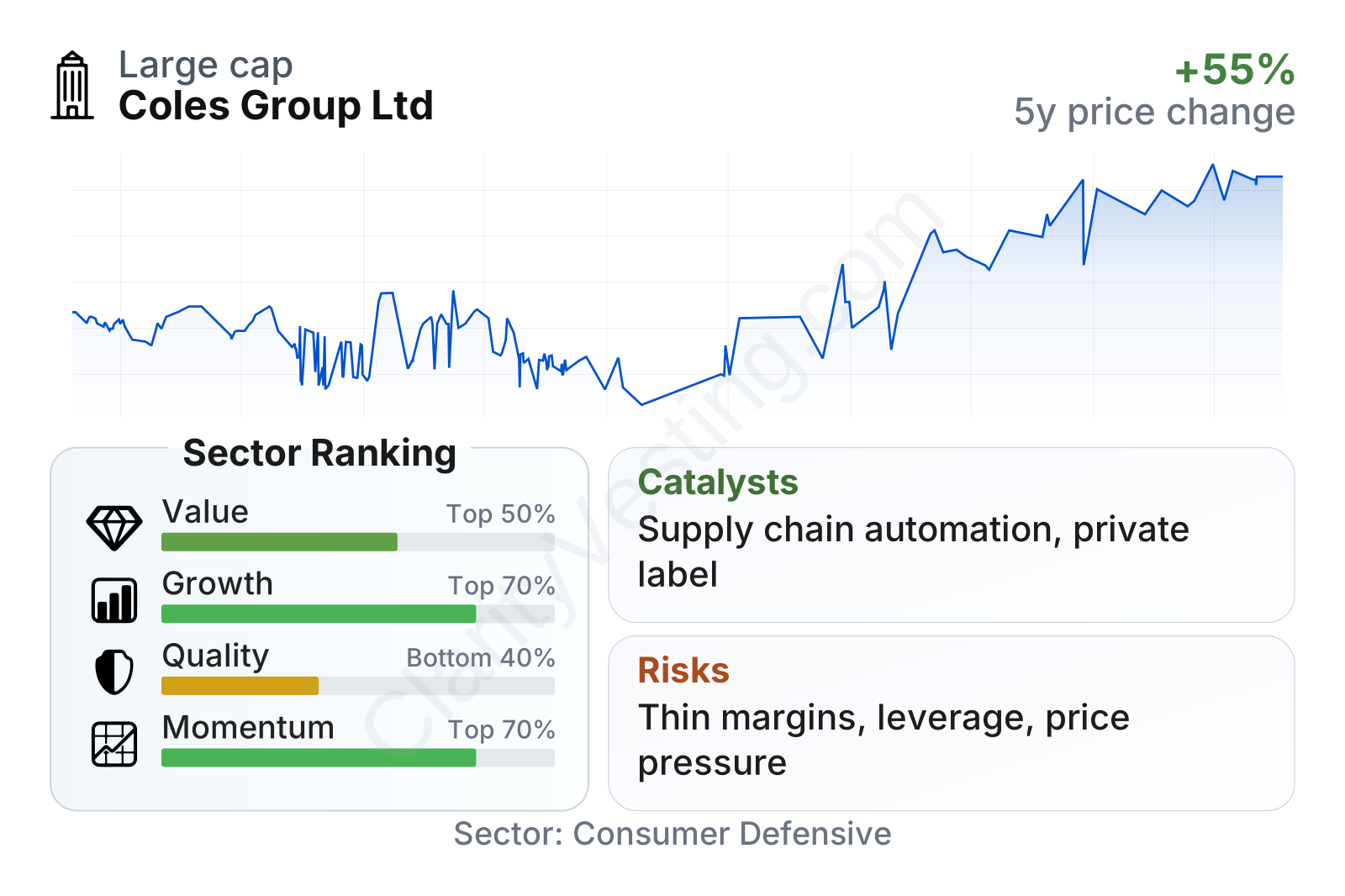
Coles stands out as a large defensive retailer with unusually low share-price volatility for a listed company, reflected in a beta well below 1. The latest factor mix is mixed but understandable for a supermarket chain. Value multiples look demanding on book value and somewhat elevated on earnings, while cash generation and dividend yield are stronger than the sector median. Growth is not especially fast on revenue, but the long-run earnings trend and margin improvement compare better than many peers. Quality metrics are pulled down by thin operating margins and a balance sheet that carries more leverage than the sector norm, even though returns on assets and long-term returns on invested capital are solid. Price momentum has been notably strong relative to the broader consumer defensive group.
Growth
Coles operates in a sector that usually grows slowly but steadily. Grocery retail is not a high-growth market in the usual sense, yet it benefits from recurring demand because food, household staples, and everyday essentials remain necessary across economic cycles. That makes the company’s growth profile more about consistency, market share, productivity, and category mix than about dramatic expansion.
The group’s strategy appears sensible for that environment. Coles has kept investing in supply chain automation, distribution capacity, digital capabilities, and own-brand products. Those initiatives matter because supermarkets compete on availability, price perception, and execution. Better logistics can reduce waste, improve in-stock levels, and support margins. Digital and omnichannel improvements can also protect relevance as more grocery spending moves online or toward hybrid shopping behavior.
Recent revenue growth has been positive but modest, around the low-single-digit range, which is broadly in line with what would be expected from a mature grocery operator. Over a five-year period, sales per share growth has lagged the sector median, so this is not a rapid expansion case. The more encouraging angle is that earnings per share growth over five years has been much stronger than the sector median, suggesting management has done a reasonable job converting a stable revenue base into better shareholder economics.
One meaningful catalyst is execution on efficiency projects. In food retail, even small improvements in margin, shrink, labor productivity, or inventory flow can have an outsized effect on profits because the starting margin is so narrow. Another catalyst is continued resilience in private-label ranges, which can strengthen customer loyalty while supporting gross margin. Coles also has room to benefit from population growth in Australia and ongoing normalization of online grocery adoption.
Recent company updates have also pointed to continued investment in distribution and technology infrastructure. That may not produce instant gains, but for a large grocer, stronger back-end systems can become a durable source of better service and lower operating friction over time.
Risks
This article is for informational purposes only and does not constitute financial advice. Some content is AI-generated. See Disclaimer


