Stock Analysis · Columbia Financial Inc (CLBK)
Overview
Columbia Financial Inc is the holding company for Columbia Bank, a regional bank based in New Jersey. It mainly serves individuals, small businesses, and commercial clients through traditional banking activities: taking deposits, making loans, and earning the spread between what it pays depositors and what it earns on loans and securities. Like many regional banks, its business is relatively straightforward and tied closely to local economic activity, real estate markets, and interest-rate conditions.
The company’s revenue is primarily generated from net interest income, which is the difference between interest earned on loans and investment securities and interest paid on deposits and borrowings. Non-interest income exists, but it is a much smaller contributor. Based on recent annual reporting patterns, the main sources of revenue appear to be:
- Net interest income: approximately 85% to 95% of total revenue. This includes income from commercial real estate loans, multifamily loans, one- to four-family residential mortgages, consumer loans, and securities, minus funding costs.
- Fee and other non-interest income: approximately 5% to 15% of total revenue. This typically includes service charges, bank-owned life insurance income, gains or losses on securities or loan sales when applicable, and other banking-related fees.
On the lending side, Columbia Bank has historically been oriented toward real estate-backed lending, especially commercial real estate, multifamily, and residential mortgage loans. On the funding side, it relies heavily on customer deposits gathered through its branch network. That makes the franchise sensitive to both local deposit competition and changes in short-term interest rates.
Over the last few years, total revenue has moved upward, but profitability has been much more volatile. The sharp rise in funding costs across the banking industry pressured margins in 2023 and 2024, and Columbia’s results reflected that. More recently, earnings have shown signs of recovery, suggesting that the worst of the margin compression may be easing.
The multi-year income flow highlights an important pattern: revenue expanded meaningfully from 2021 through 2025, but much of that growth was absorbed by higher interest expense during the period of elevated rates. Operating costs improved materially in 2025, which helped net income recover after a very weak 2024.
Key Figures
| Metric | Value | Sector ⓘ |
|---|---|---|
| Date | Oct 17, 2026 | |
| Context | ||
| Sector | Financial Services | |
| Industry | Banks - Regional | |
| Market Cap ⓘ | $2.92B | |
| Beta ⓘ | 0.26 | |
Value (Cheapness) | ||
| P/E Ratio ⓘ | 18.69 | 12.26 |
| P/B Ratio ⓘ | 2.02 | 1.23 |
| FCF Yield ⓘ | 2.35% | 10.40% |
| Dividend Yield ⓘ | N/A | 3.02% |
| EBIT / EV ⓘ | N/A | 8.14% |
| PEG ⓘ | N/A | |
Growth (Business expansion) | ||
| Revenue Growth ⓘ | 13.10% | 9.35% |
| RPS Growth (5Y CAGR) ⓘ | -6.43% | 12.19% |
| EPS Growth (5Y CAGR) ⓘ | -14.17% | -9.53% |
| BVPS Growth (5Y CAGR) ⓘ | -50.25% | 4.99% |
| Margin Growth (5Y Trend) ⓘ | -28.98% | -3.86% |
| FCF Growth (5Y CAGR) ⓘ | -10.97% | 4.81% |
| DPS Growth (5Y CAGR) ⓘ | -88.47% | 8.79% |
Quality (Business durability) | ||
| ROIC (Latest) ⓘ | N/A | 9.49% |
| ROE (Latest) ⓘ | 4.98% | 13.90% |
| ROA (Latest) ⓘ | 0.50% | 1.55% |
| ROIC (5Y Median) ⓘ | 2.30% | 7.86% |
| ROE (5Y Median) ⓘ | 1.74% | 12.17% |
| ROA (5Y Median) ⓘ | 0.48% | 1.30% |
| Net Debt / EBIT (Latest) ⓘ | N/A | 0.96 |
| Net Debt / EBIT (5Y Median) ⓘ | 11.06 | 0.73 |
| Net Debt / EBITDA (Latest) ⓘ | 1.57 | 0.92 |
| Operating Margin (Latest) ⓘ | N/A | 22.30% |
| Operating Margin (5Y Median) ⓘ | 11.86% | 24.63% |
| Debt to Equity (Latest) ⓘ | 101.86% | 58.56% |
| Profit Margin (Latest) ⓘ | 21.76% | 26.57% |
| Free Cash Flow (Latest) ⓘ | $68.75M | |
Momentum (Price trend) | ||
| 3Y Return ⓘ | +48.80% | +88.33% |
| 12M Return (excl. last month) ⓘ | +66.54% | +19.38% |
| 6M Return ⓘ | +30.52% | +4.75% |
| Price vs. 200-Day MA ⓘ | +16.33% | +3.50% |
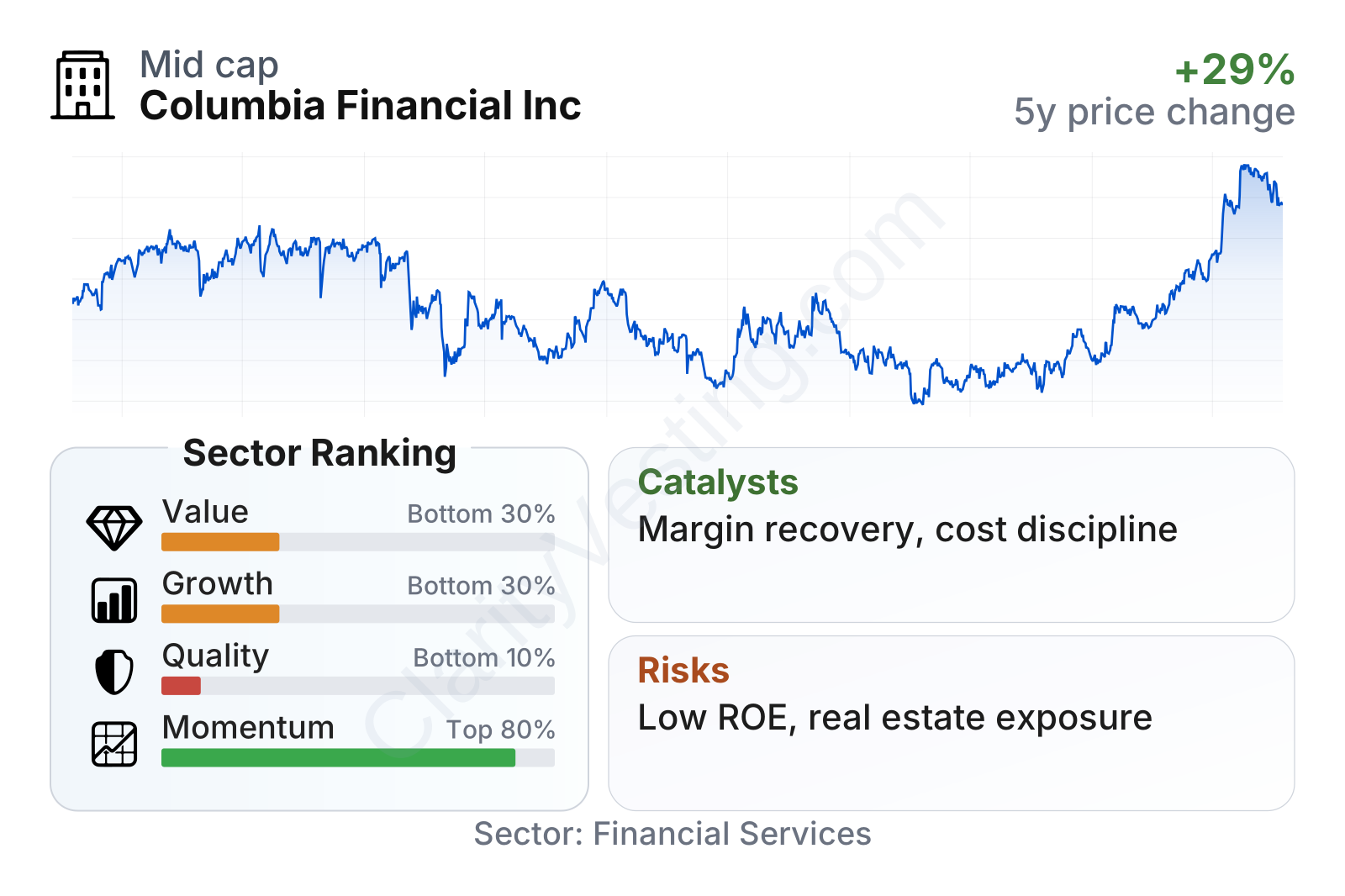
Columbia Financial is a mid-sized regional bank with unusually low share-price volatility, as shown by its beta well below 1. In the factor breakdown, momentum has recently been strong, but value, growth, and quality rank weakly versus much of the financial sector. In practical terms, the market has rewarded the recent rebound, while the underlying profitability and long-term compounding record still lag many peers.
The stock’s longer path has been uneven. After weakness through much of 2023 to 2025, the shares recovered strongly into 2026. That rebound appears tied more to improving earnings expectations and relief from prior pressure than to a long-established record of high returns.
Growth
Regional banking is a mature industry, so growth usually comes less from disruption and more from disciplined balance-sheet expansion, market share gains, deposit gathering, and margin management. Columbia Financial operates in attractive and densely populated markets in New Jersey and nearby areas, which can support loan demand over time. The sector itself is not a high-growth arena, but well-run regional banks can still expand steadily if they control credit risk and maintain strong customer relationships.
For Columbia, the clearest growth path is not rapid expansion into a new business line. It is a recovery-and-optimization path: improving net interest margin, deepening customer deposits, and growing loans selectively in markets it already knows well. That is a reasonable strategy for a traditional bank, especially after the industry-wide strain caused by higher deposit costs. If funding costs stabilize while asset yields remain supportive, earnings can improve even without dramatic balance-sheet growth.
The earnings trend shows why the market’s recent optimism is cautious rather than enthusiastic. Earnings per share fell sharply from 2021 through 2024, then improved in 2025 and remained positive in 2026. That pattern suggests the bank has moved off the bottom, but it has not yet re-established the steadier earnings power seen before rates reset the economics of deposit gathering.
Book value per share also deserves careful attention for a bank. The recent direction looks better than the severe earlier drop, but the longer-term record remains weak. For a regional bank, durable growth usually shows up in both earnings and book value over time. Columbia’s recent stabilization is encouraging, yet it still needs several periods of consistent progress to demonstrate that the recovery is not just temporary.
A potential catalyst is the broader rate environment. If deposit pricing pressure eases further and the bank can retain customers without paying aggressively for funding, its core spread business could strengthen. Another possible opportunity comes from expense discipline. The jump back to profitability in 2025 was helped by lower operating costs, which means management still has room to improve returns even if revenue growth stays moderate.
Recent company reporting in 2026 has also pointed to continued profitability after the 2024 loss period. That does not eliminate uncertainty, but it does support the view that Columbia is in a rebuilding phase rather than a worsening one.
Risks
This article is for informational purposes only and does not constitute financial advice. Some content is AI-generated. See Disclaimer


