Stock Analysis · Vesuvius plc (CKSNF)
Overview
Vesuvius plc is an industrial engineering and materials company that supplies consumable products and equipment used in high-temperature manufacturing processes, especially steel production. Its products help steelmakers control molten metal, improve yield, protect equipment, and automate parts of the casting process. The company also serves foundries, glass producers, and other industries that use extreme heat, but steel is the core end market.
The business is organized around two main divisions. Flow Control supplies products used during continuous casting, such as stopper rods, slide gates, nozzles, and related systems that regulate molten steel. Advanced Refractories provides linings, sensors, shaping systems, and other heat-resistant products used in steelmaking and in selected non-steel applications. A smaller but strategically important part of the portfolio includes digital and robotics solutions that help customers automate dangerous or repetitive tasks around molten metal.
Revenue is mainly tied to repeat demand because many of Vesuvius’ products are consumables that need frequent replacement during normal plant operations. Based on recent annual reporting, the revenue mix is approximately:
- Flow Control: about 55% to 60% of revenue. This includes consumable systems used in continuous steel casting and related automation.
- Advanced Refractories: about 40% to 45% of revenue. This includes refractory linings, sensors, crucibles, and engineered products for steel and other high-temperature industries.
Geographically, the company is diversified across Europe, the Americas, and Asia, with meaningful exposure to emerging markets where steel production capacity continues to expand. That diversification helps reduce reliance on any single country, although results are still influenced by global industrial activity and steel volumes.
One notable feature of the business model is that a large share of costs sits in raw materials, manufacturing, and logistics, while profitability depends on maintaining pricing discipline and operating efficiency. Over the last few years, revenue has remained around the same broad range after the 2022 peak, but earnings have become more pressured as margins narrowed.
The long-term pattern shows a business with relatively steady sales, but with profits moving more sharply than revenue. Sales climbed strongly in 2022, then eased over the following years, while net income fell much faster than revenue. That suggests margins have been more sensitive to cost inflation, mix, and industrial demand than the top line alone would indicate.
Key Figures
| Metric | Value | Sector ⓘ |
|---|---|---|
| Date | Oct 17, 2026 | |
| Context | ||
| Sector | Basic Materials | |
| Industry | Steel | |
| Market Cap ⓘ | $1.37B | |
| Beta ⓘ | 1.02 | |
Value (Cheapness) | ||
| P/E Ratio ⓘ | 15.47 | 16.90 |
| P/B Ratio ⓘ | 0.95 | 1.65 |
| FCF Yield ⓘ | 9.21% | 5.76% |
| Dividend Yield ⓘ | 5.34% | 2.13% |
| EBIT / EV ⓘ | N/A | 6.30% |
| PEG ⓘ | 2.04 | |
Growth (Business expansion) | ||
| Revenue Growth ⓘ | 1.70% | 11.10% |
| RPS Growth (5Y CAGR) ⓘ | 4.64% | 4.49% |
| EPS Growth (5Y CAGR) ⓘ | -21.99% | -13.47% |
| BVPS Growth (5Y CAGR) ⓘ | 1.31% | 5.51% |
| Margin Growth (5Y Trend) ⓘ | -0.33% | -1.54% |
| FCF Growth (5Y CAGR) ⓘ | 173.89% | 0.37% |
| DPS Growth (5Y CAGR) ⓘ | 3.23% | 6.08% |
Quality (Business durability) | ||
| ROIC (Latest) ⓘ | N/A | 9.26% |
| ROA (Latest) ⓘ | 4.55% | 4.91% |
| ROIC (5Y Median) ⓘ | 8.16% | 7.70% |
| ROA (5Y Median) ⓘ | 4.89% | 3.86% |
| Net Debt / EBIT (Latest) ⓘ | 1.47 | 1.40 |
| Net Debt / EBIT (5Y Median) ⓘ | 1.98 | 1.70 |
| Net Debt / EBITDA (Latest) ⓘ | 0.96 | 0.95 |
| Net Debt / Assets ⓘ | 17.26% | 13.69% |
| EBITDA / Interest ⓘ | 9.39 | 12.34 |
| Operating Margin (Latest) ⓘ | 8.04% | 13.20% |
| Operating Margin (5Y Median) ⓘ | 9.69% | 11.80% |
| Debt to Equity (Latest) ⓘ | 56.90% | 40.56% |
| Profit Margin (Latest) ⓘ | 2.09% | 6.43% |
| Free Cash Flow (Latest) ⓘ | $126.34M | |
Momentum (Price trend) | ||
| 3Y Return ⓘ | +43.76% | +68.89% |
| 12M Return (excl. last month) ⓘ | -14.99% | +30.21% |
| 6M Return ⓘ | +7.60% | -4.16% |
| Price vs. 200-Day MA ⓘ | +4.58% | -1.27% |
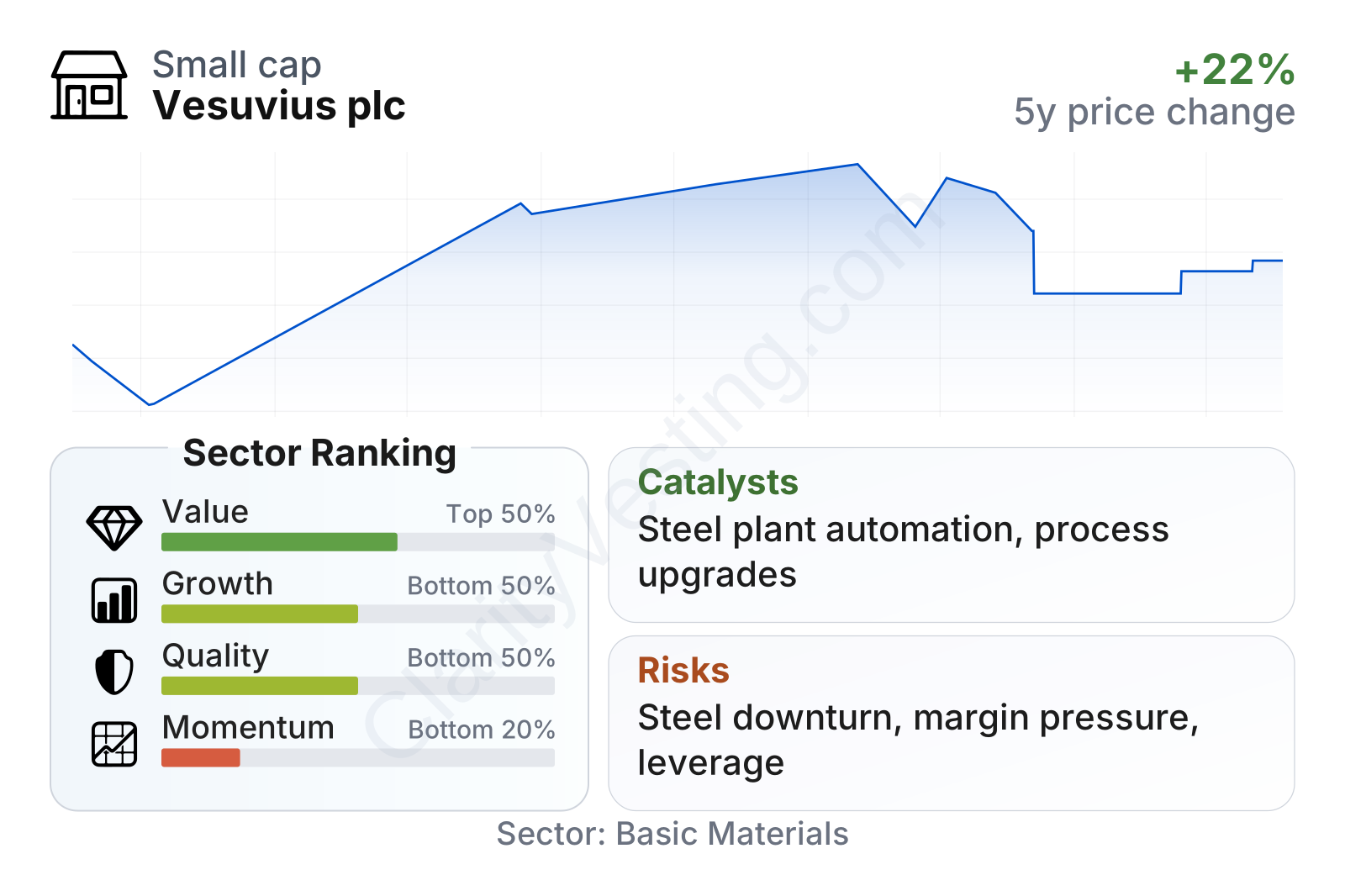
Vesuvius is a mid-sized industrial company with a share price that has been relatively stable over the last few years, though not especially strong compared with much of the broader materials sector. The valuation profile looks undemanding on several traditional measures: the earnings multiple is below the sector median, the price-to-book ratio is markedly lower than the sector median, free cash flow yield is strong, and the trailing dividend yield is well above the sector norm.
That cheaper valuation comes with trade-offs. Growth metrics are mixed to weak: recent revenue growth has been modest, earnings growth over five years has been negative, and book value growth has lagged much of the sector. On quality, the picture is also uneven. Returns on assets are close to sector levels, but profit margin and operating margin are lower than the median, while leverage is somewhat higher. Interest coverage remains adequate rather than stretched, which reduces immediate balance-sheet concern, but it does not leave the company looking unusually robust.
The most encouraging financial signal is cash generation. Free cash flow has improved substantially over a longer period and remains strong relative to the company’s size. In practical terms, that gives management flexibility to support dividends, fund bolt-on investments, and manage debt even when profits are under pressure.
Growth
Vesuvius operates in a sector that is mature rather than fast-growing, but it still has several avenues for steady expansion. Global steel demand is closely tied to construction, infrastructure, energy, automotive, and manufacturing activity. That means the addressable market can grow over time, especially in regions adding production capacity or modernizing older plants, even if annual demand is cyclical.
The company’s strategy is sensible for that environment. Instead of depending only on higher steel output, it focuses on products that improve customer productivity, safety, yield, and energy efficiency. This matters because steel producers are under pressure to cut waste, lower emissions, and automate hazardous processes. A supplier that can reduce metal loss, extend campaign life, or improve process control can grow even if total steel volumes move slowly.
Vesuvius also has a useful installed-base effect. Once its systems are qualified inside a customer’s process, switching can be disruptive because these products directly affect throughput, quality, and safety. That does not make the business immune to competition, but it can support recurring sales and long customer relationships.
A meaningful catalyst is the industrial push toward cleaner and more efficient steelmaking. Steel plants are investing in process upgrades, digital monitoring, and automation, and Vesuvius has positioned itself with robotics and advanced process technologies rather than only traditional refractory products. If adoption of these higher-value solutions increases, it could help margins as well as revenue mix.
Another opportunity comes from regional capacity additions in countries still investing in steel infrastructure. New or upgraded plants often create openings for qualified suppliers to win consumables contracts and embed process technologies early. This is especially relevant in faster-growing manufacturing regions, where the company already has an international footprint.
Risks
This article is for informational purposes only and does not constitute financial advice. Some content is AI-generated. See Disclaimer


