Stock Analysis · CK Hutchison Holdings LTD (CKHUY)
Overview
CK Hutchison Holdings is a Hong Kong-based conglomerate with operations spread across infrastructure-like and consumer-facing businesses. The group is unusual because it combines ports, telecom, retail, infrastructure, and finance-related investments under one corporate umbrella. That mix gives it exposure to many economies across Europe and Asia rather than relying on one country or one industry.
In simple terms, the company earns money from moving goods, running mobile networks, operating large retail chains, owning regulated infrastructure assets, and holding stakes in energy and other long-duration businesses. Its long-term appeal mainly comes from diversification, cash generation, and the presence of assets that can be difficult or expensive for competitors to replicate.
Based on the latest annual disclosures, the main sources of revenue are approximately:
- Retail: about 65% to 70% — health and beauty chains, supermarkets, and related store operations across multiple markets, including A.S. Watson.
- Telecommunications: about 15% to 20% — mobile and related telecom services in Europe and Asia through brands and networks controlled by the group.
- Ports and related services: about 8% to 10% — container terminals and logistics activities tied to global trade flows.
- Infrastructure: about 3% to 5% — regulated or contracted assets such as utilities, energy, transportation, and water interests held mainly through CK Infrastructure and associated investments.
- Finance & investments and others: about 2% to 4% — treasury activities, listed stakes, and miscellaneous holdings.
That revenue mix can understate the importance of infrastructure and telecom to profit and cash flow, because lower-revenue segments often have steadier margins than retail. Over the last few years, group revenue has stayed broadly stable, but earnings have been more uneven, showing how much this business depends on portfolio composition, asset valuations, currency shifts, and regional operating conditions.
The business profile shows a company with very large sales, but also with profitability that can move around materially from year to year. Revenue has been relatively resilient, while net income has been more volatile, which is typical for a diversified holding group rather than a simple single-line operator.
Key Figures
| Metric | Value | Sector ⓘ |
|---|---|---|
| Date | Oct 17, 2026 | |
| Context | ||
| Sector | Industrials | |
| Industry | Conglomerates | |
| Market Cap ⓘ | $32.59B | |
| Beta ⓘ | 0.75 | |
Value (Cheapness) | ||
| P/E Ratio ⓘ | 6.75 | 22.10 |
| P/B Ratio ⓘ | 0.07 | 1.97 |
| FCF Yield ⓘ | 270.60% | 6.38% |
| Dividend Yield ⓘ | 3.52% | 1.94% |
| EBIT / EV ⓘ | N/A | 4.79% |
| PEG ⓘ | 0.43 | |
Growth (Business expansion) | ||
| Revenue Growth ⓘ | -1.90% | 9.30% |
| RPS Growth (5Y CAGR) ⓘ | -0.00% | 7.81% |
| EPS Growth (5Y CAGR) ⓘ | -57.76% | -13.06% |
| BVPS Growth (5Y CAGR) ⓘ | -4.39% | 6.14% |
| Margin Growth (5Y Trend) ⓘ | -4.98% | 0.88% |
| FCF Growth (5Y CAGR) ⓘ | 36.67% | 11.01% |
| DPS Growth (5Y CAGR) ⓘ | -2.94% | 9.48% |
Quality (Business durability) | ||
| ROIC (Latest) ⓘ | 6.72% | 10.84% |
| ROA (Latest) ⓘ | 4.01% | 5.41% |
| ROIC (5Y Median) ⓘ | 3.47% | 9.38% |
| ROA (5Y Median) ⓘ | 2.04% | 4.95% |
| Net Debt / EBIT (Latest) ⓘ | 1.96 | 2.08 |
| Net Debt / EBIT (5Y Median) ⓘ | 4.93 | 2.27 |
| Net Debt / EBITDA (Latest) ⓘ | 0.93 | 1.39 |
| Net Debt / Assets ⓘ | 11.93% | 19.28% |
| EBITDA / Interest ⓘ | N/A | 9.58 |
| Operating Margin (Latest) ⓘ | 12.53% | 10.50% |
| Operating Margin (5Y Median) ⓘ | 13.86% | 10.29% |
| Debt to Equity (Latest) ⓘ | 54.80% | 65.48% |
| Profit Margin (Latest) ⓘ | 13.62% | 6.67% |
| Free Cash Flow (Latest) ⓘ | $88.20B | |
Momentum (Price trend) | ||
| 3Y Return ⓘ | +85.11% | +61.68% |
| 12M Return (excl. last month) ⓘ | +36.07% | +12.58% |
| 6M Return ⓘ | +5.62% | 0.00% |
| Price vs. 200-Day MA ⓘ | +1.04% | +0.02% |
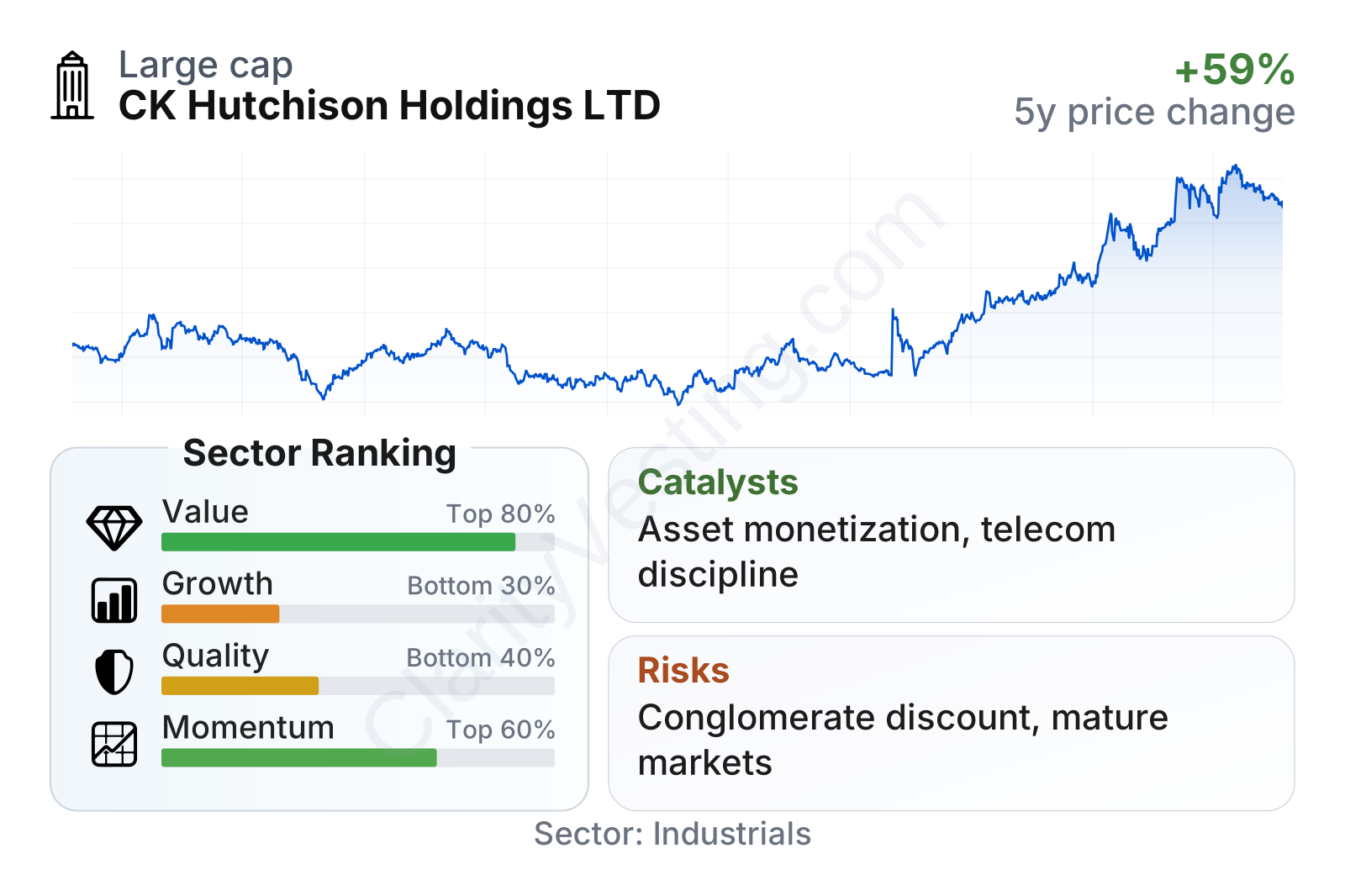
CK Hutchison is a large-cap company with relatively low share-price volatility, as indicated by a beta below 1. On valuation metrics, it screens cheaply versus the broader industrials sector, with a low earnings multiple, a very low price-to-book ratio, and a dividend yield above the sector median. At the same time, its growth and profitability rankings are more mixed: growth measures sit in the weaker part of the sector, while margins and cash generation look better than the ranking for returns on capital would suggest. Momentum has recently been favorable, meaning the market has been improving its view of the shares even though the business is not currently a fast grower.
Growth
CK Hutchison is not concentrated in a single high-growth industry, so the growth case is different from that of a pure technology or healthcare company. Instead, it operates in sectors that tend to be essential and durable: consumer staples retail, telecom connectivity, ports tied to world trade, and regulated infrastructure. These are generally mature sectors, but they can still produce steady expansion through efficiency gains, network upgrades, acquisitions, portfolio reshaping, and rising demand for connectivity and logistics.
The company’s strategy makes sense for long-term resilience more than for rapid expansion. Retail gives it scale and recurring consumer demand. Telecom offers ongoing data usage growth and potential monetization from network quality and consolidation. Ports benefit from trade recovery and supply-chain normalization. Infrastructure brings cash flow visibility because many assets operate under regulation or long-term contractual frameworks.
Revenue growth has been modest rather than strong. Recent periods show low-single-digit improvement after earlier declines, which suggests stabilization more than acceleration. That fits the profile of a mature global group. One brighter point is cash generation: free cash flow has expanded strongly over a multi-year period even while revenue growth has been soft. For a conglomerate, that matters because it supports debt reduction, dividends, reinvestment, and optionality for future transactions.
A meaningful catalyst is portfolio value realization. CK Hutchison has a long history of owning assets that may be worth more separately than inside the current structure. When markets begin to recognize the underlying value of ports, telecom towers, infrastructure stakes, or retail operations, the group can benefit from asset sales, partnerships, restructurings, or simplification moves. Another catalyst is telecom industry discipline in Europe, where better pricing and lower capital intensity can improve returns if competition becomes more rational.
Recent operating context also supports selective opportunities. Demand for mobile data continues to rise, health and beauty retail remains structurally relevant, and global logistics activity can recover with trade volumes. None of these alone transforms the company, but together they support a case for gradual improvement rather than dramatic expansion.
Risks
This article is for informational purposes only and does not constitute financial advice. Some content is AI-generated. See Disclaimer


