Stock Analysis · Capitec Bank Holdings Ltd (CKHGY)
Overview
Capitec Bank Holdings Ltd is a South African retail bank focused on everyday banking, unsecured lending, savings, insurance, and digital financial services. The group built its brand around a simplified, low-fee model aimed at mass-market consumers, and over time it expanded from a lender into a broader banking platform. Its American depositary receipt trades in the U.S. under the symbol CKHGY, but the business itself is centered in South Africa.
Capitec’s revenue base is mainly tied to traditional banking income, especially interest earned on loans and investments, followed by non-interest income from transaction fees and a growing contribution from insurance and other value-added services. Based on recent annual reporting, the mix is approximately as follows:
- Net interest income: about 55% to 65% of total operating income. This includes interest earned on personal loans, credit products, and the bank’s treasury and investment balances, minus funding costs.
- Net transaction fee income: about 20% to 30%. This comes from card use, account fees, payment activity, cash handling, and other daily banking services.
- Insurance income and related services: about 8% to 12%. This includes credit life, funeral, and other insurance offerings distributed through the bank’s customer base.
- Other income: usually below 10%. This can include value-added services, commissions, and smaller operating items.
The broad direction is clear: Capitec is no longer just a lender. It is increasingly monetizing a large active client base through payments, deposits, insurance, and digital services, which matters because fee income and cross-selling can make earnings more resilient over time.
The recent financial flow also points to a business that has scaled quickly. Revenue and net income have risen sharply over the last few years, and profitability has expanded even as operating costs increased to support growth.
The main takeaway from the revenue and profit flow is that Capitec’s earnings base has become much larger in a relatively short period. That suggests the bank is benefiting from both balance-sheet growth and deeper use of its platform by existing customers.
Key Figures
| Metric | Value | Sector ⓘ |
|---|---|---|
| Date | Nov 14, 2026 | |
| Context | ||
| Sector | Financial Services | |
| Industry | Banks - Regional | |
| Market Cap ⓘ | $33.96B | |
| Beta ⓘ | 0.70 | |
Value (Cheapness) | ||
| P/E Ratio ⓘ | 30.86 | 12.38 |
| P/B Ratio ⓘ | N/A | 1.54 |
| FCF Yield ⓘ | 6.84% | 8.62% |
| Dividend Yield ⓘ | 1.73% | 2.91% |
| EBIT / EV ⓘ | N/A | 8.22% |
| PEG ⓘ | N/A | |
Growth (Business expansion) | ||
| Revenue Growth ⓘ | 12.90% | 7.00% |
| RPS Growth (5Y CAGR) ⓘ | 124.97% | 12.30% |
| EPS Growth (5Y CAGR) ⓘ | 59.29% | -0.81% |
| BVPS Growth (5Y CAGR) ⓘ | 125.16% | 4.87% |
| Margin Growth (5Y Trend) ⓘ | N/A | -4.00% |
| FCF Growth (5Y CAGR) ⓘ | 7.85% | 4.68% |
| DPS Growth (5Y CAGR) ⓘ | 26.04% | 8.77% |
Quality (Business durability) | ||
| ROIC (Latest) ⓘ | -1.08% | 9.69% |
| ROE (Latest) ⓘ | 59.45% | 14.05% |
| ROA (Latest) ⓘ | 13.20% | 1.58% |
| ROIC (5Y Median) ⓘ | -2.50% | 7.79% |
| ROE (5Y Median) ⓘ | 46.29% | 12.05% |
| ROA (5Y Median) ⓘ | 6.16% | 1.28% |
| Net Debt / EBIT (Latest) ⓘ | -212.77 | 0.97 |
| Net Debt / EBIT (5Y Median) ⓘ | N/A | 0.73 |
| Net Debt / EBITDA (Latest) ⓘ | -11.49 | 0.75 |
| Operating Margin (Latest) ⓘ | 0.13% | 23.57% |
| Operating Margin (5Y Median) ⓘ | -26.40% | 24.30% |
| Debt to Equity (Latest) ⓘ | 5.47% | 59.34% |
| Profit Margin (Latest) ⓘ | 40.75% | 26.53% |
| Free Cash Flow (Latest) ⓘ | $2.32B | |
Momentum (Price trend) | ||
| 3Y Return ⓘ | +208.16% | +85.82% |
| 12M Return (excl. last month) ⓘ | +23.27% | +16.88% |
| 6M Return ⓘ | +17.74% | +8.29% |
| Price vs. 200-Day MA ⓘ | +9.46% | +5.17% |
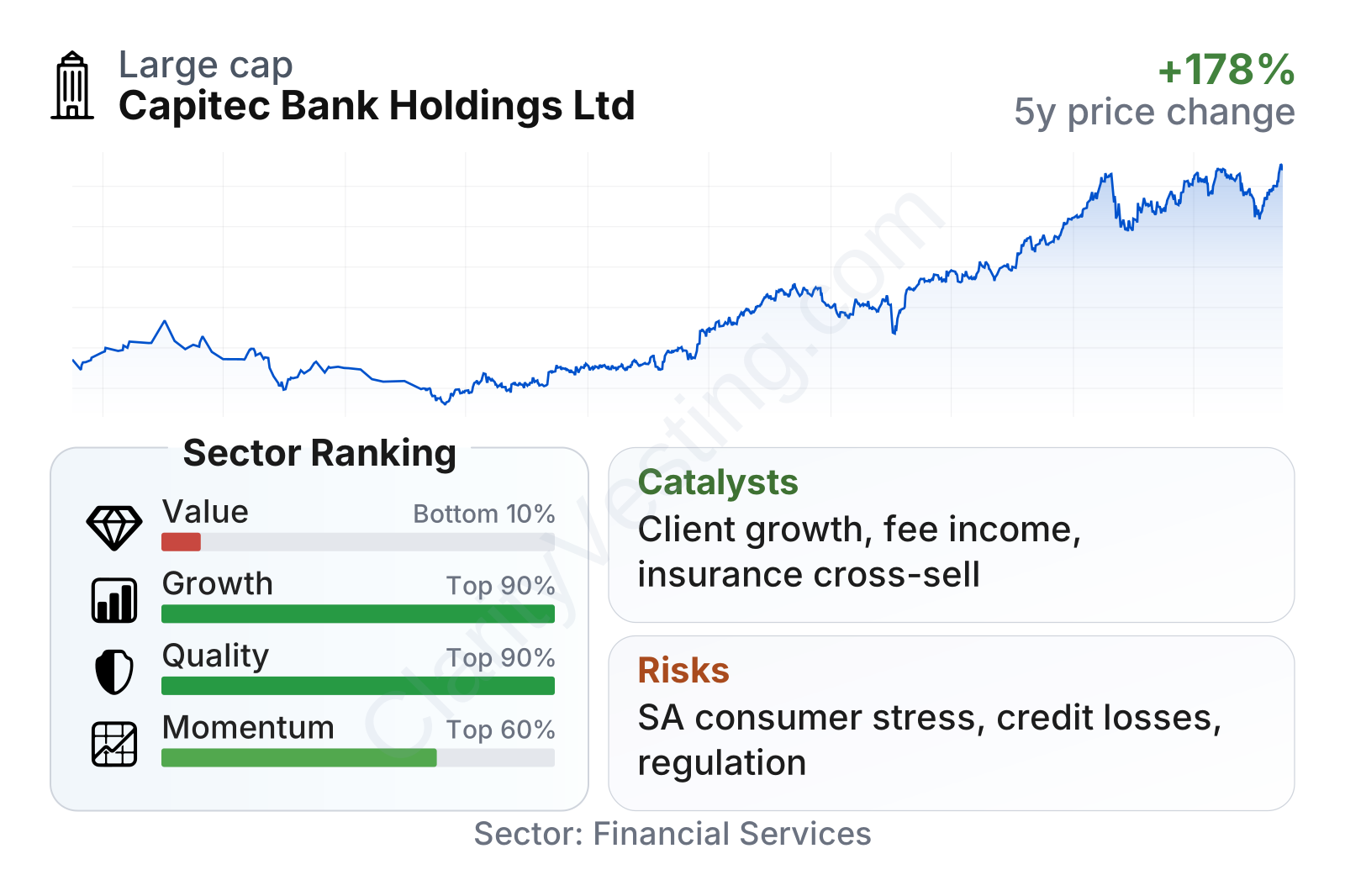
Capitec stands out on growth and profitability, with both factors ranking near the top of its sector. Revenue growth, earnings growth, return on equity, return on assets, and profit margin are all well above typical regional bank levels. The market is therefore assigning a richer earnings multiple than the sector median, even though the stock still screens below peers on price-to-book. Momentum has cooled in the shorter term after a very strong multiyear run, which suggests the shares are no longer in the same powerful upward phase seen earlier.
The stock price history shows a major rebound from 2023 into 2026. That rise reflects stronger operating performance and a market willing to recognize Capitec as a fast-growing retail bank rather than a typical slow-growth lender.
Growth
Capitec operates in a sector that can still grow structurally in South Africa: consumer banking remains under pressure economically, but digital adoption, migration away from cash, and demand for low-cost banking services continue to create room for efficient operators. In that environment, Capitec’s strategy is coherent. It combines simple pricing, high customer accessibility, a large branch network, and strong app-based engagement, all of which can help it gain market share in both banking and adjacent financial products.
A key part of the long-term growth case is customer deepening rather than only customer acquisition. Once a client uses Capitec as a primary bank account, the company can layer on card usage, payments, savings, credit, insurance, and merchant-related services. That tends to raise revenue per customer without requiring the same level of acquisition spending each time.
Earnings per share remain on a strong trend, even if interim numbers can be seasonal. Over a five-year period, earnings growth has been far stronger than the sector median, which supports the view that Capitec is taking share and converting that into real profit rather than just balance-sheet expansion.
Book value per share has also climbed sharply, which is important for a bank. It shows that the company has been adding capital through retained earnings while still growing the business. For long-term analysis, that combination matters because it suggests growth has not come at the cost of a weak capital base.
Another useful catalyst is the ongoing diversification away from pure unsecured lending. Capitec has steadily broadened its product set, including insurance and business-related services, which can smooth results over time. The company has also invested in technology and customer experience, and that can become a lasting advantage in a banking market where convenience and pricing transparency influence switching behavior.
Recent reporting also indicates continued expansion in headline earnings, client activity, and product penetration. That does not remove macroeconomic risk, but it does suggest that the company still has operating momentum and multiple avenues for future revenue growth.
Risks
This article is for informational purposes only and does not constitute financial advice. Some content is AI-generated. See Disclaimer