Stock Analysis · China Jinmao Holdings Group Limited (CJNHF)
Overview
China Jinmao Holdings Group Limited is a large Chinese real estate company focused on property development, while also operating commercial properties, hotels, and property management activities. The group is part of the wider Sinochem system, which matters because state-backed ownership can improve financing access and project credibility in a sector that has been under pressure. Its business is still centered on developing and selling residential and mixed-use projects in major Chinese cities, but it also has recurring-income segments that add some diversification.
The main sources of revenue are led by property development and land development, with smaller contributions from hotel operations, commercial leasing, and management-related services. Based on recent annual disclosures and segment structure, the revenue mix is approximately:
- Property development and land development: about 90% to 94% — sale of residential units, mixed-use projects, and urban development projects.
- Hotel operations: about 3% to 5% — room revenue, food and beverage, and hospitality services from owned or managed hotels.
- Commercial property leasing and retail operations: about 2% to 4% — office buildings, shopping centers, and other investment properties generating rental income.
- Property management and other services: about 1% to 3% — community services, project-related services, and other ancillary activities.
This mix shows that China Jinmao remains overwhelmingly tied to the Chinese housing market. The benefit is that any improvement in homebuyer confidence or policy support can have a large effect on results. The drawback is that the company is still far less insulated than landlords or service-heavy real estate groups with larger recurring income bases.
Over the last several years, revenue has declined materially, but the cost base has also been reduced. Gross profit has compressed less dramatically than sales, and operating income improved in the most recent period despite the weaker top line. Net income turned negative in 2023 and then recovered to a modest profit in 2024 and 2025, suggesting that the company is in a repair phase rather than a broad expansion phase.
The operating picture points to a business that has shrunk with the sector downturn, but one that has also cut selling and administrative costs and stabilized profitability after a very difficult 2023.
Key Figures
| Metric | Value | Sector ⓘ |
|---|---|---|
| Date | Oct 17, 2026 | |
| Context | ||
| Sector | Real Estate | |
| Industry | Real Estate - Development | |
| Market Cap ⓘ | $2.05B | |
| Beta ⓘ | 0.98 | |
Value (Cheapness) | ||
| P/E Ratio ⓘ | N/A | 17.38 |
| P/B Ratio ⓘ | 0.01 | 0.85 |
| FCF Yield ⓘ | 173.17% | 7.38% |
| Dividend Yield ⓘ | 17.15% | 4.85% |
| EBIT / EV ⓘ | N/A | 3.78% |
| PEG ⓘ | 0.09 | |
Growth (Business expansion) | ||
| Revenue Growth ⓘ | -14.70% | 5.30% |
| RPS Growth (5Y CAGR) ⓘ | 47.38% | 6.02% |
| EPS Growth (5Y CAGR) ⓘ | -22.52% | -11.37% |
| BVPS Growth (5Y CAGR) ⓘ | 53.69% | 0.45% |
| Margin Growth (5Y Trend) ⓘ | 1.55% | -0.22% |
| FCF Growth (5Y CAGR) ⓘ | N/A | 5.40% |
| DPS Growth (5Y CAGR) ⓘ | -0.87% | 5.02% |
Quality (Business durability) | ||
| ROIC (Latest) ⓘ | N/A | 5.69% |
| ROE (Latest) ⓘ | 11.25% | 7.56% |
| ROA (Latest) ⓘ | 0.48% | 2.85% |
| ROIC (5Y Median) ⓘ | 1.74% | 4.22% |
| ROE (5Y Median) ⓘ | 2.66% | 6.03% |
| ROA (5Y Median) ⓘ | 0.29% | 2.44% |
| Net Debt / EBIT (Latest) ⓘ | 10.30 | 7.59 |
| Net Debt / EBIT (5Y Median) ⓘ | 16.55 | 8.40 |
| Net Debt / EBITDA (Latest) ⓘ | 9.04 | 5.27 |
| Net Debt / Assets ⓘ | 21.10% | 37.76% |
| EBITDA / Interest ⓘ | 3.36 | 4.10 |
| Operating Margin (Latest) ⓘ | 8.48% | 35.29% |
| Operating Margin (5Y Median) ⓘ | 7.50% | 37.31% |
| Debt to Equity (Latest) ⓘ | 352.68% | 88.87% |
| Profit Margin (Latest) ⓘ | 1.87% | 19.61% |
| Free Cash Flow (Latest) ⓘ | $3.55B | |
Momentum (Price trend) | ||
| 3Y Return ⓘ | +5.57% | +30.75% |
| 12M Return (excl. last month) ⓘ | -15.61% | +4.36% |
| 6M Return ⓘ | +2.57% | -2.52% |
| Price vs. 200-Day MA ⓘ | +2.48% | -2.34% |
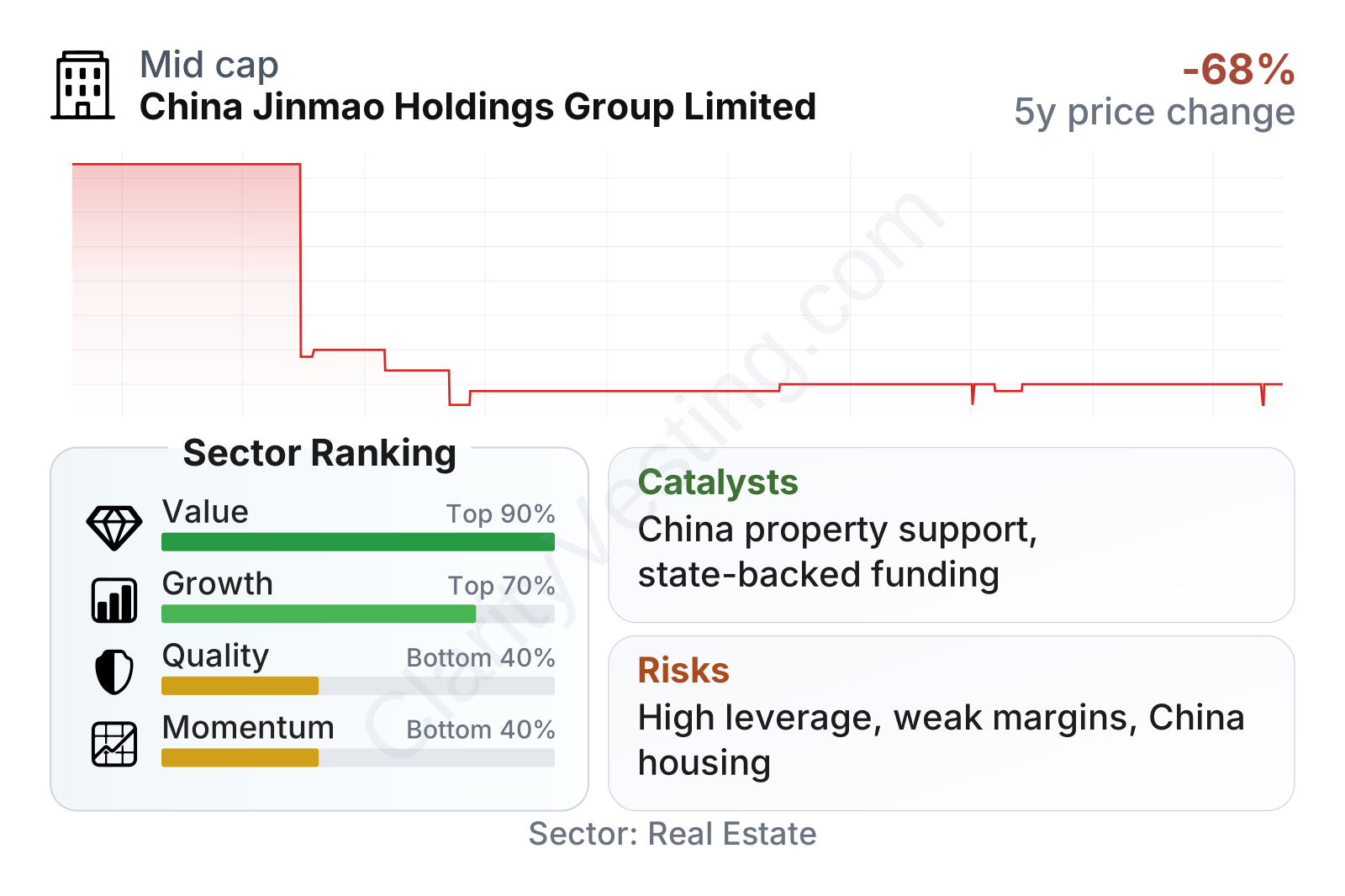
China Jinmao is a mid-sized listed real estate developer by market value, and the share price has been mostly flat at very low levels since late 2022 after a sharp derating. In factor terms, the stock screens as very strong on traditional valuation measures, helped by an extremely low price-to-book ratio, elevated free cash flow yield, and a high trailing dividend yield. Growth metrics are mixed: long-term book value and revenue-per-share trends look strong on paper, but recent year-over-year revenue remains negative and earnings growth has been weak. Quality is the weakest area, with thin profit margins, low asset returns, and leverage ratios that sit above sector medians on several debt measures. Momentum is also not especially strong, even though the shares are trading slightly above their long-term average.
Growth
China Jinmao operates in a sector that has attractive long-term structural importance but difficult near-term economics. Chinese urban housing, urban renewal, and mixed-use development remain enormous markets, yet the real estate development industry is still dealing with slower sales, cautious buyers, and tighter funding conditions than in the peak years. That means the growth question is less about whether housing demand exists at all and more about which developers can survive the shakeout and gain share when conditions normalize.
The company’s strategy is reasonably coherent for that environment. It combines large-scale residential development with city operation projects, premium mixed-use developments, and some recurring-income assets such as hotels and investment properties. That model can work if the company continues shifting toward higher-quality projects in stronger cities while preserving access to funding. Its state-linked background is an important strategic asset because financing access has become one of the biggest dividing lines in Chinese property.
The longer-term revenue-per-share trend has been volatile rather than steady. There was a multi-year decline through 2024, which fits the sector downturn, and then a sharp rebound in the latest period. That kind of jump is not the profile of a stable compounder yet; it is more consistent with a developer whose reported results can move sharply based on project delivery timing, disposals, and accounting recognition.
The dividend pattern tells a similar story. Payouts were cut heavily after 2021, then partially recovered. This suggests management is willing to preserve cash when conditions are difficult, which is financially sensible, but it also means the dividend should be viewed as variable rather than highly predictable.
The clearest catalyst for future growth is policy support in China’s property market. Measures that improve mortgage demand, reduce inventory, support high-quality developers, or ease financing conditions can disproportionately help companies like China Jinmao. Another positive catalyst is industry consolidation: weaker private developers have retreated, and state-backed groups can be better positioned to win projects, complete developments, and gain buyer trust. Recent profitability recovery, along with lower interest expense versus prior years, also points to a more stable operating base than the market may assume.
Risks
This article is for informational purposes only and does not constitute financial advice. Some content is AI-generated. See Disclaimer


