Stock Analysis · China Taiping Insurance Holdings Company Limited (CINSF)
Overview
China Taiping Insurance Holdings Company Limited is a Hong Kong-listed financial group focused on insurance and related services, with operations centered on mainland China, Hong Kong, Macau, Singapore, and selected overseas markets. Its core business is selling life insurance, but it also operates property and casualty insurance, reinsurance, pension management, asset management, and insurance brokerage activities. For a long-term reader, the simplest way to view the company is as a broad insurance platform whose earnings depend on both underwriting results and the returns it earns on the large pool of assets invested from premiums.
Based on recent annual disclosures, the largest revenue and operating contribution comes from life insurance, followed by property and casualty insurance, then reinsurance and other financial services. Exact mixes can shift from year to year because insurance groups report both premium income and investment-related income, but the business model is broadly organized as follows:
- Life insurance: approximately 70% to 80% of insurance service activity. This includes long-term savings products, health protection, annuities, and traditional life policies sold mainly in mainland China and Hong Kong.
- Property and casualty insurance: approximately 15% to 25%. This covers motor, accident, liability, engineering, and other non-life policies.
- Reinsurance, asset management, pension, brokerage, and other services: generally below 10% combined. These activities support the wider insurance platform and add fee income as well as institutional investment capabilities.
The company’s recent financial direction looks stronger than it did a few years ago. Revenue and profit have recovered meaningfully, and the business mix still gives it exposure to one of the largest insurance markets in the world. That said, as with most insurers, reported results can move sharply because investment gains, reserve assumptions, and capital market conditions can materially affect earnings.
The business has shown a clear rebound since 2022, with revenue, operating income, and net income all moving higher into 2024 and 2025. The recent step-up in profit appears much larger than the rise in revenue alone, which suggests improving operating leverage, better investment outcomes, or both.
Key Figures
| Metric | Value | Sector ⓘ |
|---|---|---|
| Date | Nov 21, 2026 | |
| Context | ||
| Sector | Financial Services | |
| Industry | Insurance - Life | |
| Market Cap ⓘ | $11.21B | |
| Beta ⓘ | 1.01 | |
Value (Cheapness) | ||
| P/E Ratio ⓘ | 2.71 | 12.01 |
| P/B Ratio ⓘ | N/A | 1.48 |
| FCF Yield ⓘ | 294.80% | 8.77% |
| Dividend Yield ⓘ | 39.42% | 3.01% |
| EBIT / EV ⓘ | -58.51% | 8.31% |
| PEG ⓘ | N/A | |
Growth (Business expansion) | ||
| Revenue Growth ⓘ | 22.20% | 6.70% |
| RPS Growth (5Y CAGR) ⓘ | 44.83% | 12.35% |
| EPS Growth (5Y CAGR) ⓘ | -27.44% | -0.27% |
| BVPS Growth (5Y CAGR) ⓘ | 38.38% | 4.83% |
| Margin Growth (5Y Trend) ⓘ | 16.50% | -4.16% |
| FCF Growth (5Y CAGR) ⓘ | 12.49% | 4.69% |
| DPS Growth (5Y CAGR) ⓘ | 61.54% | 8.82% |
Quality (Business durability) | ||
| ROIC (Latest) ⓘ | -8.84% | 9.49% |
| ROE (Latest) ⓘ | 84.74% | 14.02% |
| ROA (Latest) ⓘ | 2.17% | 1.53% |
| ROIC (5Y Median) ⓘ | 8.07% | 7.80% |
| ROE (5Y Median) ⓘ | 11.57% | 12.09% |
| ROA (5Y Median) ⓘ | 0.52% | 1.28% |
| Net Debt / EBIT (Latest) ⓘ | N/A | 0.88 |
| Net Debt / EBIT (5Y Median) ⓘ | 3.82 | 0.73 |
| Net Debt / EBITDA (Latest) ⓘ | 1.35 | 0.71 |
| Operating Margin (Latest) ⓘ | -14.72% | 23.37% |
| Operating Margin (5Y Median) ⓘ | 14.53% | 24.29% |
| Debt to Equity (Latest) ⓘ | 179.96% | 59.34% |
| Profit Margin (Latest) ⓘ | 22.71% | 26.65% |
| Free Cash Flow (Latest) ⓘ | $33.06B | |
Momentum (Price trend) | ||
| 3Y Return ⓘ | +109.13% | +73.29% |
| 12M Return (excl. last month) ⓘ | +111.35% | +18.35% |
| 6M Return ⓘ | +97.47% | +3.24% |
| Price vs. 200-Day MA ⓘ | +39.48% | +2.17% |
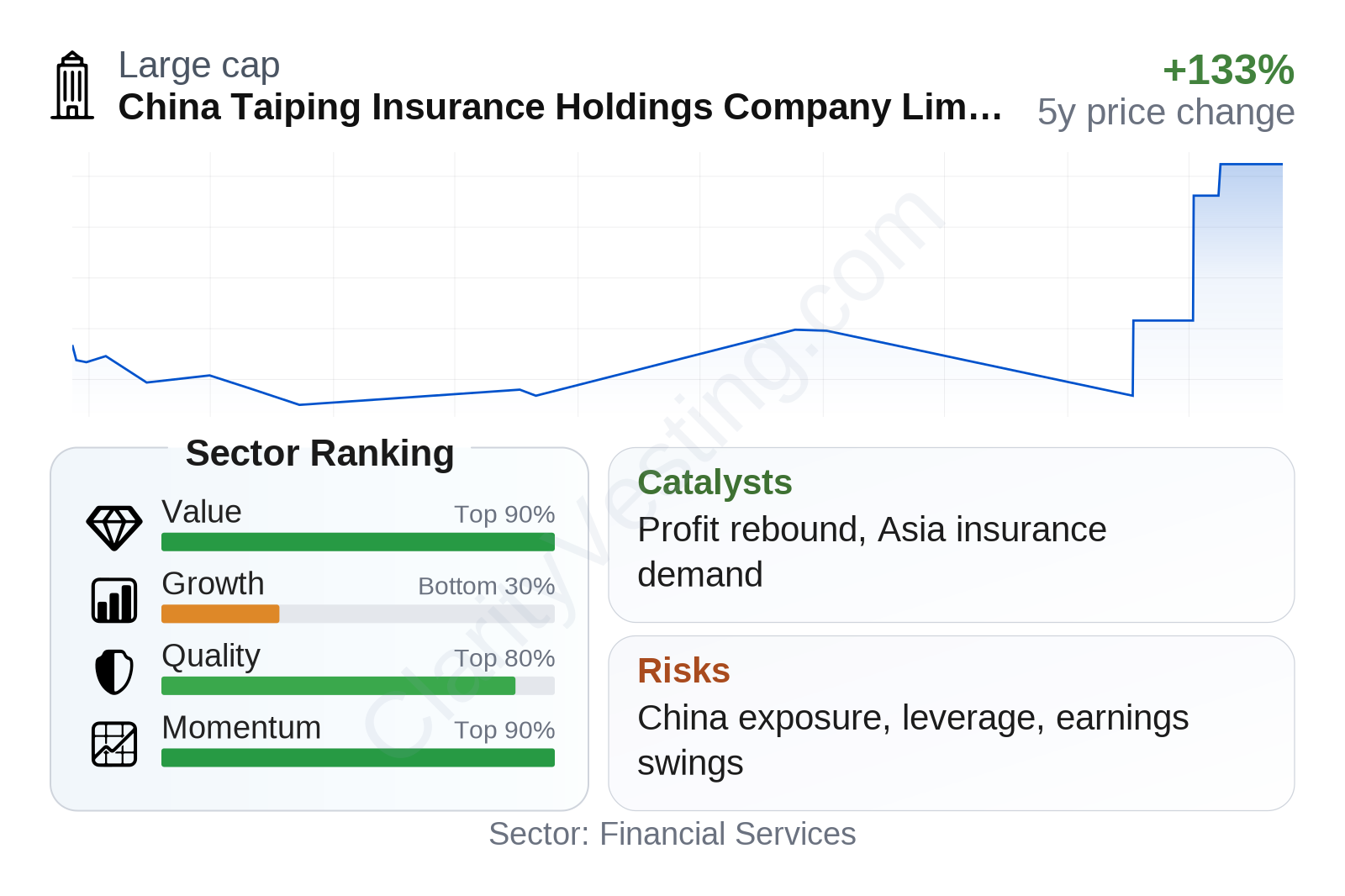
On a factor basis, the company screens as unusually strong on value, quality, and momentum, while its growth profile is less straightforward. The valuation multiples are far below sector norms, especially on earnings and book value, which points either to a market dislocation or to skepticism about how durable current profits and balance-sheet values are. Profitability metrics have improved sharply, and recent share-price performance has also been much stronger than the sector median. At the same time, the growth picture is mixed because revenue and book value have expanded well, but earnings growth over five years remains uneven.
The stock chart reflects that changing market view. The shares were relatively subdued for several years and then re-rated sharply in 2026. Even after that move, the company still trades at a very low price-to-book level compared with peers, which is unusual for a profitable insurer of this size.
Growth
China Taiping operates in a sector that still has structural room to grow over the long run. In China and across parts of Asia, aging populations, rising household wealth, retirement planning needs, and demand for health coverage support long-term insurance demand. These are favorable industry conditions for life insurers that can build distribution, maintain solvency, and earn acceptable returns on invested assets.
The company’s strategy is broadly sensible for that environment. It is not just a single-product insurer: it combines life insurance, general insurance, reinsurance, pension-related services, and asset management. That diversification matters because it can smooth results over time and create cross-selling opportunities. It also gives the group a wider base of investable assets and customer relationships than a narrower insurer would have.
Recent operating trends support the idea that the business has regained momentum. Revenue growth has been ahead of the sector median, book value per share has risen strongly over the multi-year period, and free cash flow generation has also improved. Dividend growth has been robust as well, although insurers’ cash generation should always be interpreted carefully because accounting and regulatory capital are central to the business.
Earnings growth is the main area where the picture is less clean. The five-year EPS trend remains weak overall, even though more recent profits improved substantially. That usually means the company went through a volatile period and is now emerging from it rather than delivering a smooth compounding pattern. For long-term analysis, that distinction matters: recovery is positive, but it is not the same as steady expansion.
Book value is especially important for insurers because it reflects the capital base supporting underwriting and investment activity. The recent jump in book value per share is striking and likely ties to stronger profitability, capital movements, or accounting effects. If that higher book value proves durable, it strengthens the case that the market price is still discounting the franchise heavily.
A meaningful catalyst is the combination of improving profits and a still-depressed valuation. Another is the company’s exposure to retirement, savings, and protection demand in mainland China and Greater China markets. In addition, if interest rates and investment conditions remain supportive for insurers, recurring investment income could continue to help earnings.
Risks
This article is for informational purposes only and does not constitute financial advice. Some content is AI-generated. See Disclaimer