Stock Analysis · China Mengniu Dairy Company Limited (CIADF)
Overview
China Mengniu Dairy Company Limited is one of China’s largest dairy producers. The company sells a broad range of milk and dairy products, including liquid milk, ice cream, milk formula, cheese, yogurt, and other packaged dairy items. Its business is centered on China’s consumer market, where dairy demand is influenced by household income, birth trends, health awareness, convenience, and brand trust.
Mengniu’s revenue mainly comes from packaged dairy products sold under a portfolio of brands. Based on the company’s recent annual disclosures, the business mix is led by liquid milk, with other segments contributing smaller but still meaningful shares.
- Liquid milk: about 80% to 85% of revenue. This includes UHT milk, fresh milk, yogurt drinks, and other everyday milk beverages sold through retail and distribution channels.
- Ice cream: about 5% to 8% of revenue. This covers packaged frozen dairy snacks and desserts, an area where brand recognition and distribution scale matter.
- Milk formula: about 5% to 8% of revenue. This includes infant and adult nutrition products, a category with higher quality requirements and stronger regulation.
- Cheese and other products: about 3% to 6% of revenue. This includes cheese snacks, ingredients, and selected dairy-based products outside the core milk category.
The company’s structure shows a business that is still heavily dependent on mainstream milk consumption, but with efforts to build premium and higher-value categories such as fresh milk, cheese, and nutrition. Over the last several years, revenue expanded through 2023, then weakened in 2024 and 2025, while profits fell much more sharply than sales. That gap matters: it suggests pricing pressure, weaker product mix, or heavier costs rather than a simple volume slowdown.
The business model still produces sizable gross profit, but the recent years show that a large revenue base has not translated into stable bottom-line performance. Gross profit remained substantial even as sales declined, yet operating income and net income became much more volatile, which points to pressure below the gross profit line from expenses, impairments, competition, or mix changes.
Key Figures
| Metric | Value | Sector ⓘ |
|---|---|---|
| Date | Oct 17, 2026 | |
| Context | ||
| Sector | Consumer Defensive | |
| Industry | Packaged Foods | |
| Market Cap ⓘ | $7.80B | |
| Beta ⓘ | 0.31 | |
Value (Cheapness) | ||
| P/E Ratio ⓘ | 28.86 | 17.88 |
| P/B Ratio ⓘ | 0.19 | 1.29 |
| FCF Yield ⓘ | 176.92% | 12.39% |
| Dividend Yield ⓘ | 25.74% | 2.85% |
| EBIT / EV ⓘ | N/A | 6.43% |
| PEG ⓘ | 0.08 | |
Growth (Business expansion) | ||
| Revenue Growth ⓘ | 7.80% | 4.10% |
| RPS Growth (5Y CAGR) ⓘ | -1.99% | 6.18% |
| EPS Growth (5Y CAGR) ⓘ | -12.57% | -13.59% |
| BVPS Growth (5Y CAGR) ⓘ | -1.69% | 3.20% |
| Margin Growth (5Y Trend) ⓘ | -2.38% | -0.15% |
| FCF Growth (5Y CAGR) ⓘ | 47.67% | 4.10% |
| DPS Growth (5Y CAGR) ⓘ | 17.21% | 6.79% |
Quality (Business durability) | ||
| ROIC (Latest) ⓘ | N/A | 12.34% |
| ROA (Latest) ⓘ | 1.49% | 6.30% |
| ROIC (5Y Median) ⓘ | 7.64% | 10.49% |
| ROA (5Y Median) ⓘ | 4.13% | 5.44% |
| Net Debt / EBIT (Latest) ⓘ | 1.78 | 1.96 |
| Net Debt / EBIT (5Y Median) ⓘ | 3.17 | 2.35 |
| Net Debt / EBITDA (Latest) ⓘ | 0.96 | 1.38 |
| Net Debt / Assets ⓘ | 13.16% | 21.51% |
| EBITDA / Interest ⓘ | 5.95 | 9.46 |
| Operating Margin (Latest) ⓘ | 4.42% | 8.87% |
| Operating Margin (5Y Median) ⓘ | 7.50% | 9.53% |
| Debt to Equity (Latest) ⓘ | 75.56% | 72.35% |
| Profit Margin (Latest) ⓘ | 2.19% | 5.40% |
| Free Cash Flow (Latest) ⓘ | $13.80B | |
Momentum (Price trend) | ||
| 3Y Return ⓘ | -29.41% | +20.92% |
| 12M Return (excl. last month) ⓘ | +10.20% | +2.13% |
| 6M Return ⓘ | -4.83% | +1.26% |
| Price vs. 200-Day MA ⓘ | -20.55% | +1.39% |
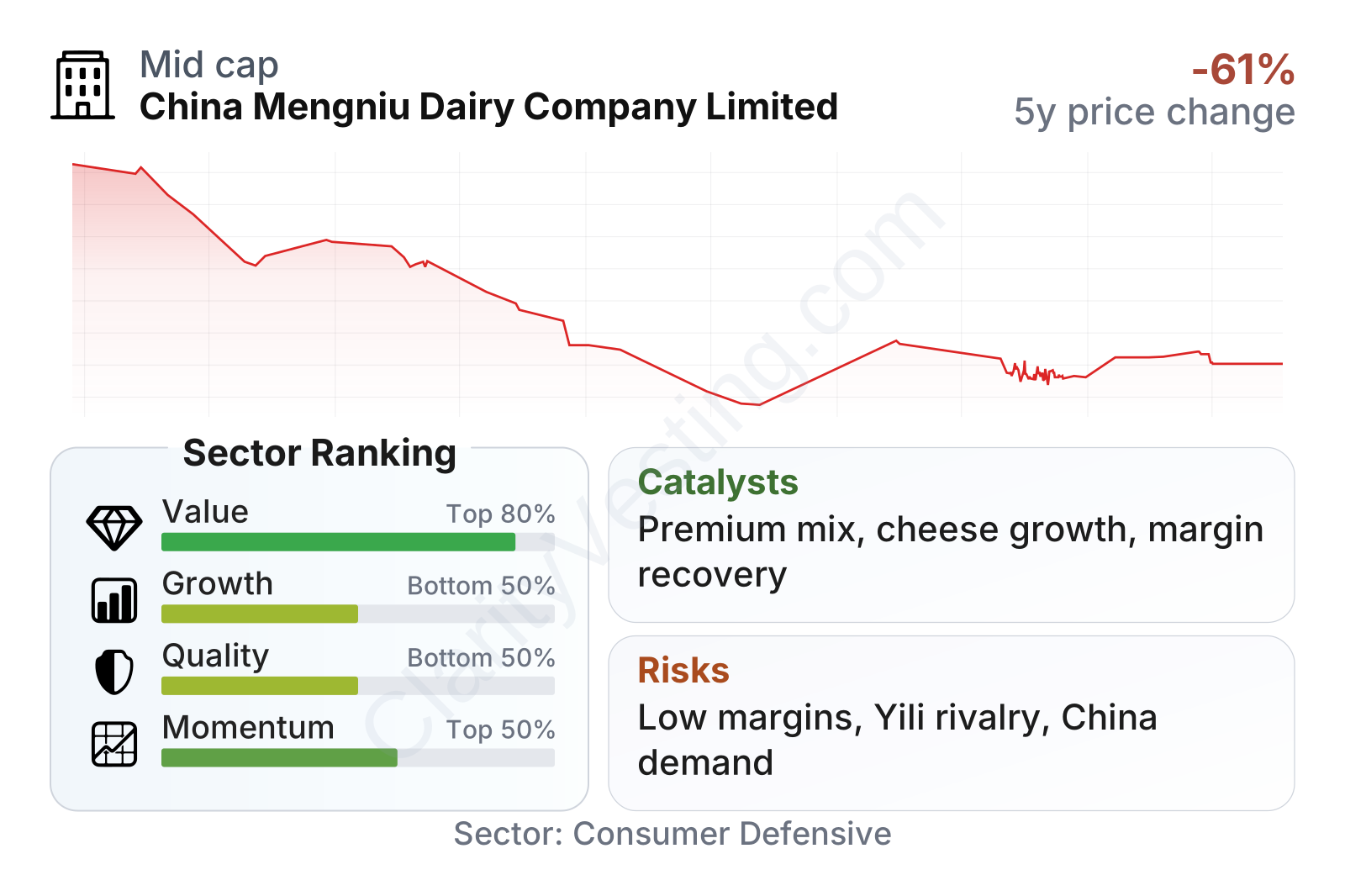
Mengniu is a large consumer staples company with unusually low share-price volatility, reflected in a beta well below 1. On valuation factors, the picture is mixed: the earnings multiple looks higher than the sector median, but price-to-book is far lower and free cash flow yield is notably stronger. Growth and quality rankings sit in the weaker half of the sector, while momentum also remains soft after a multi-year share-price decline. In short, the market appears to be discounting operating weakness even though cash generation and asset-based valuation metrics look more supportive.
Growth
Dairy remains a structurally important food category in China, and over the long run it is still linked to urbanization, cold-chain development, premiumization, and rising interest in protein and nutrition. That said, the sector is no longer a simple high-growth market. It is maturing, and growth now depends more on taking share, moving customers toward premium products, and expanding into categories such as fresh milk, cheese, functional dairy, and adult nutrition.
Mengniu’s strategy broadly fits that environment. The company has emphasized premium products, brand building, product innovation, and category expansion beyond basic shelf-stable milk. It also benefits from nationwide distribution and scale, which can help in product launches and shelf placement. Its participation in premium milk, chilled dairy, cheese, and nutrition gives it more paths to growth than a single-category dairy company.
Recent operating trends, however, call for caution. Short-term revenue growth has at times been better than the sector median, but the longer five-year picture is weaker, with revenue per share and book value per share under pressure. This suggests that while Mengniu can still post periodic rebounds, sustaining consistent long-term expansion has been harder. Free cash flow growth has been much stronger than its long-term sales trend, which may indicate better cash discipline, but it does not fully offset the slower operating profile.
A meaningful catalyst is the company’s ability to improve product mix. If premium milk, fresh dairy, cheese, and nutrition products increase as a share of sales, margins could recover even without rapid top-line growth. Another potential tailwind is continued supply-chain optimization and digital retail execution, especially in a market where efficiency and brand reach can make a visible difference. In addition, any stabilization in China’s consumer spending environment could help large everyday brands such as Mengniu more quickly than niche premium players.
Recent company communications have also highlighted ongoing efforts around brand development, product upgrades, and operational efficiency. Those initiatives are important because the company does not need explosive industry growth to improve results; it mainly needs better execution and healthier profitability within categories where it already has scale.
Risks
This article is for informational purposes only and does not constitute financial advice. Some content is AI-generated. See Disclaimer


