Stock Analysis · CH Robinson Worldwide Inc (CHRW)
Overview
CH Robinson Worldwide is one of the largest third-party logistics companies in North America. In simple terms, it helps shippers move goods without owning most of the trucks, ships, or planes itself. Instead, it acts as a middleman and service provider: it matches customer freight with a wide network of carriers, manages pricing, handles transportation planning, and increasingly uses software and data tools to improve routing, visibility, and execution.
The business is mainly organized around freight brokerage and forwarding. Based on the company’s recent annual reporting structure, revenue is primarily generated from transportation services, with North American truck brokerage still representing the core profit engine, while ocean and air forwarding add international exposure.
Main sources of revenue, from largest to smallest, are approximately:
- North American Surface Transportation: about 65% to 75% of total revenue. This includes truckload, less-than-truckload, intermodal, and other domestic surface transportation services, mostly in the United States and Canada.
- Global Forwarding: about 20% to 30% of total revenue. This segment includes ocean freight forwarding, air freight forwarding, and customs brokerage.
- All Other and managed services: generally less than 10% of total revenue. This includes sourcing, supply chain consulting, managed transportation, and other logistics-related services.
One important point for readers new to the sector: reported revenue for a freight broker is heavily influenced by transportation purchase costs passed through to customers. That means revenue can move sharply even when the underlying business is more stable. Gross profit and operating income often give a better picture of business quality than sales alone.
The multi-year financial flow shows that CH Robinson’s revenue fell sharply after the 2022 freight boom, but operating income and net income have been recovering since the 2023 trough. It also shows the basic reality of this industry: most revenue is paid out to carriers, so efficiency and pricing discipline matter far more than headline sales growth.
Key Figures
| Metric | Value | Sector ⓘ |
|---|---|---|
| Date | Oct 24, 2026 | |
| Context | ||
| Sector | Industrials | |
| Industry | Integrated Freight & Logistics | |
| Market Cap ⓘ | $16.40B | |
| Beta ⓘ | 0.95 | |
Value (Cheapness) | ||
| P/E Ratio ⓘ | 26.83 | 22.29 |
| P/B Ratio ⓘ | 10.37 | 1.98 |
| FCF Yield ⓘ | 4.08% | 6.26% |
| Dividend Yield ⓘ | 1.81% | 1.92% |
| EBIT / EV ⓘ | 4.65% | 4.83% |
| PEG ⓘ | 1.82 | |
Growth (Business expansion) | ||
| Revenue Growth ⓘ | 19.30% | 9.30% |
| RPS Growth (5Y CAGR) ⓘ | -6.20% | 7.76% |
| EPS Growth (5Y CAGR) ⓘ | -22.05% | -13.17% |
| BVPS Growth (5Y CAGR) ⓘ | 0.14% | 6.13% |
| Margin Growth (5Y Trend) ⓘ | 0.16% | 0.74% |
| FCF Growth (5Y CAGR) ⓘ | 147.02% | 10.79% |
| DPS Growth (5Y CAGR) ⓘ | 4.60% | 9.41% |
Quality (Business durability) | ||
| ROIC (Latest) ⓘ | N/A | 10.75% |
| ROA (Latest) ⓘ | 11.44% | 5.41% |
| ROIC (5Y Median) ⓘ | 21.16% | 9.37% |
| ROA (5Y Median) ⓘ | 11.34% | 4.95% |
| Net Debt / EBIT (Latest) ⓘ | 2.02 | 2.04 |
| Net Debt / EBIT (5Y Median) ⓘ | 1.87 | 2.27 |
| Net Debt / EBITDA (Latest) ⓘ | 1.82 | 1.39 |
| Net Debt / Assets ⓘ | 31.11% | 19.27% |
| EBITDA / Interest ⓘ | 6.12 | 9.58 |
| Operating Margin (Latest) ⓘ | 5.29% | 10.49% |
| Operating Margin (5Y Median) ⓘ | 4.68% | 10.30% |
| Debt to Equity (Latest) ⓘ | 121.19% | 64.82% |
| Profit Margin (Latest) ⓘ | 3.73% | 6.67% |
| Free Cash Flow (Latest) ⓘ | $668.76M | |
Momentum (Price trend) | ||
| 3Y Return ⓘ | +76.72% | +67.77% |
| 12M Return (excl. last month) ⓘ | +14.04% | +12.05% |
| 6M Return ⓘ | -22.65% | 0.00% |
| Price vs. 200-Day MA ⓘ | -16.93% | +0.67% |
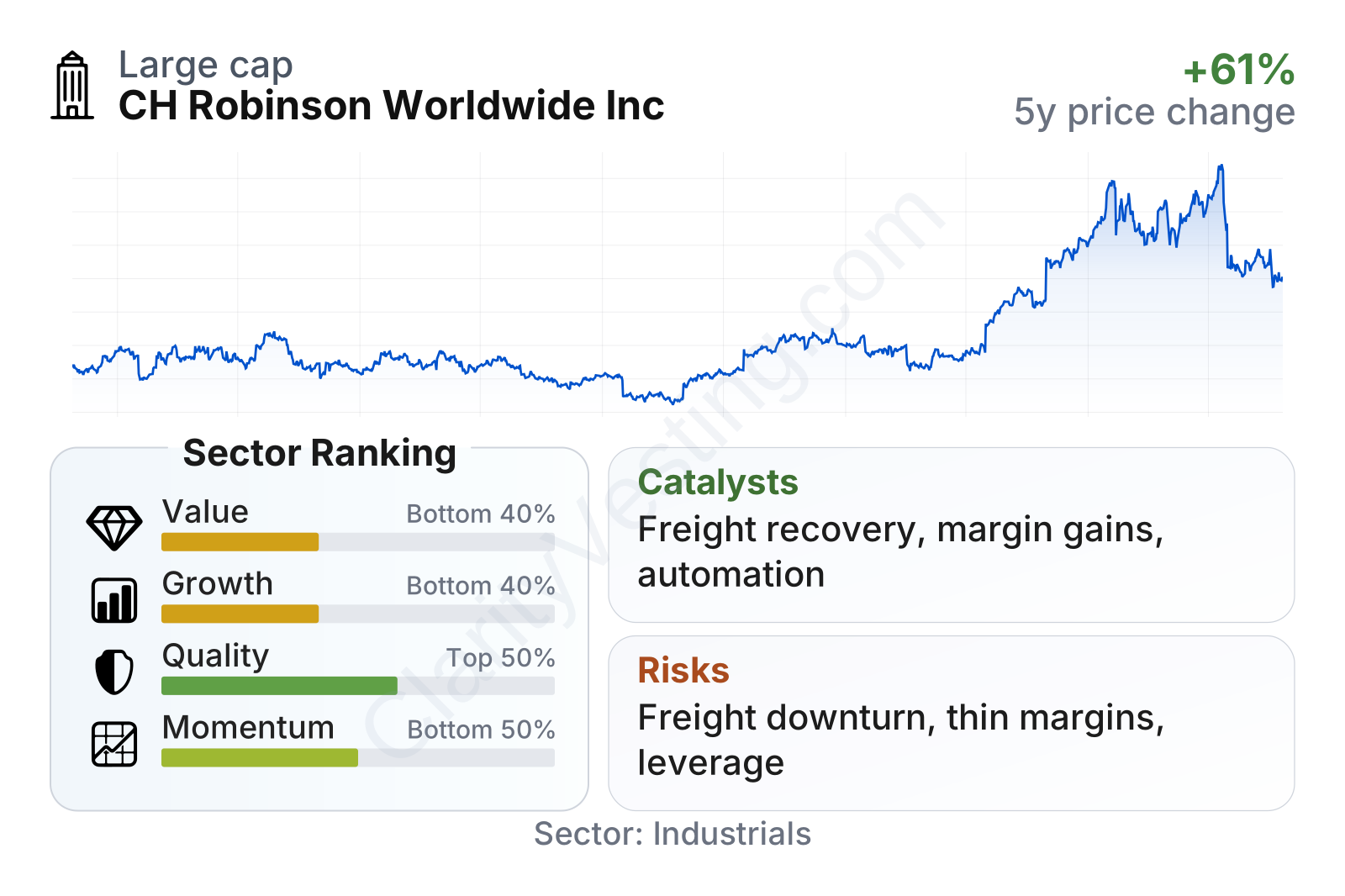
CH Robinson is a large logistics company with a stock that has climbed strongly over the last several years, although the recent period has been more uneven. The current factor picture is mixed. Business quality remains solid versus much of the sector, helped by strong returns on assets and a strong long-term return on invested capital. However, value metrics look less favorable, with earnings and book multiples above sector medians and free cash flow yield below the typical peer level. Growth is also a split picture: recent year-over-year revenue has improved, but the longer five-year record still reflects the post-pandemic freight downturn and weaker earnings base.
Growth
CH Robinson operates in a sector with long-term relevance rather than explosive structural growth. Freight transportation and logistics are essential to the economy, and the market remains highly fragmented. That fragmentation creates room for a scaled broker to win share by connecting shippers with a broad carrier network, offering technology tools, and delivering more reliable service than smaller competitors. In that sense, the sector can support steady consolidation even if end-market demand grows only in line with trade volumes and industrial activity.
The company’s strategy for future growth is sensible. Management has been focusing on productivity, automation, pricing discipline, and deeper use of its technology platform. For a logistics intermediary, this matters because better digital execution can reduce labor intensity, improve shipment matching, and protect margins during soft freight markets. CH Robinson also has one advantage smaller brokers often lack: a very large carrier network and long-standing shipper relationships, which can be valuable when customers want capacity and service consistency across different transportation modes.
Recent revenue trends suggest the business is moving out of a difficult cycle. Sales growth was negative for a prolonged period after the freight market cooled from pandemic highs, but more recent readings show a clear improvement, including a return to positive year-over-year growth in the latest period. That does not automatically mean a straight-line recovery, but it does indicate that comparisons are getting easier and market conditions have become less hostile than they were in 2023 and parts of 2024.
Cash generation has also improved materially from the weaker period. Free cash flow has rebounded from low levels and is now running at a much healthier pace. That is important because CH Robinson’s business does not require massive capital spending, so stronger cash conversion can support debt management, dividends, and operating flexibility even when freight markets remain uneven.
A meaningful catalyst is the possibility of margin normalization if trucking conditions continue to rebalance. In freight brokerage, earnings can improve quickly when pricing discipline, shipment volume, and purchased transportation costs move in the right direction at the same time. Another opportunity comes from international forwarding and managed solutions, where larger customers increasingly want integrated supply chain support rather than only transactional freight matching.
Recent company updates have also pointed to ongoing cost discipline and productivity initiatives. Those efforts are not as dramatic as a new product launch in technology, but in logistics they can materially affect profits because even modest margin improvement on a very large revenue base can have an outsized impact on earnings.
Risks
This article is for informational purposes only and does not constitute financial advice. Some content is AI-generated. See Disclaimer