Stock Analysis · ChronoScale Corporation (CHRN)
Overview
ChronoScale Corporation is a data infrastructure company focused on software for time-series and event data. In simple terms, it helps organizations store, manage, and analyze large streams of information that arrive continuously over time, such as application metrics, financial transactions, industrial sensor readings, and security logs. Its main platform is built around PostgreSQL-compatible technology, which matters because many developers already know PostgreSQL and can adopt ChronoScale’s tools without learning a completely different database system.
The business has historically operated through software subscriptions and related support, with an increasing emphasis on cloud-delivered services. Public company materials describe a strategy centered on making time-series workloads easier and cheaper to run while also broadening into analytics and artificial intelligence-related use cases. That positions the company in a part of enterprise software where customers care about performance, reliability, and the ability to scale as data volumes rise.
Based on the company’s public disclosures, revenue is primarily generated from recurring software and service relationships rather than one-time hardware or consumer sales. Exact percentages are not clearly broken out in the latest public materials available here, but the revenue mix can be framed as follows:
- Cloud and subscription software: the core source of revenue, including hosted database services and subscription access to the company’s platform.
- Support and professional services: a smaller source of revenue tied to implementation, customer assistance, and technical services.
The business remains relatively small in market size compared with major enterprise software vendors, and that can be both an opportunity and a constraint. It leaves room for expansion if execution improves, but it also means results can be volatile while the company invests in product development and customer acquisition.
The operating flow still shows a business under pressure. Revenue declined year over year, but losses narrowed meaningfully, with lower operating expenses, lower interest expense, and a smaller net loss. Cost of revenue remained high enough to keep gross profit negative, which indicates the current model still needs much better scale and cost control before it resembles the margins usually expected from mature software companies.
Key Figures
| Metric | Value | Sector ⓘ |
|---|---|---|
| Date | Oct 31, 2026 | |
| Context | ||
| Sector | Technology | |
| Industry | Information Technology Services | |
| Market Cap ⓘ | $2.54B | |
| Beta ⓘ | 0.98 | |
Value (Cheapness) | ||
| P/E Ratio ⓘ | N/A | 29.73 |
| FCF Yield ⓘ | N/A | 3.96% |
| Dividend Yield ⓘ | N/A | 1.30% |
| EBIT / EV ⓘ | N/A | 2.90% |
| PEG ⓘ | N/A | |
Growth (Business expansion) | ||
| Revenue Growth ⓘ | 148.10% | 15.80% |
| RPS Growth (5Y CAGR) ⓘ | N/A | 8.54% |
| EPS Growth (5Y CAGR) ⓘ | -74.08% | -10.19% |
| Margin Growth (5Y Trend) ⓘ | N/A | 0.45% |
| FCF Growth (5Y CAGR) ⓘ | N/A | 9.80% |
| DPS Growth (5Y CAGR) ⓘ | N/A | 7.67% |
Quality (Business durability) | ||
| ROIC (Latest) ⓘ | N/A | 9.74% |
| ROIC (5Y Median) ⓘ | N/A | 8.31% |
| Net Debt / EBIT (Latest) ⓘ | N/A | 0.53 |
| Net Debt / EBIT (5Y Median) ⓘ | N/A | 0.46 |
| Net Debt / EBITDA (Latest) ⓘ | N/A | 0.29 |
| Net Debt / Assets ⓘ | 32.44% | 3.45% |
| EBITDA / Interest ⓘ | N/A | 13.54 |
| Operating Margin (Latest) ⓘ | N/A | 10.12% |
| Operating Margin (5Y Median) ⓘ | N/A | 8.50% |
| Debt to Equity (Latest) ⓘ | 73.72% | 35.18% |
| Profit Margin (Latest) ⓘ | -84.64% | 7.13% |
| Free Cash Flow (Latest) ⓘ | N/A | |
Momentum (Price trend) | ||
| 3Y Return ⓘ | +45.99% | +61.79% |
| 12M Return (excl. last month) ⓘ | +292.68% | +12.78% |
| 6M Return ⓘ | +53.83% | +7.85% |
| Price vs. 200-Day MA ⓘ | +9.94% | +5.43% |
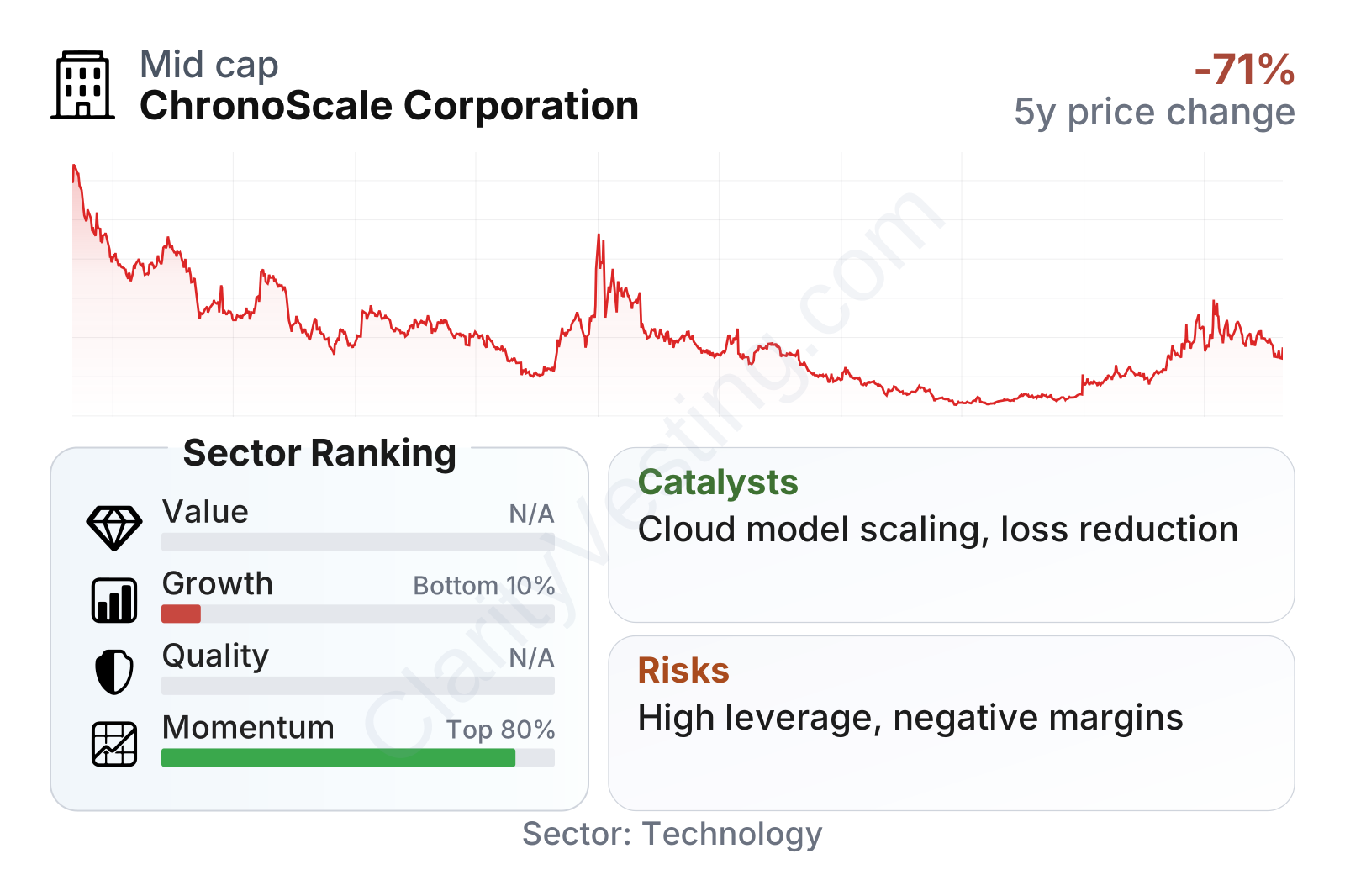
The share price history has been unusually volatile. After a steep decline from 2021 through most of 2025, the stock rebounded sharply in 2026. That recent move shows a clear change in market sentiment, but it also highlights how sensitive the stock has been to expectations around execution and financing.
The metrics table paints a mixed picture. Growth looks distorted in the short term: reported year-over-year revenue growth is exceptionally high versus the sector median, yet the broader growth profile remains weak enough to rank near the bottom of the sector, largely because earnings have deteriorated significantly over five years. Quality is also challenged. Debt levels are elevated relative to the sector, net margins remain deeply negative, and leverage is high for a company that is still unprofitable. Momentum is the strongest area, with recent price performance far ahead of the sector over the last six to twelve months. In short, the market is reacting to improving expectations faster than the underlying fundamentals have fully recovered.
Growth
ChronoScale operates in a sector with attractive long-term demand. Time-series data continues to expand as companies collect more machine, application, observability, and transaction information. That trend is reinforced by cloud adoption, artificial intelligence workloads, and the growing need to process real-time operational data. These are favorable conditions for specialized database platforms, especially those that fit inside existing developer tools and enterprise workflows.
The company’s strategy makes sense on paper. A PostgreSQL-compatible approach lowers adoption friction, and a cloud-based model can make expansion easier if customers increase usage over time. If ChronoScale can win workloads tied to monitoring, analytics, industrial systems, or AI pipelines, it can benefit from recurring revenue and higher customer lifetime value. The key question is not whether the market exists, but whether the company can capture enough of it efficiently.
A meaningful recent positive sign is that losses have narrowed materially over the last year. Operating losses, interest expense, and net losses all improved, which suggests management has been taking costs out of the business and reducing some financial strain. At the same time, the strong stock rebound in 2026 indicates that the market has started to price in a better path than it did during the sharp decline in 2024 and 2025.
The strongest catalyst appears to be a successful transition toward a more scalable cloud software model combined with better cost discipline. If the company can improve gross margin while stabilizing revenue and keeping financing costs under control, the business profile could look substantially better than it did a year ago. The broader industry backdrop remains supportive enough that even modest execution improvements could have an outsized effect on sentiment.
Risks
This article is for informational purposes only and does not constitute financial advice. Some content is AI-generated. See Disclaimer


