Stock Analysis · China Hongqiao Group Limited (CHHQF)
Overview
China Hongqiao Group Limited is one of the world’s largest aluminum producers. The company is based in China and operates across several steps of the aluminum value chain, from alumina to molten aluminum alloy and finished aluminum products. In simple terms, it turns raw materials into metal used in construction, transportation, packaging, machinery, consumer goods, and increasingly in lightweight industrial and energy-related applications.
The business is mainly driven by the sale of aluminum products, with alumina and related materials adding another important layer. Based on the company’s reporting structure in recent annual disclosures, revenue is broadly concentrated in the following areas:
- Aluminum products: approximately 75% to 85% — this is the core business and includes molten aluminum alloy, aluminum alloy ingots, aluminum busbars, and other processed aluminum products.
- Alumina products: approximately 10% to 20% — alumina is an intermediate material used to make primary aluminum and can also be sold externally.
- Other products and services: approximately 1% to 10% — this can include by-products, processing-related items, and other ancillary activities depending on the year.
What makes the company notable is scale. Hongqiao is not a niche producer; it is a very large, low-cost operator in a commodity industry where cost position matters a great deal. That scale can support profitability when aluminum prices are healthy and can help the company remain competitive when markets weaken.
Over the last several years, revenue has moved higher overall, while profitability improved sharply after the weaker 2022 period. The business mix also shows that most of the economic value comes from producing and selling aluminum rather than from a wide set of unrelated activities, which makes the company easier to understand but also more exposed to aluminum market cycles.
The profit flow shows a clear recovery after 2022. Revenue increased from roughly RMB 114 billion in 2021 to more than RMB 162 billion in 2025, while net income rebounded strongly and stayed above RMB 22 billion in 2024 and 2025. That suggests stronger pricing, better cost absorption, or both, even though this remains a cyclical materials business.
Key Figures
| Metric | Value | Sector ⓘ |
|---|---|---|
| Date | Oct 03, 2026 | |
| Context | ||
| Sector | Basic Materials | |
| Industry | Aluminum | |
| Market Cap ⓘ | $27.32B | |
| Beta ⓘ | 0.91 | |
Value (Cheapness) | ||
| P/E Ratio ⓘ | 6.96 | 17.61 |
| P/B Ratio ⓘ | 0.22 | 1.77 |
| FCF Yield ⓘ | 139.71% | 5.87% |
| Dividend Yield ⓘ | 53.30% | 2.06% |
| EBIT / EV ⓘ | N/A | 6.43% |
| PEG ⓘ | N/A | |
Growth (Business expansion) | ||
| Revenue Growth ⓘ | 8.00% | 11.30% |
| RPS Growth (5Y CAGR) ⓘ | 9.59% | 4.46% |
| EPS Growth (5Y CAGR) ⓘ | N/A | -13.11% |
| BVPS Growth (5Y CAGR) ⓘ | 11.50% | 5.51% |
| Margin Growth (5Y Trend) ⓘ | -1.22% | -1.57% |
| FCF Growth (5Y CAGR) ⓘ | 6.08% | 0.55% |
| DPS Growth (5Y CAGR) ⓘ | 11.57% | 6.02% |
Quality (Business durability) | ||
| ROIC (Latest) ⓘ | N/A | 9.31% |
| ROA (Latest) ⓘ | 17.95% | 4.94% |
| ROIC (5Y Median) ⓘ | 13.42% | 7.91% |
| ROA (5Y Median) ⓘ | 8.69% | 3.93% |
| Net Debt / EBIT (Latest) ⓘ | 0.13 | 1.40 |
| Net Debt / EBIT (5Y Median) ⓘ | 0.75 | 1.70 |
| Net Debt / EBITDA (Latest) ⓘ | 0.11 | 0.91 |
| Net Debt / Assets ⓘ | 3.87% | 13.69% |
| EBITDA / Interest ⓘ | 22.48 | 11.93 |
| Operating Margin (Latest) ⓘ | 24.54% | 13.07% |
| Operating Margin (5Y Median) ⓘ | 21.64% | 11.86% |
| Debt to Equity (Latest) ⓘ | 43.74% | 40.43% |
| Profit Margin (Latest) ⓘ | 16.28% | 6.57% |
| Free Cash Flow (Latest) ⓘ | $38.17B | |
Momentum (Price trend) | ||
| 3Y Return ⓘ | +246.25% | +65.06% |
| 12M Return (excl. last month) ⓘ | -2.94% | +36.05% |
| 6M Return ⓘ | -41.24% | +1.89% |
| Price vs. 200-Day MA ⓘ | -25.90% | +1.03% |
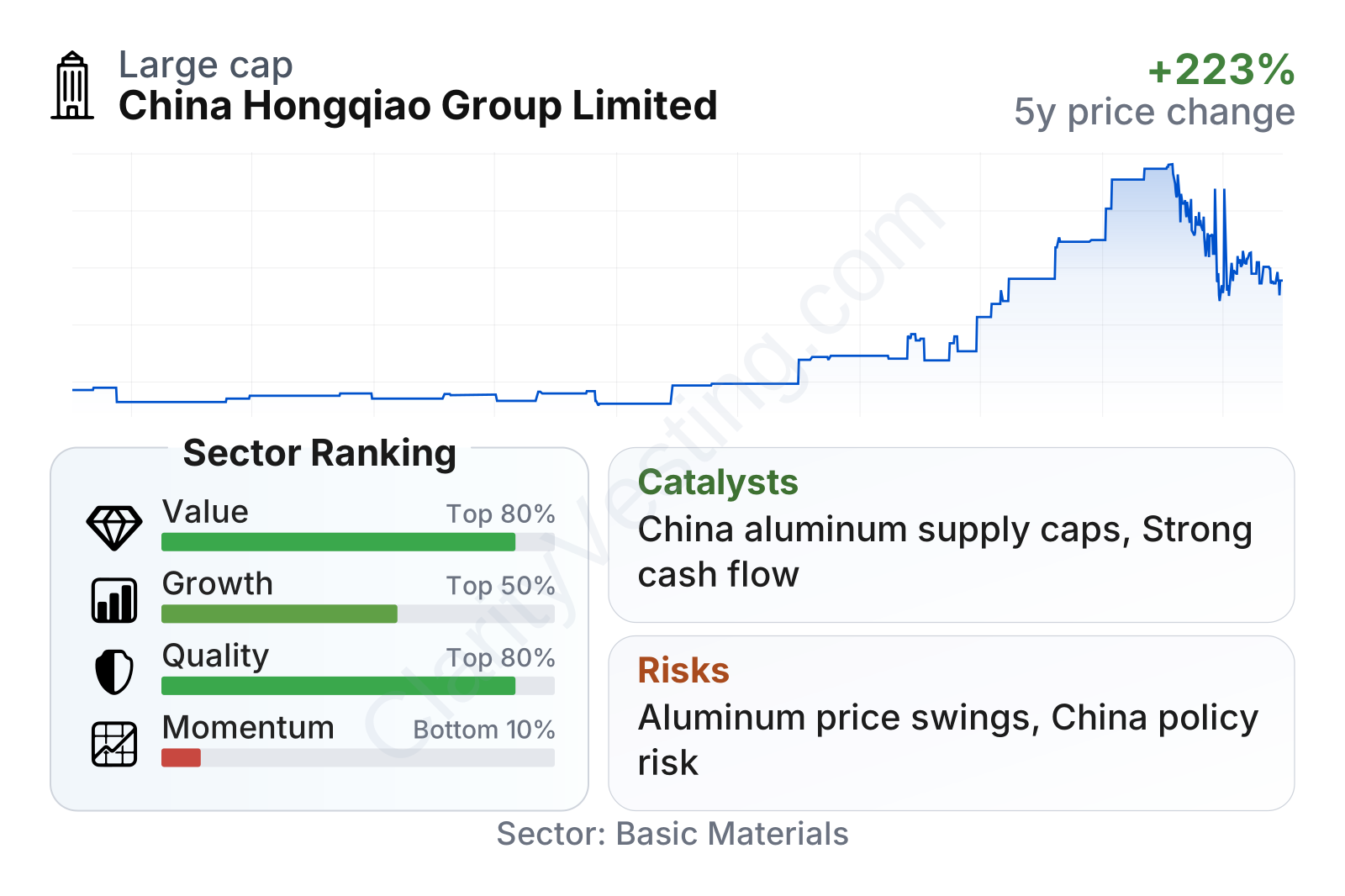
The company currently stands out on valuation and operating quality. Its earnings multiple is well below the sector median, while its price-to-book ratio is far lower than most peers. At the same time, profitability is not weak: operating margin is around the mid-20% range versus a sector median near the low teens, and profit margin is also well above the industry midpoint.
Balance sheet pressure appears limited relative to many commodity producers. Net debt is very low compared with earnings, net debt as a share of assets is modest, and interest coverage is strong. Free cash flow generation is also substantial, which helps explain why the dividend yield is unusually high. On growth, the near-term revenue increase is positive but not exceptional versus the sector, while the five-year record for revenue per share, book value per share, free cash flow, and dividend growth looks stronger than average.
Market performance is more mixed than the fundamentals. The stock has delivered a very strong three-year return, but the shorter-term trend has turned weak, with a sizable decline over the last six months and the share price sitting well below its 200-day average. That combination often signals that the market has become more cautious even though the company’s reported profitability remains strong.
Growth
China Hongqiao operates in a sector that has long-term structural support, even if the path is uneven. Aluminum demand is tied to urbanization, transport, power infrastructure, consumer manufacturing, and the push for lighter materials. It also benefits from electrification trends because aluminum is widely used in power transmission, renewable energy equipment, and electric vehicles. Those themes do not guarantee steady annual growth, but they do create a durable base of demand over time.
The company’s strategy broadly makes sense for that environment. Its integrated model gives it more control over important inputs, and its large production base helps spread fixed costs. In commodity industries, operational efficiency often matters more than branding, and Hongqiao has historically built its position on scale, vertical integration, and cost discipline.
A meaningful catalyst is the tighter supply backdrop in Chinese aluminum. Capacity controls, environmental standards, and energy constraints have made it harder for new production to expand freely. For a large incumbent producer, that can be favorable because disciplined supply can support margins when demand is stable or improving.
Another positive factor is the company’s financial flexibility. With low leverage relative to earnings and strong cash generation, Hongqiao has room to maintain operations, fund upgrades, and continue shareholder distributions without relying heavily on new borrowing. In a capital-intensive industry, that matters.
Recent operating trends also point to a significant opportunity: revenue climbed to a new high in 2025 after a strong 2024, while net income remained elevated rather than collapsing after one unusually good year. That does not remove cyclicality, but it suggests the earnings base may currently be stronger than the market had previously assumed.
Risks
This article is for informational purposes only and does not constitute financial advice. Some content is AI-generated. See Disclaimer


