Stock Analysis · China Foods Ltd (CHFHY)
Overview
China Foods Ltd is a China-based consumer staples company focused mainly on packaged beverages. Its core business is the bottling, distribution, and sale of Coca-Cola products in a number of Chinese territories through franchise arrangements. In practical terms, the company manufactures or packages ready-to-drink soft drinks and sells them through supermarkets, convenience stores, restaurants, and other retail channels.
The business is relatively easy to understand: it earns revenue primarily by selling branded non-alcoholic beverages with very high consumer recognition. That gives it exposure to everyday consumption rather than one-time purchases, which is usually a stabilizing feature in consumer defensive businesses.
Public company materials indicate that the beverage operation is the main economic engine. Based on recent annual disclosures and the structure of the group, revenue is dominated by beverage sales, with smaller contributions from related logistics, packaging, or other support activities where applicable.
- Beverage bottling and distribution: approximately 90% to 95% of revenue. This includes Coca-Cola, Sprite, Fanta, Minute Maid, and other ready-to-drink products sold in franchised territories in China.
- Other activities: approximately 5% to 10% of revenue. This typically includes ancillary operations tied to the beverage platform rather than a separate large business line.
The revenue mix matters because it shows that China Foods is not a diversified conglomerate in practice. It is mostly a focused beverage bottler, so long-term performance depends heavily on volume growth, pricing, distribution efficiency, and its relationship with the Coca-Cola system in China.
The business flow has been fairly steady over the last several years. Revenue has moved gradually higher, gross profit has improved, and operating income has trended upward faster than sales. That suggests execution has been disciplined, with costs and overhead not rising as quickly as the top line.
Key Figures
| Metric | Value | Sector ⓘ |
|---|---|---|
| Date | Oct 17, 2026 | |
| Context | ||
| Sector | Consumer Defensive | |
| Industry | Beverages - Non-Alcoholic | |
| Market Cap ⓘ | $1.30B | |
| Beta ⓘ | 0.55 | |
Value (Cheapness) | ||
| P/E Ratio ⓘ | 9.96 | 17.88 |
| P/B Ratio ⓘ | 0.18 | 1.29 |
| FCF Yield ⓘ | 336.44% | 12.39% |
| Dividend Yield ⓘ | 4.87% | 2.85% |
| EBIT / EV ⓘ | N/A | 6.43% |
| PEG ⓘ | N/A | |
Growth (Business expansion) | ||
| Revenue Growth ⓘ | 4.00% | 4.10% |
| RPS Growth (5Y CAGR) ⓘ | 2.77% | 6.18% |
| EPS Growth (5Y CAGR) ⓘ | N/A | -13.59% |
| BVPS Growth (5Y CAGR) ⓘ | -11.00% | 3.20% |
| Margin Growth (5Y Trend) ⓘ | 2.13% | -0.15% |
| FCF Growth (5Y CAGR) ⓘ | 58.14% | 4.10% |
| DPS Growth (5Y CAGR) ⓘ | 14.48% | 6.79% |
Quality (Business durability) | ||
| ROIC (Latest) ⓘ | N/A | 12.34% |
| ROA (Latest) ⓘ | 9.54% | 6.30% |
| ROIC (5Y Median) ⓘ | 22.13% | 10.49% |
| ROA (5Y Median) ⓘ | 4.79% | 5.44% |
| Net Debt / EBIT (Latest) ⓘ | -1.55 | 1.96 |
| Net Debt / EBIT (5Y Median) ⓘ | -1.27 | 2.35 |
| Net Debt / EBITDA (Latest) ⓘ | -1.05 | 1.38 |
| Net Debt / Assets ⓘ | -30.00% | 21.51% |
| EBITDA / Interest ⓘ | N/A | 9.46 |
| Operating Margin (Latest) ⓘ | 8.43% | 8.87% |
| Operating Margin (5Y Median) ⓘ | 8.15% | 9.53% |
| Debt to Equity (Latest) ⓘ | 0.78% | 72.35% |
| Profit Margin (Latest) ⓘ | 4.02% | 5.40% |
| Free Cash Flow (Latest) ⓘ | $4.36B | |
Momentum (Price trend) | ||
| 3Y Return ⓘ | +53.72% | +20.92% |
| 12M Return (excl. last month) ⓘ | -9.22% | +2.13% |
| 6M Return ⓘ | -9.22% | +1.26% |
| Price vs. 200-Day MA ⓘ | +23.97% | +1.39% |
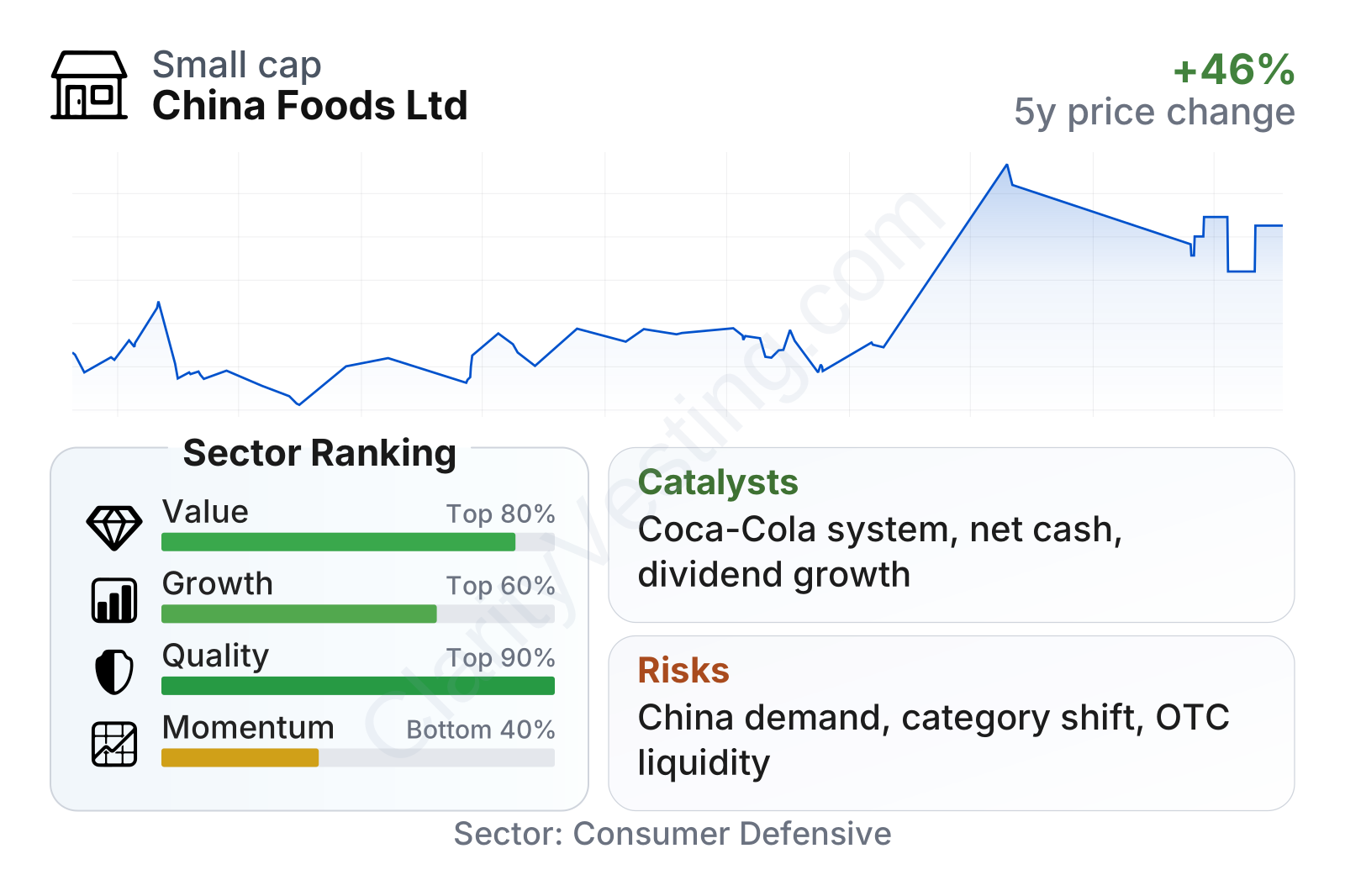
China Foods sits in the smaller end of the public consumer staples universe by market value, and its share price volatility has been relatively low, with a beta around 0.5. That usually means the stock has moved less dramatically than the broader market.
The valuation profile looks notably inexpensive relative to the sector on traditional measures. The earnings multiple is well below the sector median, the price-to-book ratio is extremely low, and the cash generation implied by free cash flow yield stands out positively. The dividend yield is also above the sector median, adding to the picture of a stock that the market is pricing conservatively.
On business quality, the balance sheet is a major strength. Debt is almost negligible relative to equity, and net debt metrics are negative, which points to a net cash position rather than financial strain. Returns on assets are solid, and long-term returns on invested capital appear stronger than many sector peers. Margins are not best-in-class, but they have been stable to improving.
Growth indicators are more mixed. Recent yearly revenue growth is modest but slightly ahead of the sector median, while longer-term revenue per share growth has been slower than many peers. On the other hand, free cash flow and dividends have grown at a much faster pace than the sector median, which suggests that operating discipline and capital allocation have been improving even without rapid headline sales growth.
Market performance has been uneven. The longer three-year record has been good, but the last year and the last six months have been weaker than the sector. That combination often reflects a business that remains fundamentally solid while market sentiment has cooled.
Growth
China Foods operates in the non-alcoholic beverage market, a large and durable category supported by repeat purchases, broad distribution, and brand strength. This is not a fast-changing technology market, but it can still produce steady growth through population density, urban retail penetration, premium products, low-sugar variants, package innovation, and route-to-market improvements.
The company’s strategy makes sense for this kind of sector. As a Coca-Cola bottling partner, it benefits from globally established brands while focusing on local execution. That can be a powerful model in a market as large and operationally complex as China, where scale in manufacturing and delivery matters. Growth does not need to come only from new consumers; it can also come from better mix, wider cold-drink placement, more immediate-consumption channels, and product upgrades.
Recent revenue progression points to a company growing, but at a measured pace rather than a breakout pace. Sales have generally moved upward over the past several years, and operating profit has improved faster than revenue. That is important because it shows that efficiency and mix can still create value even when volume growth is not dramatic.
A meaningful catalyst is the company’s link to Coca-Cola’s product system. New product launches, no-sugar demand, juice and ready-to-drink category expansion, and stronger penetration in convenience and food-service channels can all support future gains. Another favorable point is cash generation: free cash flow has grown strongly over time, giving the company more flexibility for dividends, reinvestment, and balance sheet resilience.
In broader industry terms, health-conscious consumption is both a challenge and an opportunity. Traditional sugary soda faces pressure, but companies with strong brand portfolios can respond through zero-sugar, reduced-sugar, water, juice, tea, and functional beverage offerings. China Foods is better positioned than a smaller local bottler because it operates under brands that already have national recognition and product-development support.
Risks
This article is for informational purposes only and does not constitute financial advice. Some content is AI-generated. See Disclaimer


