Stock Analysis · China Everbright International Ltd (CHFFY)
Overview
China Everbright International Ltd, now widely known through its mainland-listed platform China Everbright Environment Group, operates environmental infrastructure projects in China and selected overseas markets. Its core business is turning waste and wastewater into regulated public-utility services. In practical terms, the company builds and runs waste-to-energy plants, hazardous and solid waste treatment facilities, water treatment systems, and related environmental services. This makes it less dependent on one-time product sales and more tied to long-life assets that can generate recurring operating income.
The business model is a mix of construction income from developing projects, service income from operating them, and utility-like revenue from treatment fees and electricity sales. Based on the company’s recent annual disclosures, revenue has been concentrated in environmental energy first, followed by greentech and environmental water, with a smaller contribution from other environmental services and project-related items.
- Environmental energy: approximately 55% to 65% of revenue. This includes waste-to-energy, biomass power generation, food and kitchen waste treatment, sludge treatment, and related integrated waste management services.
- Greentech: approximately 20% to 30% of revenue. This generally includes equipment, engineering, technology solutions, and environmental protection process services connected to the group’s project base.
- Environmental water: approximately 10% to 20% of revenue. This covers wastewater treatment, reusable water, raw water supply, river-basin restoration, and other water environment projects.
- Other environmental services: a low-single-share contribution relative to the total. This can include hazardous and solid waste treatment, resource recovery, and selected ancillary services depending on project mix in a given year.
The business has changed meaningfully over the last few years. Revenue has moved down from roughly 50 billion in 2021 to below 28 billion in 2025, which suggests the company is shifting away from a more construction-heavy phase toward a more operation-focused base. At the same time, the cost structure has become leaner, and interest expense has started to fall, which matters because this is a capital-intensive business.
The long-term pattern is clear: sales have contracted, but the company still keeps solid operating profitability. That combination usually points to a maturing infrastructure owner rather than a high-growth developer.
Key Figures
| Metric | Value | Sector ⓘ |
|---|---|---|
| Date | Oct 24, 2026 | |
| Context | ||
| Sector | Industrials | |
| Industry | Waste Management | |
| Market Cap ⓘ | $3.98B | |
| Beta ⓘ | 0.61 | |
Value (Cheapness) | ||
| P/E Ratio ⓘ | 7.54 | 22.29 |
| P/B Ratio ⓘ | 0.07 | 1.98 |
| FCF Yield ⓘ | 384.75% | 6.26% |
| Dividend Yield ⓘ | 5.49% | 1.92% |
| EBIT / EV ⓘ | N/A | 4.83% |
| PEG ⓘ | N/A | |
Growth (Business expansion) | ||
| Revenue Growth ⓘ | -0.90% | 9.30% |
| RPS Growth (5Y CAGR) ⓘ | -13.86% | 7.76% |
| EPS Growth (5Y CAGR) ⓘ | 19.90% | -13.17% |
| BVPS Growth (5Y CAGR) ⓘ | -6.20% | 6.13% |
| Margin Growth (5Y Trend) ⓘ | 4.54% | 0.74% |
| FCF Growth (5Y CAGR) ⓘ | N/A | 10.79% |
| DPS Growth (5Y CAGR) ⓘ | -9.00% | 9.41% |
Quality (Business durability) | ||
| ROIC (Latest) ⓘ | N/A | 10.75% |
| ROA (Latest) ⓘ | 4.00% | 5.41% |
| ROIC (5Y Median) ⓘ | 5.32% | 9.37% |
| ROA (5Y Median) ⓘ | 2.33% | 4.95% |
| Net Debt / EBIT (Latest) ⓘ | 5.77 | 2.04 |
| Net Debt / EBIT (5Y Median) ⓘ | 8.11 | 2.27 |
| Net Debt / EBITDA (Latest) ⓘ | 4.47 | 1.39 |
| Net Debt / Assets ⓘ | 44.65% | 19.27% |
| EBITDA / Interest ⓘ | 4.01 | 9.58 |
| Operating Margin (Latest) ⓘ | 27.20% | 10.49% |
| Operating Margin (5Y Median) ⓘ | 29.70% | 10.30% |
| Debt to Equity (Latest) ⓘ | 172.40% | 64.82% |
| Profit Margin (Latest) ⓘ | 15.15% | 6.67% |
| Free Cash Flow (Latest) ⓘ | $15.33B | |
Momentum (Price trend) | ||
| 3Y Return ⓘ | +118.79% | +67.77% |
| 12M Return (excl. last month) ⓘ | +21.13% | +12.05% |
| 6M Return ⓘ | -7.71% | 0.00% |
| Price vs. 200-Day MA ⓘ | +49.85% | +0.67% |
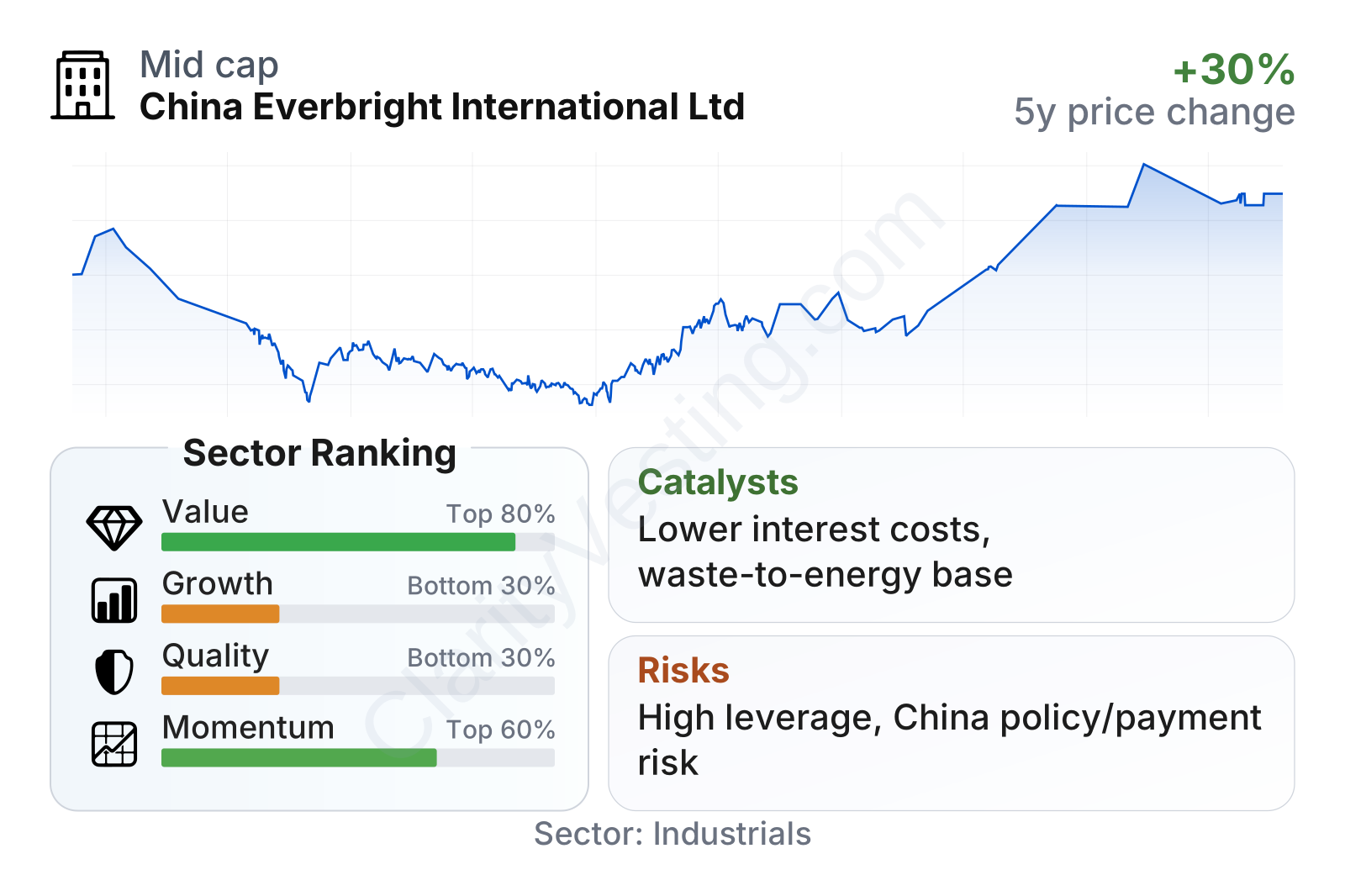
The market profile is that of a mid-sized environmental infrastructure company with relatively low share-price volatility. The most notable strengths in the latest metrics are valuation and profitability: the earnings multiple is well below the sector median, the dividend yield is clearly above it, and operating margin is far stronger than many peers. Free cash flow is also positive, which is important in a business that historically required heavy investment.
The weaker areas are growth and balance-sheet quality. Revenue has been flat to slightly down lately, the five-year revenue trend is negative, and leverage remains elevated. Debt compared with earnings is much higher than the sector median, while interest coverage is noticeably thinner. In short, the numbers describe a company with strong margins and inexpensive valuation, but slower expansion and a balance sheet that still needs attention.
The share-price history also shows this tension. After a prolonged decline through 2023, the stock recovered strongly into 2024 and 2025. That rebound suggests the market has started to recognize improving cash generation and lower financing pressure, although the recent six-month pullback shows that confidence is not yet fully stable.
Growth
The company operates in a sector with durable structural support. Waste treatment, waste-to-energy, water treatment, and pollution control are not optional activities for fast-urbanizing economies. China’s long-term policy direction still favors cleaner waste disposal, energy recovery, circular-economy projects, and tighter environmental standards. That does not guarantee rapid revenue growth every year, but it does create a long runway for operators that already own assets, permits, and technical know-how.
China Everbright’s strategy makes the most sense if viewed as a transition from building projects to harvesting them. Earlier phases of growth were more linked to adding new projects. The current phase appears more focused on operating efficiency, cash collection, reducing financing costs, and extracting more value from an existing asset base. That is less exciting on the surface than aggressive expansion, but it can be healthier if the sector is becoming more disciplined and if local governments are less willing to support rapid project rollouts.
One useful growth catalyst is that waste-to-energy and integrated waste management remain hard-to-replicate public infrastructure. Once a plant is built and connected to a local waste stream, it can benefit from recurring feedstock supply and long operating periods. Another catalyst is lower interest expense. The company’s financing burden has come down from recent peaks, and if that trend continues, more of operating profit can reach net income and free cash flow.
A further opportunity is industry consolidation. Smaller or weaker operators may struggle in a higher-discipline financing environment, while established groups with operating scale can strengthen their positions through selective project wins, technology services, or upgrades to existing plants. For China Everbright, that could mean growth coming less from headline revenue and more from better returns on the assets it already controls.
Risks
This article is for informational purposes only and does not constitute financial advice. Some content is AI-generated. See Disclaimer


