Stock Analysis · CochLear Ltd (CHEOY)
Overview
Cochlear Ltd is an Australian medical device company focused on hearing technology. Its best-known products are cochlear implants, which help people with severe to profound hearing loss. The company also sells bone conduction hearing solutions and provides a large base of sound processors, upgrades, accessories, and clinical support tied to patients already using its systems. This installed base matters because hearing implants are not one-time relationships: patients often return for upgrades, repairs, mapping, and related services over many years.
Revenue is mainly driven by two business lines disclosed by the company in recent annual reporting and investor materials.
- Cochlear implants: approximately 80% to 85% of revenue. This includes implant systems, external sound processors, upgrade sales, and accessories linked to the Nucleus platform.
- Acoustics / bone conduction: approximately 15% to 20% of revenue. This includes bone conduction implant systems and related products, largely under the Osia and Baha families.
Geographically, sales are spread across the Americas, Europe, and Asia-Pacific, which helps reduce dependence on one reimbursement system or one hospital market. Over the last several years, the business expanded revenue from about $1.6 billion to around $2.35 billion, showing that demand has remained structurally solid even though profitability weakened sharply in the most recent fiscal year. The broad financial flow also shows a company that still converts a high share of sales into gross profit, but with noticeably heavier spending on research, selling, and administrative costs recently.
The long-term pattern is favorable on revenue, but the latest year shows clear pressure: sales were roughly flat while operating income and net income dropped much more sharply. That combination suggests the current debate is less about demand disappearing and more about whether margins can recover after a period of cost inflation and elevated operating expenses.
Key Figures
| Metric | Value | Sector ⓘ |
|---|---|---|
| Date | Oct 03, 2026 | |
| Context | ||
| Sector | Healthcare | |
| Industry | Medical Devices | |
| Market Cap ⓘ | $6.25B | |
| Beta ⓘ | 0.27 | |
Value (Cheapness) | ||
| P/E Ratio ⓘ | 59.74 | 24.06 |
| P/B Ratio ⓘ | 3.40 | 3.08 |
| FCF Yield ⓘ | 7.84% | 3.07% |
| Dividend Yield ⓘ | 2.56% | 2.05% |
| EBIT / EV ⓘ | N/A | 0.63% |
| PEG ⓘ | N/A | |
Growth (Business expansion) | ||
| Revenue Growth ⓘ | 0.80% | 7.50% |
| RPS Growth (5Y CAGR) ⓘ | 9.46% | 8.70% |
| EPS Growth (5Y CAGR) ⓘ | -3.88% | -18.20% |
| BVPS Growth (5Y CAGR) ⓘ | 0.89% | 3.95% |
| Margin Growth (5Y Trend) ⓘ | -12.37% | -0.58% |
| FCF Growth (5Y CAGR) ⓘ | -1.89% | 0.88% |
| DPS Growth (5Y CAGR) ⓘ | 9.82% | 6.80% |
Quality (Business durability) | ||
| ROIC (Latest) ⓘ | N/A | 3.29% |
| ROA (Latest) ⓘ | 19.78% | 3.02% |
| ROIC (5Y Median) ⓘ | 16.49% | 4.75% |
| ROA (5Y Median) ⓘ | 11.94% | 1.93% |
| Net Debt / EBIT (Latest) ⓘ | 0.03 | 1.33 |
| Net Debt / EBIT (5Y Median) ⓘ | -0.47 | 1.83 |
| Net Debt / EBITDA (Latest) ⓘ | 0.02 | 0.99 |
| Net Debt / Assets ⓘ | 0.96% | 5.33% |
| EBITDA / Interest ⓘ | 45.58 | 9.63 |
| Operating Margin (Latest) ⓘ | 17.45% | 9.25% |
| Operating Margin (5Y Median) ⓘ | 22.04% | 7.80% |
| Debt to Equity (Latest) ⓘ | 12.22% | 28.99% |
| Profit Margin (Latest) ⓘ | 6.27% | 3.60% |
| Free Cash Flow (Latest) ⓘ | $490.32M | |
Momentum (Price trend) | ||
| 3Y Return ⓘ | -41.36% | +37.48% |
| 12M Return (excl. last month) ⓘ | -50.30% | +20.85% |
| 6M Return ⓘ | -24.90% | +9.73% |
| Price vs. 200-Day MA ⓘ | -18.74% | +4.69% |
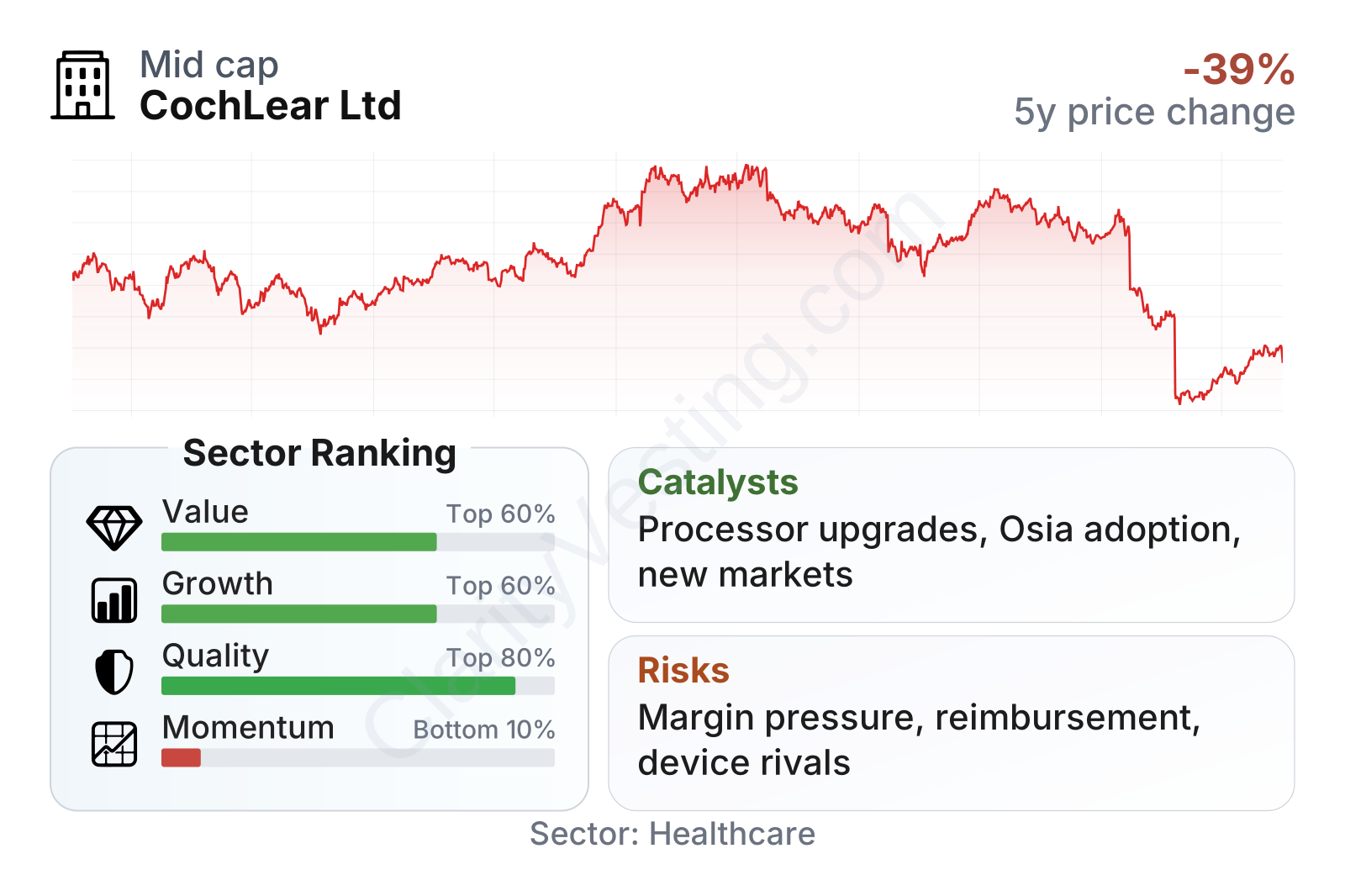
Cochlear looks like a mid-sized medical device company with unusually low share-price volatility for the sector, but the factor profile is mixed. Quality remains strong thanks to high returns on assets, solid operating margins versus peers, and very light leverage. Growth metrics are more uneven: five-year revenue per share trends are respectable, yet recent revenue growth is slow and margin trends have deteriorated. Value signals are contradictory because free cash flow yield is healthy, but the headline earnings multiple is still elevated versus the sector median. Market momentum is clearly weak after a steep price decline.
Growth
Cochlear operates in a sector with attractive long-term fundamentals. Hearing loss rises with aging populations, broader screening improves diagnosis, and implant technology continues to improve outcomes. Penetration is still relatively low in many markets, especially outside the most developed healthcare systems, which leaves room for expansion over time. In simple terms, the underlying need is large, recurring, and not tied to short product cycles in the same way as consumer electronics.
The company’s strategy is logical for that backdrop. It invests heavily in research and development, supports surgeons and audiologists, and keeps expanding a platform that combines implants, processors, software, and patient follow-up. That approach creates stickiness: once a patient enters the ecosystem, future upgrades and accessories can add recurring revenue. It also raises barriers for smaller rivals because success depends not only on device design, but also on clinical training, reimbursement support, regulatory approvals, and long-term reliability data.
Near-term growth, however, looks softer than the long-term demand picture. Recent year-over-year revenue growth is close to flat, which is below the broader healthcare sector median. That slowdown matters because Cochlear has historically been valued as a premium device company. For premium valuations to look durable, the market usually expects either faster sales growth, stronger margin expansion, or both.
Cash generation is a more encouraging part of the picture. Free cash flow has improved from late 2024 into 2025, and the latest trailing figure remains sizable relative to the company’s size. That gives Cochlear financial flexibility to keep funding product development, manufacturing capacity, and shareholder distributions without relying heavily on debt.
A meaningful catalyst is the continued rollout and adoption of newer sound processors and bone conduction systems. New product cycles can stimulate upgrades from the installed base while also helping hospitals and clinics justify new implant procedures. Another opportunity is geographic expansion in underpenetrated markets, where awareness, reimbursement access, and surgeon training can gradually raise procedure volumes. The most important recent development to watch is not a single headline event but whether management can turn stable demand into renewed earnings growth after the latest margin setback.
Risks
This article is for informational purposes only and does not constitute financial advice. Some content is AI-generated. See Disclaimer


