Stock Analysis · Cochlear Limited (CHEOF)
Overview
Cochlear Limited is an Australian medical device company focused on implantable hearing solutions. Its products are used by people with severe to profound hearing loss who do not receive enough benefit from traditional hearing aids. The company’s best-known offering is the cochlear implant system, which includes an implanted device, an external sound processor, and ongoing services and upgrades over many years. It also operates in bone conduction hearing devices and acoustic implants.
For long-term analysis, Cochlear is best understood as a specialized healthcare technology business with recurring elements. A patient may begin with surgery and an implant sale, but revenue can continue afterward through sound processor upgrades, accessories, and support. That combination gives the business both a procedure-driven component and an installed-base component.
Based on the company’s recent annual reporting, revenue is mainly generated from the following areas:
- Cochlear implants: approximately 86% of revenue. This is the core business and includes implant systems, external sound processors, upgrades, and related accessories and services.
- Acoustics: approximately 14% of revenue. This segment mainly includes bone conduction solutions and related hearing technologies.
Within the cochlear implant business, a meaningful share comes from the large global installed base, which supports upgrade sales even when new implant procedures are temporarily weaker. Geographically, Cochlear sells across the Americas, Europe, Asia-Pacific, and other international markets, which helps diversify reimbursement systems and hospital exposure.
Over the last five fiscal years, the company expanded revenue from roughly $1.6 billion to about $2.3 billion, while gross profit also increased. However, the latest year shows that sales were nearly flat while operating profit and net income fell sharply, indicating that cost pressure became much heavier than in prior years.
The long-term pattern shows a business with strong gross margins and consistent investment in research, but the latest year stands out for a much larger selling and administrative cost base. That shift helps explain why profit weakened even though revenue remained above earlier years.
Key Figures
| Metric | Value | Sector ⓘ |
|---|---|---|
| Date | Oct 17, 2026 | |
| Context | ||
| Sector | Healthcare | |
| Industry | Medical Devices | |
| Market Cap ⓘ | $5.91B | |
| Beta ⓘ | 0.24 | |
Value (Cheapness) | ||
| P/E Ratio ⓘ | 59.07 | 24.79 |
| P/B Ratio ⓘ | 3.40 | 3.08 |
| FCF Yield ⓘ | 8.15% | 3.15% |
| Dividend Yield ⓘ | 3.81% | 1.94% |
| EBIT / EV ⓘ | N/A | 0.57% |
| PEG ⓘ | N/A | |
Growth (Business expansion) | ||
| Revenue Growth ⓘ | 0.80% | 7.45% |
| RPS Growth (5Y CAGR) ⓘ | 9.15% | 8.61% |
| EPS Growth (5Y CAGR) ⓘ | -5.12% | -17.81% |
| BVPS Growth (5Y CAGR) ⓘ | 0.86% | 3.72% |
| Margin Growth (5Y Trend) ⓘ | -11.52% | -0.62% |
| FCF Growth (5Y CAGR) ⓘ | 0.59% | 1.04% |
| DPS Growth (5Y CAGR) ⓘ | 9.78% | 6.77% |
Quality (Business durability) | ||
| ROIC (Latest) ⓘ | N/A | 3.24% |
| ROA (Latest) ⓘ | 19.91% | 3.01% |
| ROIC (5Y Median) ⓘ | 17.35% | 4.60% |
| ROA (5Y Median) ⓘ | 11.94% | 1.89% |
| Net Debt / EBIT (Latest) ⓘ | 0.03 | 1.34 |
| Net Debt / EBIT (5Y Median) ⓘ | -0.47 | 1.84 |
| Net Debt / EBITDA (Latest) ⓘ | 0.02 | 1.00 |
| Net Debt / Assets ⓘ | 0.96% | 5.45% |
| EBITDA / Interest ⓘ | 46.19 | 9.64 |
| Operating Margin (Latest) ⓘ | 17.50% | 9.27% |
| Operating Margin (5Y Median) ⓘ | 22.10% | 7.38% |
| Debt to Equity (Latest) ⓘ | 12.22% | 28.58% |
| Profit Margin (Latest) ⓘ | 6.27% | 3.59% |
| Free Cash Flow (Latest) ⓘ | $481.78M | |
Momentum (Price trend) | ||
| 3Y Return ⓘ | -40.70% | +42.80% |
| 12M Return (excl. last month) ⓘ | -50.87% | +18.50% |
| 6M Return ⓘ | -26.29% | +7.57% |
| Price vs. 200-Day MA ⓘ | -34.96% | +5.12% |
Cochlear looks financially solid in balance sheet terms, but mixed in operating momentum. Profitability remains well above many healthcare peers, with operating margins still around the high teens and returns on assets far ahead of sector medians. Debt is low, interest coverage is very strong, and cash generation remains substantial for a company of this size.
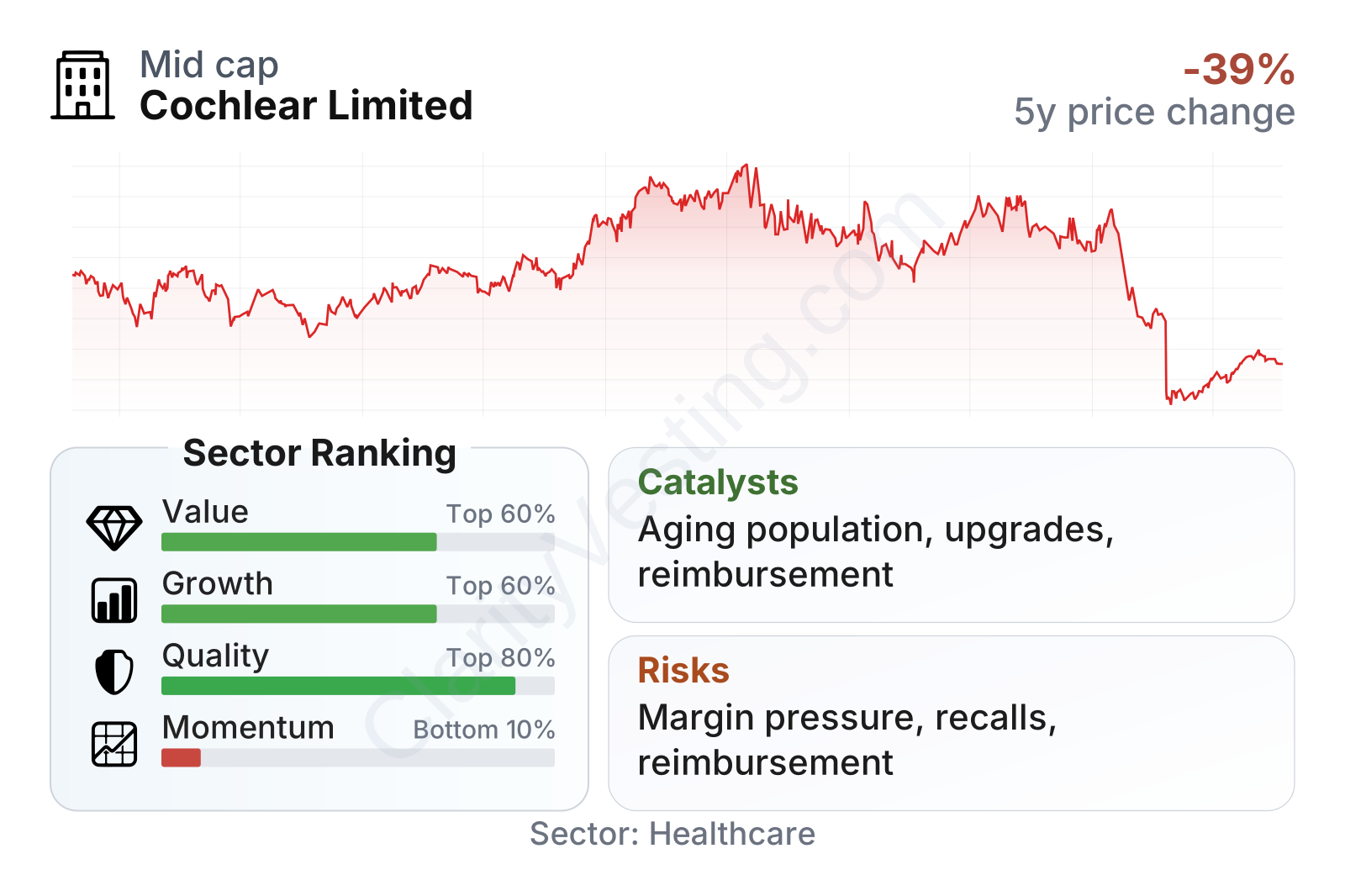
The weaker areas are growth consistency and market performance. Recent revenue growth has slowed to around 1% year over year, and operating margin has moved down versus its own five-year history. The stock has also underperformed sharply over the last three years and especially over the last twelve months, which suggests the market is reacting to a deterioration in earnings quality rather than to balance sheet concerns.
Valuation metrics send a mixed message. The earnings multiple is far above the healthcare sector median, while free cash flow yield and dividend yield look more favorable. In practice, that means the shares do not screen as obviously cheap on profit-based measures, even after a major decline, because current earnings have been pressured and the market still assigns value to the company’s franchise strength.
Growth
Cochlear operates in a sector with attractive long-term drivers. Hearing loss rises with aging populations, and diagnosis rates tend to improve as healthcare systems become better at referral and treatment. Penetration also remains low in many markets, meaning a large number of eligible patients still have not received implantable solutions. That creates a structural growth backdrop that is stronger than many mature device categories.
The company’s strategy broadly fits that opportunity. It continues to invest heavily in research and development, spends on surgeon and clinic support, and builds recurring revenue through upgrades for existing users. In hearing implants, scale matters because clinics value training, reliability, reimbursement support, and long product lifecycles. A company that already has a large installed base can reinforce growth by releasing new processors and improving connectivity, software, and patient outcomes.
A notable catalyst is the company’s product cycle. Cochlear has continued introducing upgraded sound processors and connected hearing solutions, which can stimulate replacement demand from existing users as well as support new patient adoption. Another growth factor is broader reimbursement access over time, especially when more countries or insurers recognize the long-term quality-of-life and communication benefits of implantable hearing devices.
There is also a procedure recovery angle. This business depends partly on hospital capacity, trained surgeons, and referral pipelines. When those normalize after disruptions, new implant growth can improve. For a long-term view, Cochlear’s opportunity is not based on one single breakthrough, but on a combination of demographic demand, underpenetration, technology upgrades, and global market expansion.
Risks
This article is for informational purposes only and does not constitute financial advice. Some content is AI-generated. See Disclaimer


