Stock Analysis · The Chefs Warehouse Inc (CHEF)
Overview
The Chefs’ Warehouse is a specialty food distributor focused mainly on restaurants, hotels, caterers, country clubs, and other foodservice customers. Unlike broadline distributors that compete heavily on scale and standard pantry items, the company is built around higher-end and harder-to-source products. Its positioning is centered on premium ingredients, chef relationships, and service for independent restaurants and hospitality operators that want differentiated menus.
The business generates most of its revenue from selling specialty food products across the United States, the Middle East, and Canada. Based on company disclosures, revenue is organized primarily by product categories rather than by customer contracts or subscriptions. The sales mix changes somewhat over time, but the broad structure is clear:
- Center-of-the-plate products: approximately 45% to 50% of revenue. This includes meat, seafood, and other proteins, which are major ticket items for restaurant customers.
- Specialty products: approximately 35% to 40% of revenue. This category includes imported and domestic cheeses, oils, vinegars, chocolate, pastry ingredients, charcuterie, and other premium pantry items.
- Broadline and produce-related categories: approximately 10% to 15% of revenue. This includes more standard foodservice items and fresh products sold alongside the core specialty offering.
- Equipment and other items: a small share of revenue. These sales support customer relationships but are not the main economic driver.
Geographically, the company remains predominantly U.S.-based, with the United States accounting for the large majority of sales, while Canada and the Middle East add a smaller but growing contribution. The company has expanded through both acquisitions and organic growth, building a network that combines specialty sourcing with regional distribution capabilities.
From a business model perspective, the important point for long-term readers is that The Chefs’ Warehouse is not simply moving boxes of commodity food. It is trying to occupy a more specialized niche where product selection, reliability, and chef relationships can matter more than pure price.
The earnings profile has improved materially since 2021. Revenue has climbed from below $2 billion to above $4 billion over four years, while gross profit and operating income have also expanded. The company is still working with thin margins, but the trend has been toward better scale, stronger profitability, and lower interest burden relative to sales than in earlier periods.
Key Figures
| Metric | Value | Sector ⓘ |
|---|---|---|
| Date | Oct 17, 2026 | |
| Context | ||
| Sector | Consumer Defensive | |
| Industry | Food Distribution | |
| Market Cap ⓘ | $4.48B | |
| Beta ⓘ | 1.44 | |
Value (Cheapness) | ||
| P/E Ratio ⓘ | 50.36 | 17.88 |
| P/B Ratio ⓘ | 7.66 | 1.29 |
| FCF Yield ⓘ | 2.81% | 12.39% |
| Dividend Yield ⓘ | N/A | 2.85% |
| EBIT / EV ⓘ | 3.31% | 6.43% |
| PEG ⓘ | 1.08 | |
Growth (Business expansion) | ||
| Revenue Growth ⓘ | 12.90% | 4.10% |
| RPS Growth (5Y CAGR) ⓘ | 17.36% | 6.18% |
| EPS Growth (5Y CAGR) ⓘ | -6.20% | -13.59% |
| BVPS Growth (5Y CAGR) ⓘ | 8.33% | 3.20% |
| Margin Growth (5Y Trend) ⓘ | 2.88% | -0.15% |
| FCF Growth (5Y CAGR) ⓘ | N/A | 4.10% |
| DPS Growth (5Y CAGR) ⓘ | N/A | 6.79% |
Quality (Business durability) | ||
| ROIC (Latest) ⓘ | 8.90% | 12.34% |
| ROA (Latest) ⓘ | 4.67% | 6.30% |
| ROIC (5Y Median) ⓘ | 6.25% | 10.49% |
| ROA (5Y Median) ⓘ | 2.15% | 5.44% |
| Net Debt / EBIT (Latest) ⓘ | 4.66 | 1.96 |
| Net Debt / EBIT (5Y Median) ⓘ | 7.94 | 2.35 |
| Net Debt / EBITDA (Latest) ⓘ | 3.17 | 1.38 |
| Net Debt / Assets ⓘ | 40.03% | 21.51% |
| EBITDA / Interest ⓘ | 6.33 | 9.46 |
| Operating Margin (Latest) ⓘ | 3.96% | 8.87% |
| Operating Margin (5Y Median) ⓘ | 3.28% | 9.53% |
| Debt to Equity (Latest) ⓘ | 146.03% | 72.35% |
| Profit Margin (Latest) ⓘ | 2.09% | 5.40% |
| Free Cash Flow (Latest) ⓘ | $125.77M | |
Momentum (Price trend) | ||
| 3Y Return ⓘ | +464.35% | +20.92% |
| 12M Return (excl. last month) ⓘ | +66.92% | +2.13% |
| 6M Return ⓘ | +66.73% | +1.26% |
| Price vs. 200-Day MA ⓘ | +28.47% | +1.39% |
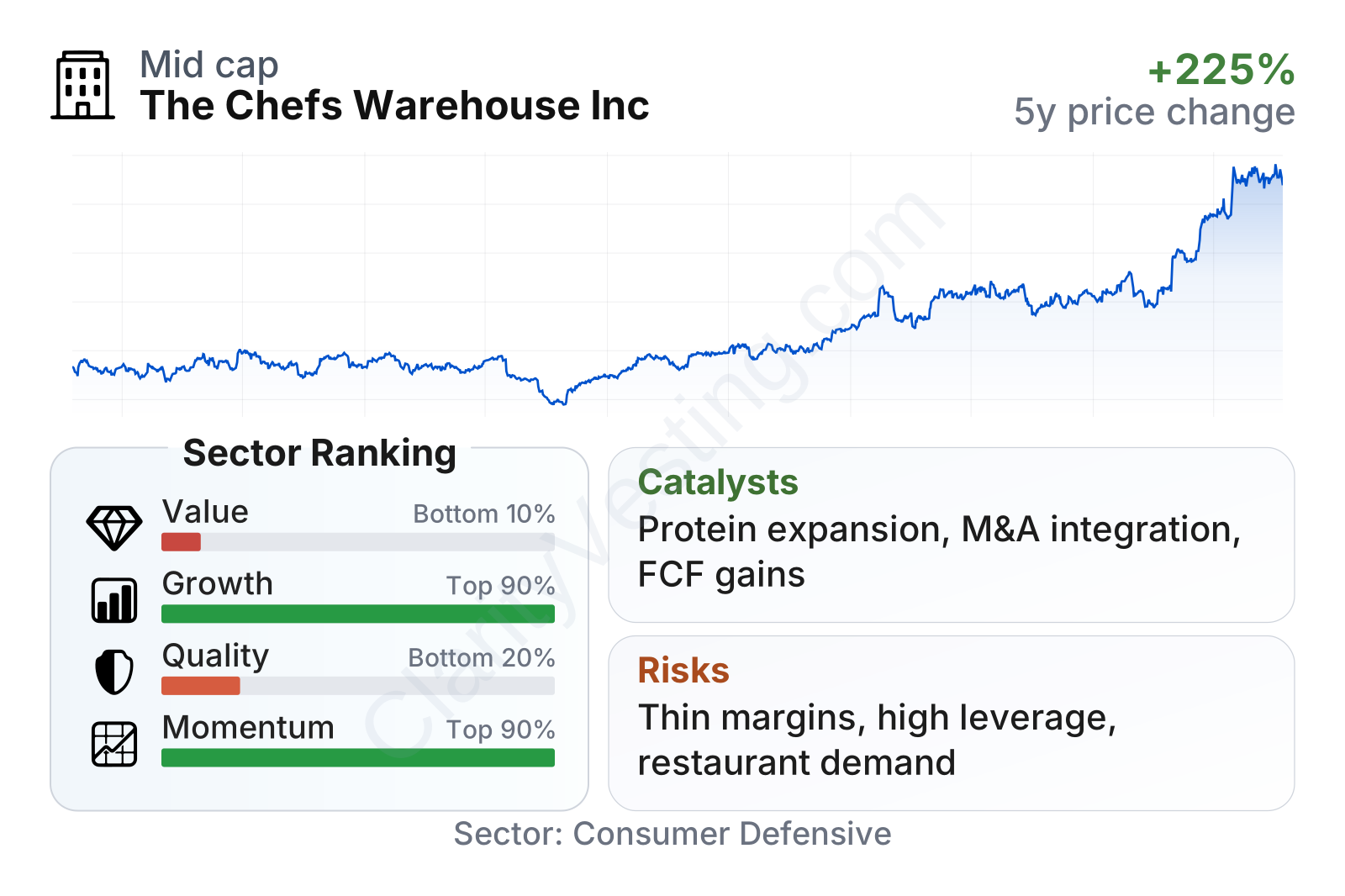
The stock has been exceptionally strong over the last three years, far outperforming the broader consumer defensive universe. On operating trends, revenue growth remains clearly above the sector median, and margin direction has improved over the last five years. The weaker side of the profile is valuation and balance-sheet quality: leverage remains elevated, returns on capital are below sector norms, and the shares trade at a much richer earnings multiple than most peers.
Growth
The company operates in a part of food distribution tied to eating-out demand, premium dining, hospitality traffic, and menu differentiation. That is not as defensive as supermarket staples, but it does sit in a large and still fragmented market. Independent restaurants and upscale hospitality operators often need specialized products and flexible service, which creates room for a focused distributor with strong sourcing and logistics.
The Chefs’ Warehouse’s strategy for future expansion is straightforward and economically logical. It combines three levers: gaining share with existing customers, expanding into adjacent geographies, and adding product categories through acquisitions and cross-selling. Because chefs often prefer to consolidate orders with trusted suppliers, each added category can deepen the customer relationship and increase wallet share without requiring entirely new accounts.
Revenue growth has cooled from the post-pandemic rebound surge, but it has remained healthy rather than collapsing back to industry averages. Most recently, year-over-year growth has been running in the low-teens, still comfortably above the sector median. That suggests the company is no longer relying on recovery effects alone and is still finding ways to expand through mix, pricing, customer additions, and market penetration.
Cash generation is another positive development. Free cash flow moved from negative territory in earlier periods to clearly positive levels, even if it has not advanced in a straight line every quarter. For a distributor, that matters because growth can consume working capital. A business that can grow while also producing meaningful cash has more flexibility to invest, reduce debt, or pursue acquisitions.
A notable catalyst is the company’s ongoing push into center-of-the-plate products, especially proteins and seafood. Those categories are large, recurring, and can strengthen customer dependence on the platform. Another support factor is the continued integration of past acquisitions, which can improve route density, procurement efficiency, and cross-selling. In addition, the premium foodservice niche remains fragmented, so there is still room for consolidation if management continues executing well.
Recent company communications have also emphasized continued demand from hospitality and foodservice customers, as well as operational initiatives designed to improve margins and network efficiency. Those developments matter because even small margin gains can have an outsized effect on earnings in distribution businesses.
Risks
This article is for informational purposes only and does not constitute financial advice. Some content is AI-generated. See Disclaimer


