Stock Analysis · Christian Dior SE (CHDRY)
Overview
Christian Dior SE is a French luxury group whose economic value comes mainly from its controlling stake in LVMH Moët Hennessy Louis Vuitton. In practice, that means an investment in Christian Dior SE is largely an indirect exposure to LVMH’s portfolio of global luxury brands across fashion, leather goods, jewelry, cosmetics, wines and spirits, and selective retail. Christian Dior Couture also exists as a brand inside the broader group structure, but for Christian Dior SE shareholders, the biggest driver is the performance of LVMH.
The business is tied to premium products sold at high price points, strong brand positioning, and global distribution. Luxury companies generally rely on pricing power, brand desirability, and scarcity rather than volume alone. That model has historically supported high margins, but it also makes demand sensitive to shifts in consumer confidence, tourism flows, and Chinese spending.
Based on LVMH’s latest annual reporting, the main revenue sources are approximately:
- Fashion & Leather Goods: about 49% — includes brands such as Louis Vuitton, Dior, Fendi, Celine, Loewe, and others. This is the core profit engine of the group.
- Selective Retailing: about 21% — mainly Sephora and travel retail activities.
- Watches & Jewelry: about 13% — includes Tiffany, Bulgari, TAG Heuer, and other jewelry and watch maisons.
- Perfumes & Cosmetics: about 10% — fragrances, skincare, and beauty products sold under several luxury brands.
- Wines & Spirits: about 7% — champagne, cognac, and other premium alcoholic beverages.
Geographically, the group is broadly diversified, with Asia excluding Japan, the United States, Europe, and Japan all representing meaningful demand centers. That diversification helps reduce dependence on one single market, although China remains particularly important for luxury demand globally.
The multi-year financial flow shows a strong expansion from 2021 to 2023, followed by a visible slowdown in 2024 and a sharper drop in 2025. Revenue, operating income, and net income all moved lower after the post-pandemic peak, which fits the broader luxury sector cooldown. Even so, gross profitability remains very large in absolute terms, highlighting the resilience of the brand portfolio.
Key Figures
| Metric | Value | Sector ⓘ |
|---|---|---|
| Date | Nov 14, 2026 | |
| Context | ||
| Sector | Consumer Cyclical | |
| Industry | Luxury Goods | |
| Market Cap ⓘ | $91.57B | |
| Beta ⓘ | 0.83 | |
Value (Cheapness) | ||
| P/E Ratio ⓘ | 17.24 | 17.68 |
| P/B Ratio ⓘ | N/A | 2.77 |
| FCF Yield ⓘ | 35.56% | 7.36% |
| Dividend Yield ⓘ | 3.29% | 2.55% |
| EBIT / EV ⓘ | 31.34% | 7.05% |
| PEG ⓘ | N/A | |
Growth (Business expansion) | ||
| Revenue Growth ⓘ | -2.90% | 5.20% |
| RPS Growth (5Y CAGR) ⓘ | 4.85% | 8.97% |
| EPS Growth (5Y CAGR) ⓘ | -3.65% | -12.17% |
| BVPS Growth (5Y CAGR) ⓘ | N/A | 5.63% |
| Margin Growth (5Y Trend) ⓘ | -5.45% | -0.17% |
| FCF Growth (5Y CAGR) ⓘ | -2.77% | 5.89% |
| DPS Growth (5Y CAGR) ⓘ | 13.60% | 10.17% |
Quality (Business durability) | ||
| ROIC (Latest) ⓘ | 38.66% | 11.44% |
| ROA (Latest) ⓘ | 6.41% | 5.57% |
| ROIC (5Y Median) ⓘ | 32.66% | 10.52% |
| ROA (5Y Median) ⓘ | 4.33% | 5.37% |
| Net Debt / EBIT (Latest) ⓘ | 0.91 | 2.06 |
| Net Debt / EBIT (5Y Median) ⓘ | 1.59 | 2.24 |
| Net Debt / EBITDA (Latest) ⓘ | 0.60 | 1.45 |
| Net Debt / Assets ⓘ | 21.49% | 21.26% |
| EBITDA / Interest ⓘ | 22.30 | 9.63 |
| Operating Margin (Latest) ⓘ | 20.20% | 9.14% |
| Operating Margin (5Y Median) ⓘ | 25.81% | 9.64% |
| Debt to Equity (Latest) ⓘ | 147.24% | 73.06% |
| Profit Margin (Latest) ⓘ | 5.72% | 5.35% |
| Free Cash Flow (Latest) ⓘ | $32.56B | |
Momentum (Price trend) | ||
| 3Y Return ⓘ | -23.42% | +20.92% |
| 12M Return (excl. last month) ⓘ | -19.28% | 0.00% |
| 6M Return ⓘ | +6.14% | +1.89% |
| Price vs. 200-Day MA ⓘ | -2.46% | +1.11% |
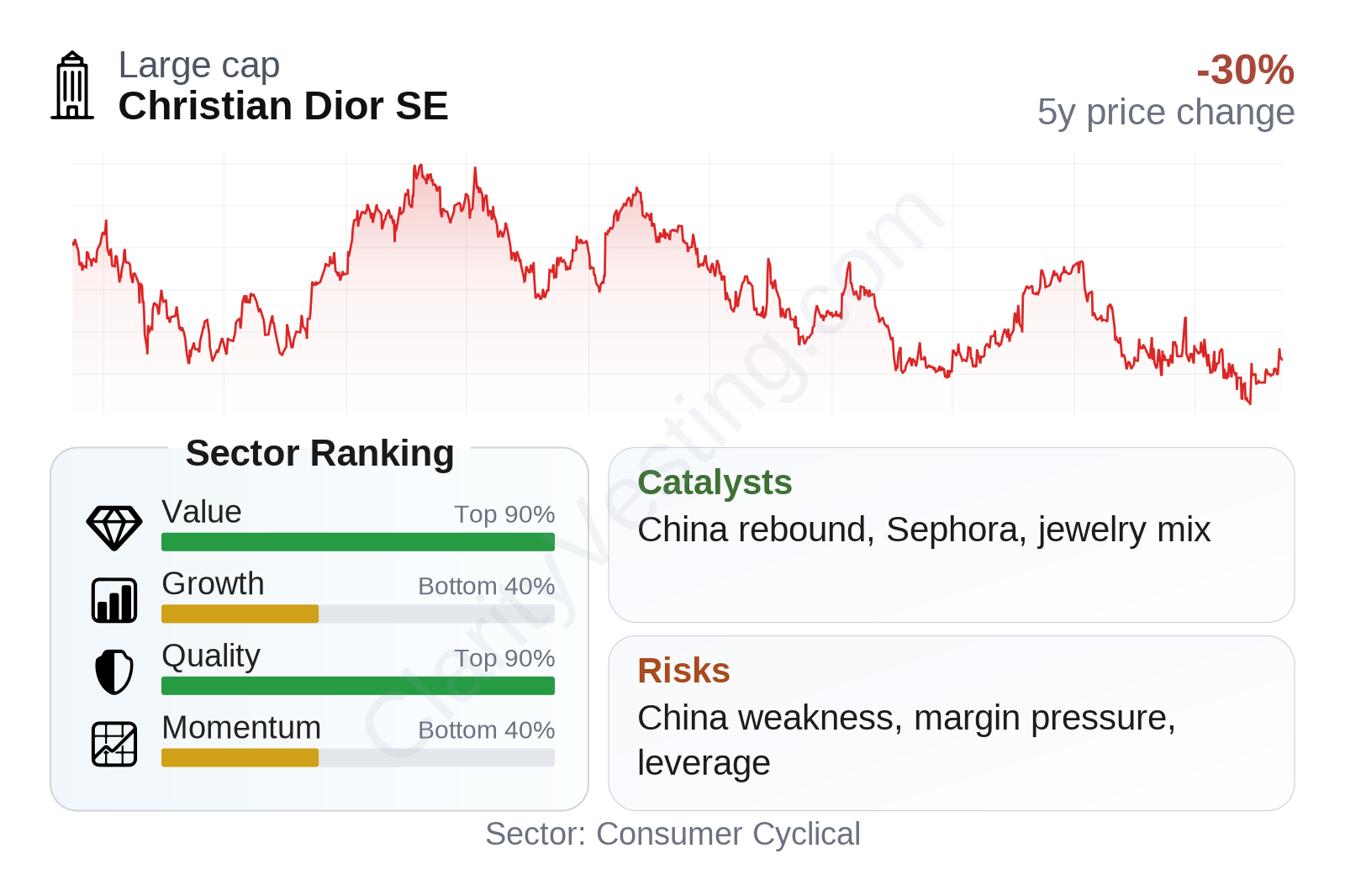
Christian Dior SE remains a very large company with relatively low share-price volatility for a consumer discretionary stock, as suggested by a beta below 1. The overall profile is mixed: quality metrics are strong, value metrics are not stretched compared with the sector, but growth and market momentum have recently been weaker. Profitability and cash generation still stand out, while the stock’s recent trading history reflects the sector’s loss of momentum since its 2023 high.
Growth
The company operates in the global luxury goods industry, which remains attractive over the long run because it benefits from rising wealth, premiumization, and brand-driven consumer behavior. Over multi-year periods, luxury has often grown faster than many other consumer categories because the strongest brands can raise prices, expand product lines, and increase penetration in beauty, jewelry, and accessories.
Christian Dior SE’s long-term growth case is therefore linked to LVMH’s strategy: owning top-tier brands, controlling distribution, investing heavily in marketing and store experience, and expanding across categories. That strategy still makes industrial sense. The group is not dependent on a single label, and it can allocate capital across brands and geographies more effectively than smaller rivals.
Near term, however, growth has softened. Recent annual figures show revenue slightly down year over year, while the five-year pace of revenue per share growth is below the sector median. That does not erase the long-term structural appeal of luxury, but it does show that the company is moving through a weaker part of the cycle.
One important catalyst is the eventual normalization of demand in China and travel retail. Luxury spending has been under pressure from cautious consumers and uneven macro conditions, but a recovery in high-end consumption could have an outsized impact on a group with this scale and brand strength. Another catalyst is category mix: jewelry, beauty, and selective retail can complement the core fashion business and broaden growth beyond handbags and apparel.
There is also a strategic advantage in size. Large-scale luxury groups can secure premium store locations, invest in craftsmanship and digital tools, and support brand desirability over long periods. If the sector reaccelerates, Christian Dior SE is positioned to benefit through its exposure to one of the broadest and most prestigious portfolios in luxury.
Risks
This article is for informational purposes only and does not constitute financial advice. Some content is AI-generated. See Disclaimer