Stock Analysis · Church & Dwight Company Inc (CHD)
Overview
Church & Dwight is a consumer products company focused on household, personal care, and health-related items. It sells everyday products that consumers tend to purchase repeatedly, which gives the business a relatively steady demand profile compared with more cyclical industries. The company is best known for the ARM & HAMMER brand, but its portfolio also includes well-known names such as OxiClean, Waterpik, Trojan, Batiste, Nair, Vitafusion, Hero, TheraBreath, and XTRA.
Its business model is straightforward: build and advertise brands, place them broadly across retail and e-commerce channels, and use a mix of internal innovation and acquisitions to add new growth platforms. A large part of its appeal comes from categories where brand recognition matters and replacement purchases are frequent.
Based on recent company reporting, revenue is primarily split between consumer products sold in the United States, consumer products sold internationally, and a smaller specialty products segment. The mix can be summarized approximately as follows:
- U.S. Consumer Domestic: about 79% of revenue. This includes household cleaning, laundry, cat litter, oral care, vitamins and supplements, hair care, sexual wellness, and personal care products sold in the U.S.
- Consumer International: about 16% of revenue. This covers many of the same branded products sold outside the U.S., including in Canada, Europe, Asia-Pacific, Mexico, and other markets.
- Specialty Products Division: about 5% of revenue. This segment serves industrial customers with products such as animal nutrition ingredients and specialty chemicals, including sodium bicarbonate-related applications.
Within the consumer portfolio, management has historically emphasized a group of “power brands,” which account for the large majority of sales. That concentration helps focus marketing and shelf space, but it also means the company relies heavily on a limited number of category leaders to keep growing.
The long-term picture shows a business that has expanded revenue steadily over the last several years, while profitability has moved around more noticeably. Sales have climbed from a little above $5.1 billion in 2021 to just over $6.2 billion in 2025, but earnings and operating income were hit by cost pressure in 2022 and again softened in 2024 before recovering. That pattern fits the profile of a consumer staples company with resilient demand but margins that can still be affected by commodity costs, integration expenses, and marketing investment.
Key Figures
| Metric | Value | Sector ⓘ |
|---|---|---|
| Date | Oct 17, 2026 | |
| Context | ||
| Sector | Consumer Defensive | |
| Industry | Household & Personal Products | |
| Market Cap ⓘ | $23.69B | |
| Beta ⓘ | 0.48 | |
Value (Cheapness) | ||
| P/E Ratio ⓘ | 32.01 | 17.88 |
| P/B Ratio ⓘ | 5.49 | 1.29 |
| FCF Yield ⓘ | 4.71% | 12.39% |
| Dividend Yield ⓘ | 1.23% | 2.85% |
| EBIT / EV ⓘ | 4.14% | 6.43% |
| PEG ⓘ | 2.67 | |
Growth (Business expansion) | ||
| Revenue Growth ⓘ | 1.60% | 4.10% |
| RPS Growth (5Y CAGR) ⓘ | 5.12% | 6.18% |
| EPS Growth (5Y CAGR) ⓘ | -11.99% | -13.59% |
| BVPS Growth (5Y CAGR) ⓘ | 6.05% | 3.20% |
| Margin Growth (5Y Trend) ⓘ | -3.97% | -0.15% |
| FCF Growth (5Y CAGR) ⓘ | 5.72% | 4.10% |
| DPS Growth (5Y CAGR) ⓘ | 4.35% | 6.79% |
Quality (Business durability) | ||
| ROIC (Latest) ⓘ | N/A | 12.34% |
| ROA (Latest) ⓘ | 8.16% | 6.30% |
| ROIC (5Y Median) ⓘ | 18.49% | 10.49% |
| ROA (5Y Median) ⓘ | 8.28% | 5.44% |
| Net Debt / EBIT (Latest) ⓘ | 2.12 | 1.96 |
| Net Debt / EBIT (5Y Median) ⓘ | 2.14 | 2.35 |
| Net Debt / EBITDA (Latest) ⓘ | 1.71 | 1.38 |
| Net Debt / Assets ⓘ | 23.87% | 21.51% |
| EBITDA / Interest ⓘ | N/A | 9.46 |
| Operating Margin (Latest) ⓘ | 16.46% | 8.87% |
| Operating Margin (5Y Median) ⓘ | 16.96% | 9.53% |
| Debt to Equity (Latest) ⓘ | 55.85% | 72.35% |
| Profit Margin (Latest) ⓘ | 11.96% | 5.40% |
| Free Cash Flow (Latest) ⓘ | $1.12B | |
Momentum (Price trend) | ||
| 3Y Return ⓘ | +18.36% | +20.92% |
| 12M Return (excl. last month) ⓘ | +2.61% | +2.13% |
| 6M Return ⓘ | +6.03% | +1.26% |
| Price vs. 200-Day MA ⓘ | +4.28% | +1.39% |
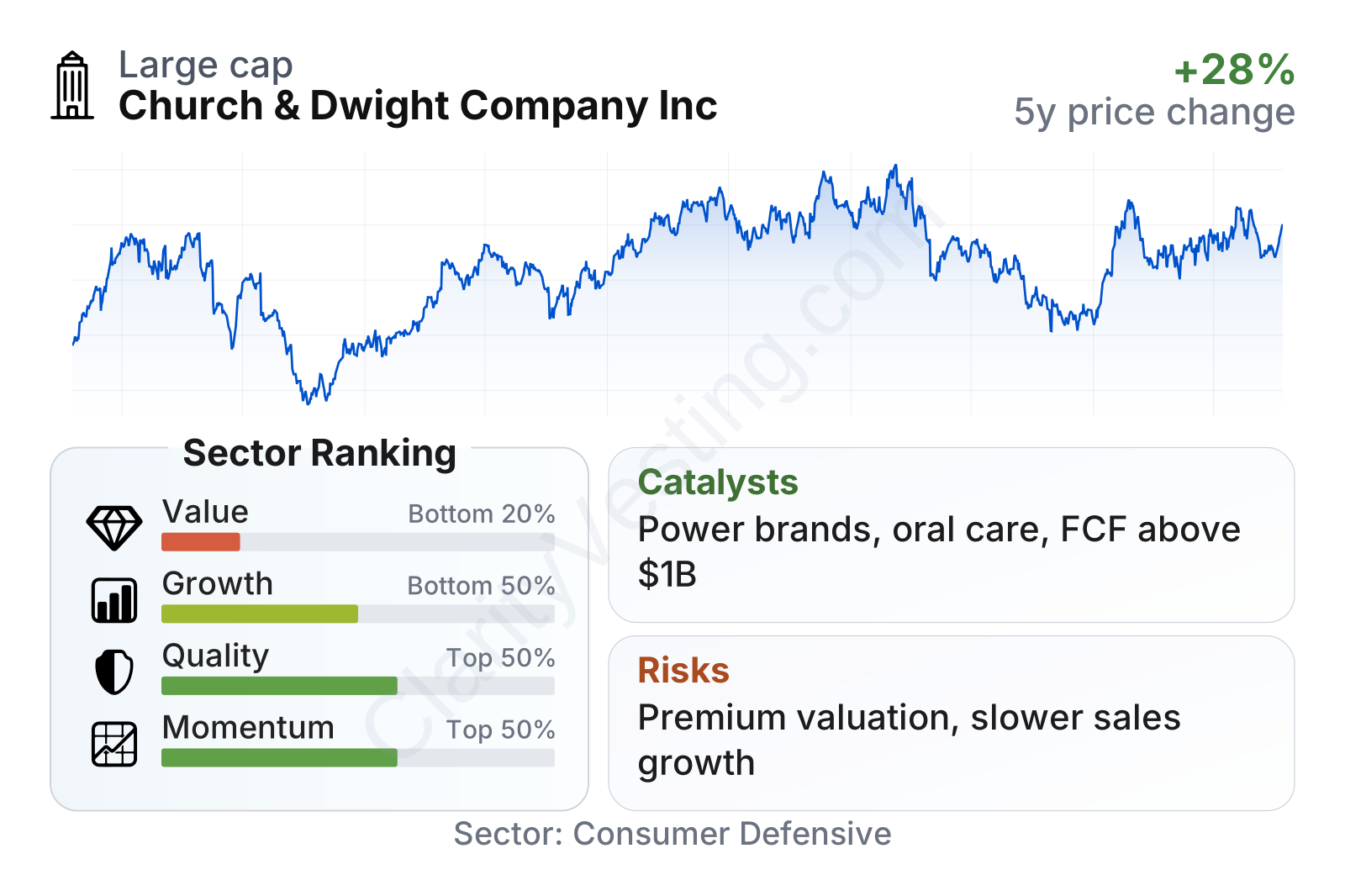
Church & Dwight is a large consumer staples company with relatively low share-price volatility, as shown by its beta well below 1. On profitability and balance-sheet quality, it compares well with much of the sector: profit margin is well above the industry median, returns on assets are stronger than average, and leverage is moderate rather than aggressive. The weaker areas are valuation and growth. The stock trades at a clear premium to the sector on earnings and book value, while recent revenue growth has been slower than the industry median. Free cash flow remains solid, but the market is already assigning a high price to that stability.
Growth
Church & Dwight operates in a defensive sector rather than a fast-expanding one. Household and personal care products usually do not deliver explosive industry growth, but they can offer durable demand because consumers keep buying essentials in both strong and weak economic periods. Long-term expansion therefore depends less on the sector itself and more on market-share gains, pricing power, product innovation, international expansion, and acquisitions.
The company’s strategy broadly matches that reality. Management has long centered the portfolio around brands with leading or near-leading positions in niche categories, then supported them with advertising, line extensions, and distribution gains. It has also used acquisitions to enter attractive adjacencies, especially in higher-margin personal care and health categories. Recent deals and brand additions in areas such as oral care and acne treatment show a continued preference for brands with repeat purchases and good consumer loyalty.
Recent sales growth has slowed materially from the stronger gains seen in 2023. Revenue growth moved from high-single-digit and low-double-digit periods then cooled to low-single-digit territory by 2026. That does not suggest a broken business, but it does show that the easy rebound phase after inflation-driven pricing and post-acquisition boosts has passed. From here, stronger growth likely requires either a more meaningful pickup in volumes, continued premiumization in personal care and health, or another successful acquisition cycle.
One encouraging point is cash generation. Free cash flow has improved meaningfully from earlier lows and now stands above $1 billion on a trailing basis. For a consumer products company, that matters because cash supports advertising, product development, debt reduction, dividends, and acquisitions. It also gives management flexibility if category growth remains modest.
A practical catalyst is the ongoing mix shift toward categories that can carry better margins and stronger brand loyalty than basic commodity-like products. Oral care, specialty personal care, and health-and-wellness products may offer more room for premium pricing than traditional cleaning staples alone. International growth is another opportunity, though it remains a smaller part of the business and therefore would need sustained execution to make a major difference at the company level.
Recent company updates have also pointed to continued brand investment and product launches across core franchises. For a business like Church & Dwight, major breakthroughs are less common than a steady accumulation of smaller wins: a stronger placement at retailers, a successful new product variation, an acquired brand scaling better inside the company’s distribution network, or improved margin performance after cost pressure eases.
Risks
This article is for informational purposes only and does not constitute financial advice. Some content is AI-generated. See Disclaimer


