Stock Analysis · City Holding Company (CHCO)
Overview
City Holding Company is a regional bank headquartered in West Virginia. Through City National Bank and related subsidiaries, it provides traditional banking services to consumers, small businesses, and commercial clients. Its footprint is centered in West Virginia, Virginia, Kentucky, and neighboring markets, with a business model built around gathering local deposits and turning those funds into loans and fee-based banking services.
Like most banks, City Holding earns money from several streams, with interest income at the center. Based on recent annual reporting, the largest source is net interest income, which comes from the spread between what the bank earns on loans and securities and what it pays on deposits and other funding. Noninterest income is smaller but still meaningful, helping diversify earnings when lending conditions change.
Main revenue sources can be summarized as follows:
- Net interest income: approximately 75% to 80% of total revenue. This includes income from commercial loans, residential real estate lending, consumer lending, and investment securities, after funding costs.
- Wealth management and trust fees: approximately 7% to 10%. This covers investment management, trust, and related advisory services.
- Service charges and deposit-related fees: approximately 5% to 8%. These come from account fees, treasury services, card-related charges, and other customer banking services.
- Mortgage banking, card, and other noninterest income: approximately 8% to 12%. This includes loan servicing or sale-related activity, interchange income, and other miscellaneous banking fees.
What stands out is that City Holding is still primarily a spread-based banking business, but with enough fee income to reduce complete dependence on loan growth alone. Over the last several years, revenue and profit have moved higher while expenses remained relatively controlled, which points to a disciplined operating model rather than a bank trying to grow at any cost.
The long-term pattern shows revenue rising meaningfully from 2021 through 2025, while net income also advanced. Funding costs climbed sharply as industry interest expenses moved up, but City Holding still preserved strong profitability, which is notable for a regional bank in a tougher rate environment.
Key Figures
| Metric | Value | Sector ⓘ |
|---|---|---|
| Date | Oct 24, 2026 | |
| Context | ||
| Sector | Financial Services | |
| Industry | Banks - Regional | |
| Market Cap ⓘ | $1.98B | |
| Beta ⓘ | 0.48 | |
Value (Cheapness) | ||
| P/E Ratio ⓘ | 15.41 | 12.46 |
| P/B Ratio ⓘ | 2.49 | 1.25 |
| FCF Yield ⓘ | 6.99% | 9.82% |
| Dividend Yield ⓘ | 2.45% | 2.94% |
| EBIT / EV ⓘ | 7.37% | 8.11% |
| PEG ⓘ | 1.91 | |
Growth (Business expansion) | ||
| Revenue Growth ⓘ | 0.90% | 9.10% |
| RPS Growth (5Y CAGR) ⓘ | 16.45% | 12.31% |
| EPS Growth (5Y CAGR) ⓘ | -10.17% | -6.97% |
| BVPS Growth (5Y CAGR) ⓘ | 6.26% | 5.02% |
| Margin Growth (5Y Trend) ⓘ | -7.17% | -4.00% |
| FCF Growth (5Y CAGR) ⓘ | 6.74% | 4.71% |
| DPS Growth (5Y CAGR) ⓘ | 8.84% | 8.92% |
Quality (Business durability) | ||
| ROIC (Latest) ⓘ | 13.92% | 9.18% |
| ROE (Latest) ⓘ | 16.39% | 13.93% |
| ROA (Latest) ⓘ | 1.96% | 1.57% |
| ROIC (5Y Median) ⓘ | 14.28% | 7.80% |
| ROE (5Y Median) ⓘ | 16.64% | 12.15% |
| ROA (5Y Median) ⓘ | 1.85% | 1.28% |
| Net Debt / EBIT (Latest) ⓘ | 1.58 | 1.02 |
| Net Debt / EBIT (5Y Median) ⓘ | 1.73 | 0.72 |
| Net Debt / EBITDA (Latest) ⓘ | 1.49 | 0.88 |
| Operating Margin (Latest) ⓘ | 43.47% | 22.30% |
| Operating Margin (5Y Median) ⓘ | 42.79% | 24.50% |
| Debt to Equity (Latest) ⓘ | 65.21% | 59.34% |
| Profit Margin (Latest) ⓘ | 41.12% | 26.42% |
| Free Cash Flow (Latest) ⓘ | $138.46M | |
Momentum (Price trend) | ||
| 3Y Return ⓘ | +75.57% | +95.73% |
| 12M Return (excl. last month) ⓘ | +15.64% | +17.30% |
| 6M Return ⓘ | +16.88% | +6.07% |
| Price vs. 200-Day MA ⓘ | +11.00% | +5.36% |
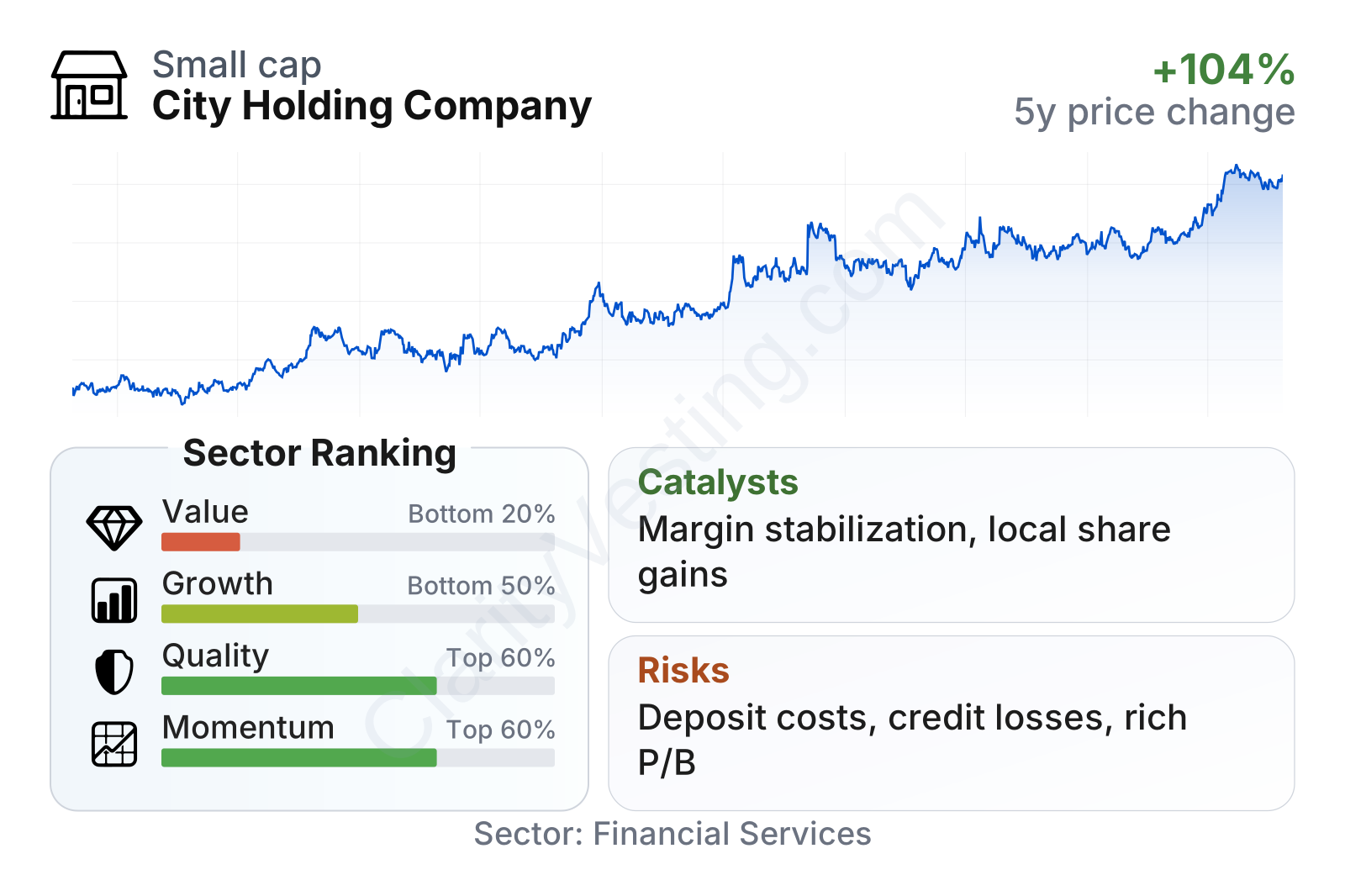
City Holding is a small-cap regional bank with unusually steady market behavior for the sector, reflected in a low beta. The factor profile is mixed in a sensible way: valuation screens look weaker than many peers because the shares trade at higher earnings and book multiples, but quality is clearly stronger than sector norms, with profitability and margins above median. Growth metrics are more balanced. Long-term growth in revenue per share, book value per share, free cash flow, and dividends has been solid, even though recent year-over-year revenue growth has been modest and multi-year EPS growth has been uneven. Price momentum is respectable, especially over the last six months, though not the strongest over a full three-year window.
Growth
Regional banking is not a high-growth industry in the way software or semiconductors can be, but it remains essential and can compound value steadily when a bank has strong underwriting, loyal deposits, and room to expand in attractive local markets. City Holding operates in a mature sector, so future growth is likely to come less from dramatic disruption and more from market share gains, disciplined lending, selective acquisitions, and continued cross-selling of treasury, trust, and wealth services.
The company’s strategy appears coherent for that kind of environment. It has historically emphasized community banking relationships, conservative credit culture, and efficiency. That matters because regional banks often succeed by being better operators rather than by being the biggest players. If deposit costs stabilize and loan demand improves, City Holding could benefit from better spreads and higher earning-asset growth without needing aggressive balance-sheet risk.
Earnings per share have generally trended upward over the past several years, although not in a straight line. After strong gains through 2023, profits softened slightly in 2024 before improving again in 2025. That pattern suggests resilience rather than rapid acceleration: the bank has been able to defend earnings through a changing rate cycle, but growth has not been explosive.
Book value per share has also moved higher over time, especially after the reset seen in 2022. That is an important sign for a bank because book value reflects the underlying capital base supporting future lending and earnings. A steady increase here usually signals that retained profits are building franchise value over time.
A practical catalyst is the interest-rate backdrop. If short-term rates stop rising or move lower while credit quality remains healthy, pressure on deposit pricing could ease. That would support net interest margin. Another catalyst is continued loan expansion in commercial and consumer categories across its existing footprint. Because City Holding is not a national giant, even moderate share gains in local markets can still make a visible difference.
Recent company reporting in 2026 also points to continued profitability and capital generation rather than signs of operational stress. For a bank of this size, consistency itself is a meaningful growth support because it leaves room for dividend growth, balance-sheet expansion, and potentially further small acquisitions.
Risks
This article is for informational purposes only and does not constitute financial advice. Some content is AI-generated. See Disclaimer


