Stock Analysis · CGN Mining Company Limited (CGNMF)
Overview
CGN Mining Company Limited is a Hong Kong-listed uranium company that trades in the U.S. over the counter under the symbol CGNMF. Its role in the nuclear fuel chain is mainly upstream and trading-oriented: it secures uranium resources, holds interests in uranium mining projects, and sells natural uranium products to customers connected to the nuclear power industry. The company is part of the wider China General Nuclear group ecosystem, which matters because China is one of the world’s largest nuclear buildout markets and needs long-term fuel supply.
For long-term analysis, the important point is that CGN Mining is not a diversified energy producer. Its economics are largely tied to uranium prices, uranium procurement, and the pace of nuclear fuel demand. That creates a simpler business to understand than a broad mining conglomerate, but it also means results can swing sharply when uranium market conditions change.
The company’s revenue base is concentrated. Public company materials indicate that natural uranium trading and related uranium product sales are the dominant source of revenue, while contributions from mining investments and other activities are much smaller at the revenue line.
- Natural uranium trading and sales: approximately 95% to 99% of revenue in recent years. This includes the purchase and sale of uranium concentrates and other uranium-related products used in the nuclear fuel supply chain.
- Other business activities: approximately 1% to 5% of revenue. This is a small category relative to the main uranium trading business and can include ancillary operations and service-related items.
- Equity-accounted mining interests: economically important, but not a major direct revenue line. These assets contribute through profit sharing, asset value, and long-term resource access rather than large reported sales.
The income flow over the last several years shows a business that expanded strongly in scale as uranium market activity increased, but profitability did not rise as smoothly as sales. Revenue moved from roughly HK$3.9 billion in 2021 to above HK$8.6 billion in 2024 before easing to about HK$6.9 billion in 2025. Over the same period, operating results became far more volatile, which suggests that margins depend heavily on procurement timing, contract structure, and uranium price movements rather than on steady cost advantages.
The operating picture is notable because revenue growth has been large, but margins have been inconsistent. In 2025, operating income fell sharply despite multi-billion-Hong-Kong-dollar revenue, while net income remained positive. That gap suggests non-operating items and investment-related contributions can materially affect bottom-line results, making headline profit less straightforward than sales growth alone might imply.
Key Figures
| Metric | Value | Sector ⓘ |
|---|---|---|
| Date | Oct 03, 2026 | |
| Context | ||
| Sector | Energy | |
| Industry | Uranium | |
| Market Cap ⓘ | $2.01B | |
| Beta ⓘ | 0.85 | |
Value (Cheapness) | ||
| P/E Ratio ⓘ | 26.51 | 14.47 |
| P/B Ratio ⓘ | 0.38 | 1.70 |
| FCF Yield ⓘ | 30.49% | 8.66% |
| Dividend Yield ⓘ | 5.28% | 3.77% |
| EBIT / EV ⓘ | N/A | 7.46% |
| PEG ⓘ | N/A | |
Growth (Business expansion) | ||
| Revenue Growth ⓘ | 18.50% | 27.35% |
| RPS Growth (5Y CAGR) ⓘ | 11.50% | 6.75% |
| EPS Growth (5Y CAGR) ⓘ | -32.01% | -15.45% |
| BVPS Growth (5Y CAGR) ⓘ | 16.44% | 5.85% |
| Margin Growth (5Y Trend) ⓘ | -6.21% | 0.75% |
| FCF Growth (5Y CAGR) ⓘ | N/A | 3.62% |
| DPS Growth (5Y CAGR) ⓘ | 5.77% | 16.85% |
Quality (Business durability) | ||
| ROIC (Latest) ⓘ | N/A | 11.33% |
| ROA (Latest) ⓘ | 8.14% | 6.03% |
| ROIC (5Y Median) ⓘ | 7.66% | 10.16% |
| ROA (5Y Median) ⓘ | 5.47% | 5.34% |
| Net Debt / EBIT (Latest) ⓘ | 1.21 | 1.62 |
| Net Debt / EBIT (5Y Median) ⓘ | 7.85 | 1.91 |
| Net Debt / EBITDA (Latest) ⓘ | 1.20 | 1.06 |
| Net Debt / Assets ⓘ | 15.65% | 17.29% |
| EBITDA / Interest ⓘ | 4.22 | 9.64 |
| Operating Margin (Latest) ⓘ | 8.01% | 16.32% |
| Operating Margin (5Y Median) ⓘ | 9.24% | 19.53% |
| Debt to Equity (Latest) ⓘ | 56.64% | 54.41% |
| Profit Margin (Latest) ⓘ | 6.13% | 8.79% |
| Free Cash Flow (Latest) ⓘ | $614.40M | |
Momentum (Price trend) | ||
| 3Y Return ⓘ | +32.54% | +62.93% |
| 12M Return (excl. last month) ⓘ | +6.98% | +44.83% |
| 6M Return ⓘ | -51.73% | -1.62% |
| Price vs. 200-Day MA ⓘ | -40.98% | +5.18% |
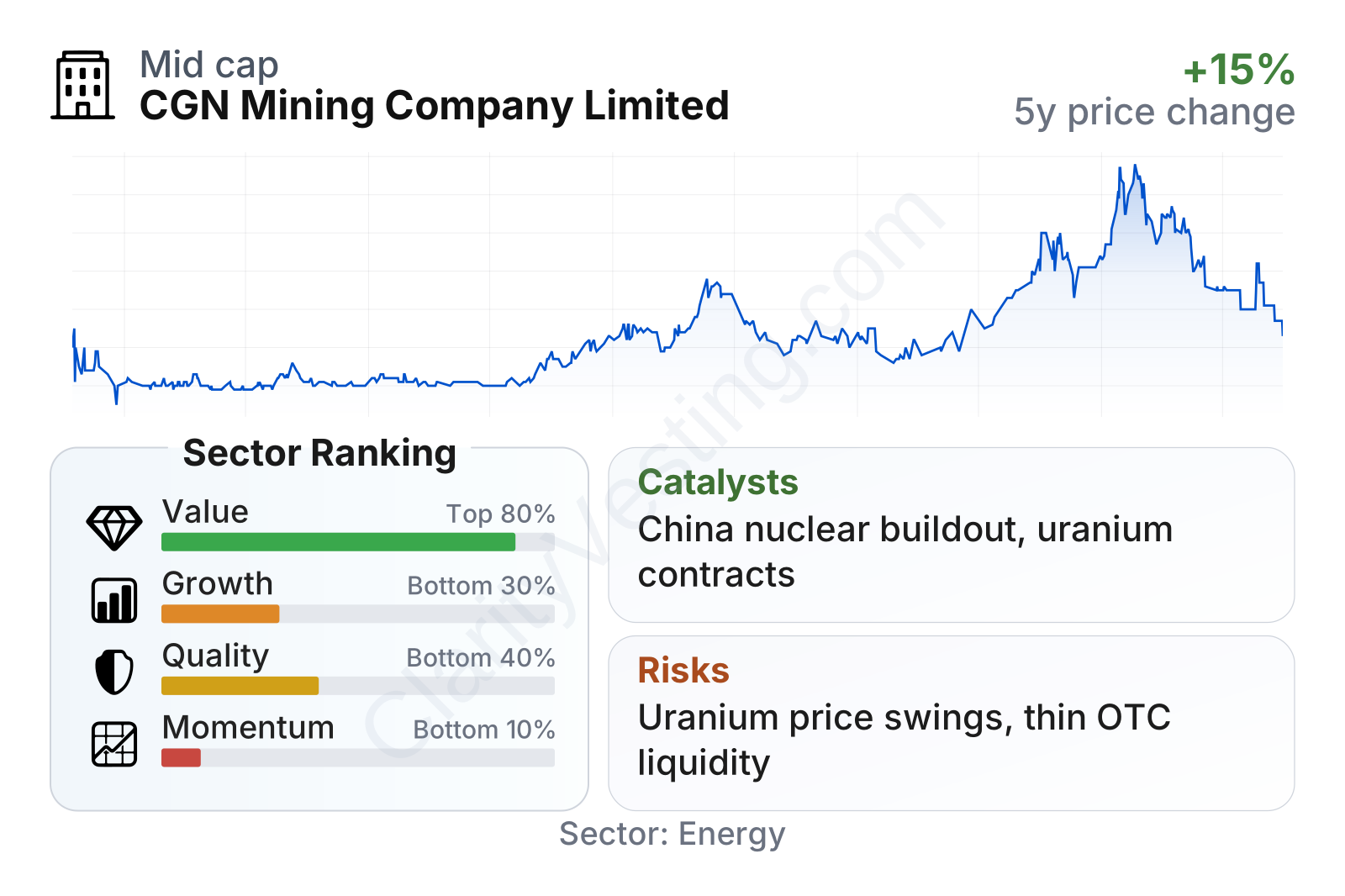
CGN Mining sits in the small-to-mid-cap range and has shown lower share-price volatility than many energy names, with a beta below 1. The balance between valuation and operating quality is unusual. On one hand, the shares trade at a low price-to-book ratio and a high free cash flow yield, while the trailing dividend yield is also above the sector median. On the other hand, the earnings multiple is above the sector median, which reflects how accounting profit can look less cheap than cash generation or asset value suggests.
The table also points to a mixed fundamental profile. Revenue growth remains positive, and five-year revenue per share growth is stronger than the sector median, but earnings growth over five years has been weak and margins have trended down. Leverage is not extreme on current earnings, with net debt around 1.2 times EBIT and 1.2 times EBITDA, yet interest coverage is meaningfully below the sector median, so financing costs are still a real constraint.
The share-price trend has been highly uneven. After trading at very low levels for several years, the stock surged into early 2026 and then gave back a large part of that move by mid-2026. That pattern fits a company exposed to commodity sentiment and to changes in expectations around uranium pricing rather than one valued mainly on stable recurring earnings.
Growth
CGN Mining operates in a sector with a credible long-term demand backdrop. Nuclear power has regained strategic importance in many countries because it offers low-carbon baseload electricity, supports energy security goals, and helps reduce dependence on fossil fuel imports. China is especially important here: it continues to expand nuclear generation capacity and needs long-term uranium supply for existing and planned reactors. That structural demand is one of the strongest reasons the uranium industry remains relevant for multi-year analysis.
The company’s strategy broadly fits that environment. Instead of relying only on direct mine production, it combines uranium trading with ownership stakes in upstream resources. That model can make sense because it gives access to supply while preserving flexibility to respond to market conditions. For a company linked to a large Chinese nuclear ecosystem, supply security can be just as important as maximizing short-term mining output.
A key catalyst is the tightening of global uranium supply after years of underinvestment in new mines. Uranium projects often require long permitting cycles, heavy capital spending, and political stability, so supply cannot always respond quickly when reactor demand improves. If long-term contracting activity rises and utilities seek to lock in deliveries, companies with established market access and resource ties can benefit.
Another growth support comes from the company’s resource portfolio and its relationship within the CGN network. Access to upstream interests in major uranium-producing regions can strengthen procurement optionality. This does not remove earnings volatility, but it can improve strategic relevance in an industry where secure feedstock matters.
Recent company communications have also emphasized continued engagement in uranium procurement and resource cooperation. The broader industry backdrop has been helped by sustained global attention to nuclear restarts, life extensions for existing plants, and new reactor construction, all of which reinforce the case for durable uranium demand over time.
Risks
This article is for informational purposes only and does not constitute financial advice. Some content is AI-generated. See Disclaimer