Stock Analysis · China Gas Holdings Limited (CGHOF)
Overview
China Gas Holdings Limited is a large Chinese utility company focused on natural gas distribution and related energy services. Its core business is delivering piped natural gas to residential, industrial, and commercial users across many cities and counties in China. The group also operates liquefied petroleum gas distribution, gas pipeline connection services for new customers, and a growing set of value-added services for households, such as kitchen, heating, and smart-home related products sold through its customer network.
The business model is fairly easy to understand: the company buys gas upstream, transports and distributes it through local networks, charges end users for consumption, and also earns one-time fees when new users or new projects are connected to its systems. This creates a mix of recurring revenue from gas sales and more cyclical revenue from new connections and equipment sales.
Based on the company’s recent annual reporting structure, the main revenue sources appear to be roughly as follows:
- Natural gas sales: approximately 75% to 85% of revenue. This is the largest segment and includes piped gas sold to residential, industrial, and commercial customers.
- Gas connection services: approximately 8% to 15% of revenue. This includes fees from connecting new residential communities, industrial facilities, and commercial sites to the gas network.
- LPG, integrated energy, and value-added services: approximately 5% to 12% of revenue combined. This includes liquefied petroleum gas distribution, energy-related services, and household product sales.
One notable pattern in recent years is that revenue has been drifting lower, mainly because lower gas prices and softer connection activity have offset customer base expansion. At the same time, financing costs have improved from earlier peaks, which has provided some support to operating performance even as net income has remained under pressure.
The business remains heavily weighted toward the gas distribution chain, with cost of revenue absorbing most of sales. That is normal for a gas utility, but it also means margins are structurally thinner than in many other utility categories. Over the last several years, revenue, gross profit, and net income have all moved down from earlier highs, while interest expense has eased, showing some balance-sheet improvement but not a full earnings recovery.
Key Figures
| Metric | Value | Sector ⓘ |
|---|---|---|
| Date | Sep 30, 2026 | |
| Context | ||
| Sector | Utilities | |
| Industry | Utilities - Regulated Gas | |
| Market Cap ⓘ | $3.81B | |
| Beta ⓘ | 1.00 | |
Value (Cheapness) | ||
| P/E Ratio ⓘ | 11.67 | 16.94 |
| P/B Ratio ⓘ | 0.08 | 1.47 |
| FCF Yield ⓘ | 114.58% | 0.63% |
| Dividend Yield ⓘ | 6.47% | 3.90% |
| EBIT / EV ⓘ | N/A | 4.98% |
| PEG ⓘ | 1.20 | |
Growth (Business expansion) | ||
| Revenue Growth ⓘ | -11.40% | 5.95% |
| RPS Growth (5Y CAGR) ⓘ | -3.99% | 4.23% |
| EPS Growth (5Y CAGR) ⓘ | -13.41% | -12.45% |
| BVPS Growth (5Y CAGR) ⓘ | -5.60% | 4.87% |
| Margin Growth (5Y Trend) ⓘ | -3.40% | 3.54% |
| FCF Growth (5Y CAGR) ⓘ | N/A | -9.19% |
| DPS Growth (5Y CAGR) ⓘ | -2.44% | 4.50% |
Quality (Business durability) | ||
| ROIC (Latest) ⓘ | 7.59% | 6.46% |
| ROA (Latest) ⓘ | 3.84% | 3.18% |
| ROIC (5Y Median) ⓘ | 4.97% | 5.98% |
| ROA (5Y Median) ⓘ | 2.19% | 2.75% |
| Net Debt / EBIT (Latest) ⓘ | 4.68 | 7.13 |
| Net Debt / EBIT (5Y Median) ⓘ | 7.38 | 7.35 |
| Net Debt / EBITDA (Latest) ⓘ | 3.06 | 4.44 |
| Net Debt / Assets ⓘ | 34.33% | 39.16% |
| EBITDA / Interest ⓘ | 5.08 | 4.41 |
| Operating Margin (Latest) ⓘ | 7.57% | 20.99% |
| Operating Margin (5Y Median) ⓘ | 8.58% | 20.70% |
| Debt to Equity (Latest) ⓘ | 116.38% | 140.88% |
| Profit Margin (Latest) ⓘ | 3.69% | 11.37% |
| Free Cash Flow (Latest) ⓘ | $4.37B | |
Momentum (Price trend) | ||
| 3Y Return ⓘ | -4.98% | +45.73% |
| 12M Return (excl. last month) ⓘ | -26.15% | +12.16% |
| 6M Return ⓘ | -26.95% | -3.03% |
| Price vs. 200-Day MA ⓘ | -51.37% | -1.75% |
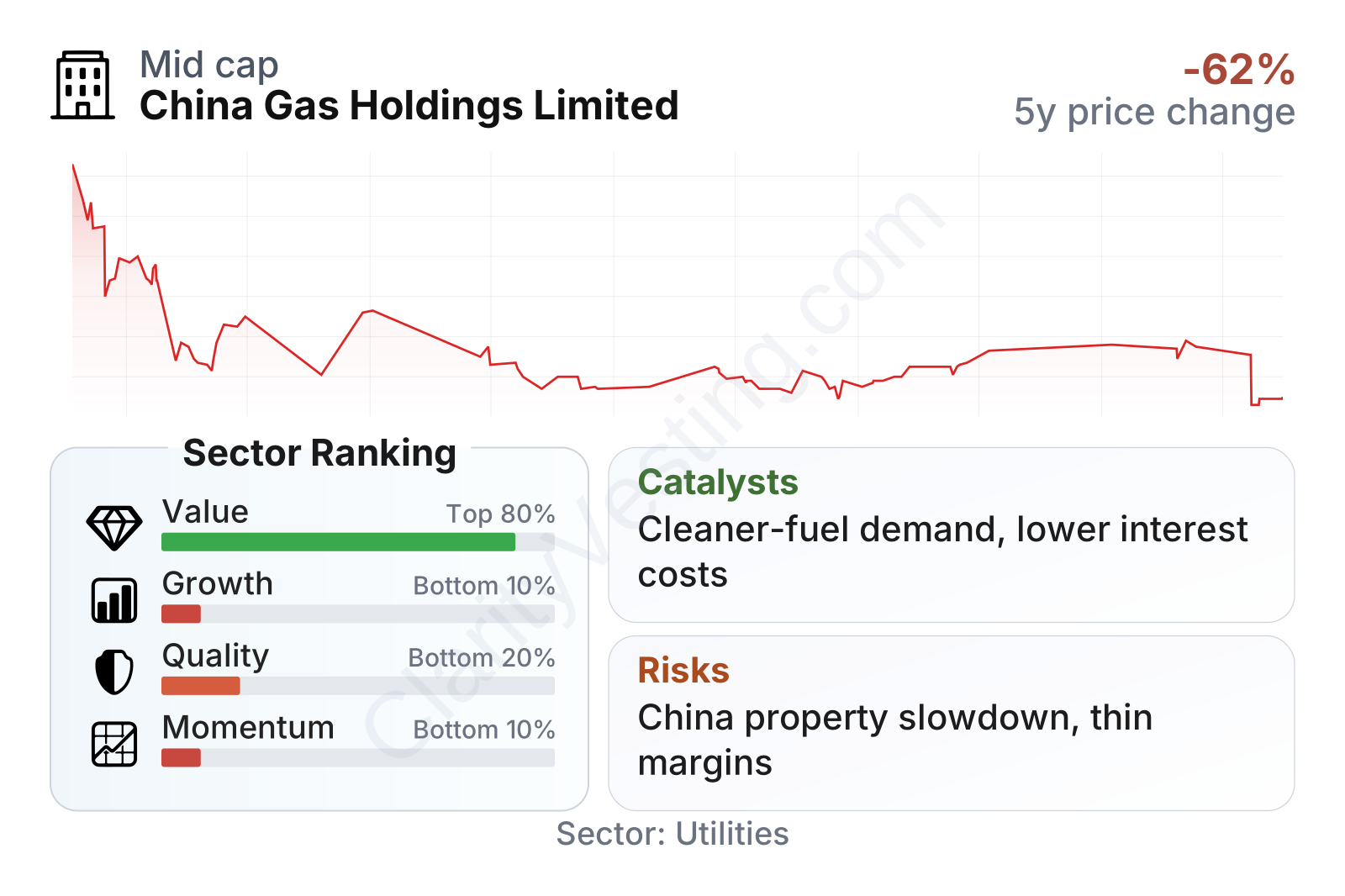
China Gas is a mid-sized listed utility with a stock that has fallen sharply from its 2021 level and has remained weak through 2026. In factor terms, the strongest area is valuation: earnings multiple, cash flow yield, and dividend yield all screen favorably against the sector median. By contrast, growth, quality, and share-price momentum are notably weak relative to peers. Profitability is modest for the sector, but leverage looks more manageable than many utility peers, with net debt to EBITDA and interest coverage in a better position than the median.
Growth
China’s city-gas sector still has long-term relevance. Natural gas remains an important transition fuel in China because it is cleaner than coal for many residential, industrial, and commercial uses. That supports ongoing demand in urban distribution, industrial fuel switching, and broader energy infrastructure. In that sense, the company operates in a sector that still has structural importance, even if it no longer offers the fast expansion profile seen during earlier gas network build-out years.
For China Gas specifically, the growth outlook is mixed. The company still benefits from a very large customer footprint and broad geographic presence, which gives it a platform to add users, sell more gas per connected customer, and cross-sell household services. Its strategy of combining gas supply, urban distribution, and value-added products makes sense because it deepens customer relationships and can lift revenue per customer over time. However, recent performance shows that this strategy has not yet translated into strong top-line momentum.
Revenue per share has trended down since fiscal 2023 after a brief rise, which suggests growth from network expansion has been more than offset by lower pricing, weaker connection activity, or softer demand in some end markets. That does not invalidate the long-term role of the business, but it does show that the company is operating in a slower and more difficult phase of the cycle.
A practical catalyst is policy support for cleaner fuel use and local energy infrastructure. If industrial demand improves, property-related connection activity stabilizes, or the company gains traction in higher-margin household and integrated energy services, earnings quality could improve. Another helpful sign is lower interest expense compared with prior years, which can support net profit even without strong revenue growth. The most significant opportunity is therefore not explosive expansion, but steadier monetization of an already large installed network.
Risks
This article is for informational purposes only and does not constitute financial advice. Some content is AI-generated. See Disclaimer


