Stock Analysis · China Gas Holdings Ltd (CGHLY)
Overview
China Gas Holdings Ltd is a large downstream natural gas utility and service provider focused mainly on mainland China. The company builds and operates city gas pipeline networks, sells natural gas to homes, commercial users, and industrial customers, and also provides related services such as gas connection, engineering, and value-added home products. In simple terms, it helps move gas from upstream suppliers into cities and neighborhoods, then earns money from delivering that gas and from services attached to those customer relationships.
Its business mix is centered on gas sales and distribution, with additional income from connecting new customers and selling equipment or services around the home. Based on the company’s recent annual reporting structure, the main revenue sources can be summarized as follows:
- Natural gas sales: approximately 85% to 90% of revenue. This includes retail and wholesale gas sold through the company’s city-gas networks to residential, industrial, and commercial users.
- Gas connection and engineering: approximately 5% to 10% of revenue. This covers fees for connecting new residential developments, industrial sites, and commercial projects to the gas network.
- LPG, integrated energy, and value-added services: approximately 5% to 10% of revenue. This includes liquefied petroleum gas distribution, heating and distributed energy solutions, and household services such as kitchen and heating-related products.
That revenue split also helps explain the company’s financial profile. Gas sales produce scale but often at thinner margins, while connection and service activities can be more profitable but more sensitive to real-estate construction activity and local project timing.
Over the last several fiscal years, total revenue has moved down from the low-90-billion renminbi range toward the mid-70-billion range, while gross profit has held up better than sales. Interest expense has eased from earlier peaks, showing some balance-sheet improvement, but net income remains well below the level reached several years ago. This points to a business that is still sizable and cash-generative, but operating in a less favorable demand and pricing environment than before.
Key Figures
| Metric | Value | Sector ⓘ |
|---|---|---|
| Date | Oct 17, 2026 | |
| Context | ||
| Sector | Utilities | |
| Industry | Utilities - Regulated Gas | |
| Market Cap ⓘ | $3.87B | |
| Beta ⓘ | 1.02 | |
Value (Cheapness) | ||
| P/E Ratio ⓘ | 11.09 | 17.28 |
| P/B Ratio ⓘ | 0.07 | 1.51 |
| FCF Yield ⓘ | 112.97% | 0.65% |
| Dividend Yield ⓘ | 6.28% | 3.77% |
| EBIT / EV ⓘ | N/A | 5.01% |
| PEG ⓘ | 1.19 | |
Growth (Business expansion) | ||
| Revenue Growth ⓘ | -11.40% | 6.10% |
| RPS Growth (5Y CAGR) ⓘ | -3.87% | 3.87% |
| EPS Growth (5Y CAGR) ⓘ | 3.91% | -11.30% |
| BVPS Growth (5Y CAGR) ⓘ | -5.60% | 4.23% |
| Margin Growth (5Y Trend) ⓘ | -3.40% | 3.57% |
| FCF Growth (5Y CAGR) ⓘ | 31.16% | -8.84% |
| DPS Growth (5Y CAGR) ⓘ | -2.32% | 4.84% |
Quality (Business durability) | ||
| ROIC (Latest) ⓘ | 7.59% | 6.53% |
| ROA (Latest) ⓘ | 3.84% | 3.20% |
| ROIC (5Y Median) ⓘ | 4.97% | 5.95% |
| ROA (5Y Median) ⓘ | 2.19% | 2.75% |
| Net Debt / EBIT (Latest) ⓘ | 4.67 | 7.13 |
| Net Debt / EBIT (5Y Median) ⓘ | 7.38 | 7.23 |
| Net Debt / EBITDA (Latest) ⓘ | 3.04 | 4.31 |
| Net Debt / Assets ⓘ | 34.33% | 38.42% |
| EBITDA / Interest ⓘ | 5.10 | 4.58 |
| Operating Margin (Latest) ⓘ | 7.57% | 20.83% |
| Operating Margin (5Y Median) ⓘ | 8.58% | 20.08% |
| Debt to Equity (Latest) ⓘ | 116.38% | 137.69% |
| Profit Margin (Latest) ⓘ | 3.69% | 11.37% |
| Free Cash Flow (Latest) ⓘ | $4.37B | |
Momentum (Price trend) | ||
| 3Y Return ⓘ | -15.03% | +52.37% |
| 12M Return (excl. last month) ⓘ | -26.50% | +8.84% |
| 6M Return ⓘ | -26.95% | -3.95% |
| Price vs. 200-Day MA ⓘ | -15.26% | -0.79% |
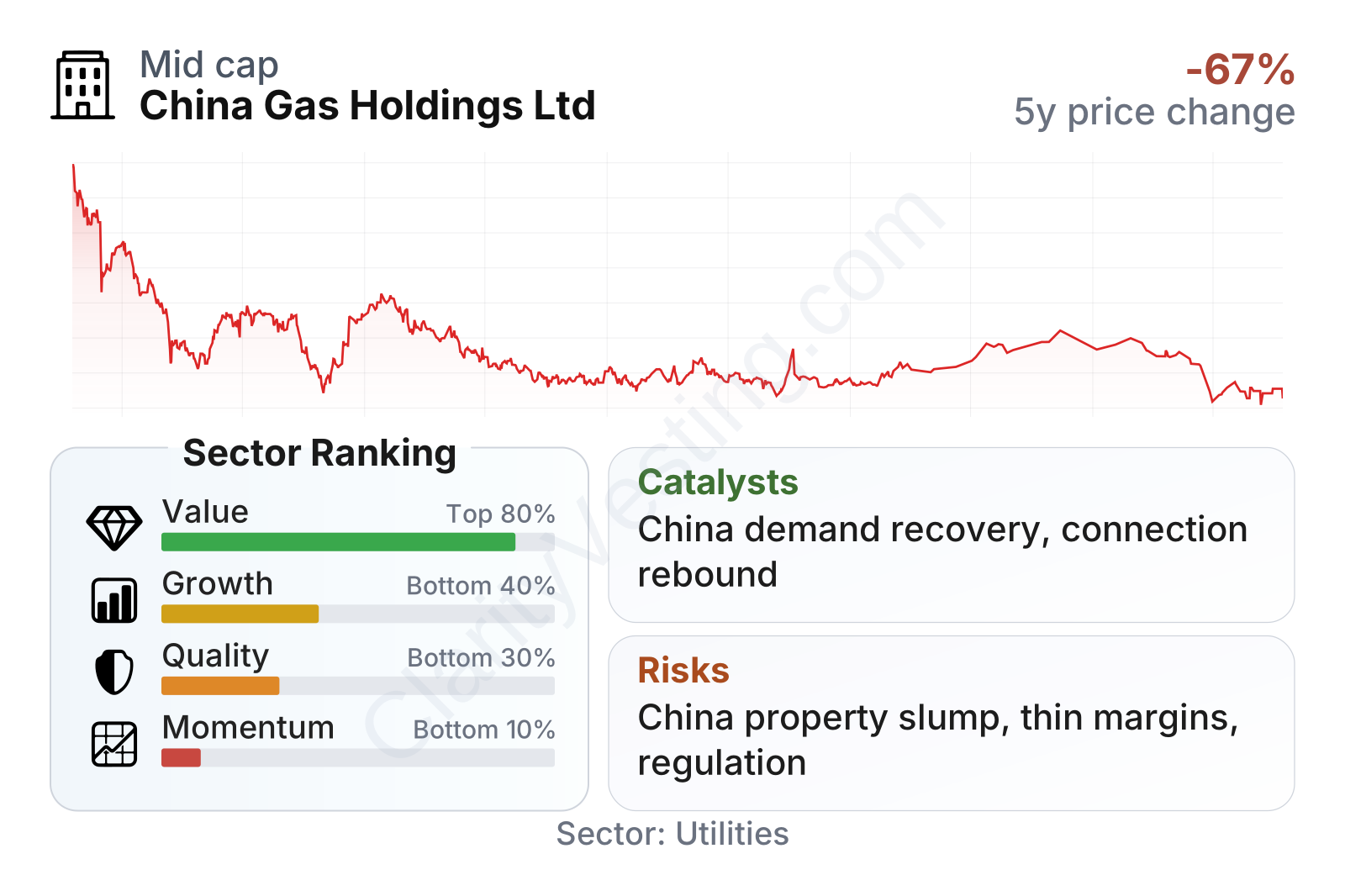
China Gas sits in the mid-cap range and its share-price behavior is close to the broader market, with a beta around 1. On valuation metrics, it screens cheaper than many regulated utility peers: the earnings multiple is below the sector median, free-cash-flow yield is unusually high, and the dividend yield is also above the sector norm. At the same time, growth and momentum are weak, and profitability metrics such as operating margin and profit margin trail many peers. In other words, the market appears to be pricing in slower expansion and lower business quality, while still recognizing the company’s cash generation and income distribution capacity.
The stock-price history also reflects this tension. The shares fell heavily from 2021 into 2022, then spent a long period moving sideways at lower levels before a partial recovery into early 2026. That pattern usually signals that investors are waiting for clearer proof that earnings and volumes can stabilize rather than simply assuming a quick rebound.
Growth
China Gas operates in a sector that still has a long-term role in China, even if it no longer has the same straightforward growth profile it once enjoyed. Urban gas distribution benefits from ongoing urbanization, household penetration, industrial fuel switching, and public policy support for cleaner-burning fuels compared with coal. Natural gas also remains important as a transition fuel in heating, manufacturing, and commercial energy use.
The company’s strategy broadly makes industrial sense. A city-gas operator with a wide network can deepen usage from existing customers, add value-added household products, expand integrated energy services, and improve returns from infrastructure already in place. This is often more attractive than relying only on new city concessions. China Gas has also been working on efficiency, cash flow, and debt control, which matters in a lower-growth environment.
Still, recent growth has been muted. Revenue has declined year over year, and revenue per share has trended downward over the last five fiscal years. That suggests volume, pricing, or mix pressure has outweighed the benefits of network expansion and adjacent services. The more encouraging detail is that earnings per share over five years have held up better than many sector peers, and free cash flow has improved strongly over that period, pointing to better capital discipline.
A potential catalyst is any improvement in China’s property and construction markets, because gas connection revenue is tied to new residential and commercial development. Another catalyst is a broader pickup in industrial activity, which can lift gas consumption through existing networks. The company’s value-added and integrated energy activities may also matter more over time if management can raise the share of revenue from recurring customer services rather than depending mainly on pure gas throughput.
Recent company communications have also emphasized shareholder returns, including dividends and share repurchases, which can support market confidence if operating trends stop weakening. That does not create growth by itself, but it can reinforce the case that the business is producing usable cash even in a slower phase.
Risks
This article is for informational purposes only and does not constitute financial advice. Some content is AI-generated. See Disclaimer


