Stock Analysis · ChinaSoft International Ltd (CFTLF)
Overview
ChinaSoft International Ltd is a Chinese information technology services company focused on digital transformation for enterprises and public-sector clients. Its business centers on cloud services, software development, systems integration, consulting, and outsourced technology services. The company has long been closely associated with the Huawei ecosystem, and that relationship remains an important part of its market positioning, especially in cloud migration, industry solutions, and enterprise digital infrastructure.
In practical terms, ChinaSoft helps customers build and run business software, move workloads to the cloud, modernize legacy systems, and deploy industry-specific digital tools. Its clients span government, manufacturing, finance, energy, telecommunications, internet platforms, and other large organizations in China and overseas.
Based on the company’s annual reporting structure, revenue mainly comes from two operating segments.
- Technical professional services group: approximately 75% to 85% of revenue in recent years. This segment includes outsourced IT services, software development, testing, operations support, and project-based delivery for enterprise customers.
- Internet IT services group: approximately 15% to 25% of revenue in recent years. This business serves internet platform customers and typically includes product engineering, digital operations support, and related technology services.
Within those segments, cloud and digital transformation work has become strategically important, with Huawei-related cloud solutions and enterprise modernization services standing out as a core theme in the company’s positioning.
Over the last several years, the business mix also shows pressure on profitability. Revenue has stayed in a relatively stable range after peaking in 2022, but gross profit, operating income, and net income have trended lower, suggesting that pricing, customer mix, or competition have become more challenging even as the company continues to generate solid cash flow.
The profit flow highlights a business that still converts a meaningful amount of revenue into cash, but with thinner earnings than a few years ago. Research and development spending remains material, which supports the company’s technical relevance, yet the overall margin profile has clearly compressed.
Key Figures
| Metric | Value | Sector ⓘ |
|---|---|---|
| Date | Oct 31, 2026 | |
| Context | ||
| Sector | Technology | |
| Industry | Information Technology Services | |
| Market Cap ⓘ | $1.27B | |
| Beta ⓘ | 0.69 | |
Value (Cheapness) | ||
| P/E Ratio ⓘ | 25.80 | 29.73 |
| FCF Yield ⓘ | 44.47% | 3.96% |
| Dividend Yield ⓘ | 8.14% | 1.30% |
| EBIT / EV ⓘ | N/A | 2.90% |
| PEG ⓘ | 0.89 | |
Growth (Business expansion) | ||
| Revenue Growth ⓘ | 5.20% | 15.80% |
| RPS Growth (5Y CAGR) ⓘ | 0.37% | 8.54% |
| EPS Growth (5Y CAGR) ⓘ | 26.64% | -10.19% |
| Margin Growth (5Y Trend) ⓘ | -2.64% | 0.45% |
| FCF Growth (5Y CAGR) ⓘ | N/A | 9.80% |
| DPS Growth (5Y CAGR) ⓘ | 18.34% | 7.67% |
Quality (Business durability) | ||
| ROIC (Latest) ⓘ | N/A | 9.74% |
| ROIC (5Y Median) ⓘ | 4.38% | 8.31% |
| Net Debt / EBIT (Latest) ⓘ | 2.10 | 0.53 |
| Net Debt / EBIT (5Y Median) ⓘ | -0.66 | 0.46 |
| Net Debt / EBITDA (Latest) ⓘ | 1.60 | 0.29 |
| Net Debt / Assets ⓘ | 18.26% | 3.45% |
| EBITDA / Interest ⓘ | N/A | 13.54 |
| Operating Margin (Latest) ⓘ | 5.93% | 10.12% |
| Operating Margin (5Y Median) ⓘ | 4.35% | 8.50% |
| Debt to Equity (Latest) ⓘ | 51.15% | 35.18% |
| Profit Margin (Latest) ⓘ | 2.04% | 7.13% |
| Free Cash Flow (Latest) ⓘ | $564.23M | |
Momentum (Price trend) | ||
| 3Y Return ⓘ | -25.66% | +61.79% |
| 12M Return (excl. last month) ⓘ | -35.85% | +12.78% |
| 6M Return ⓘ | -2.82% | +7.85% |
| Price vs. 200-Day MA ⓘ | -8.60% | +5.43% |
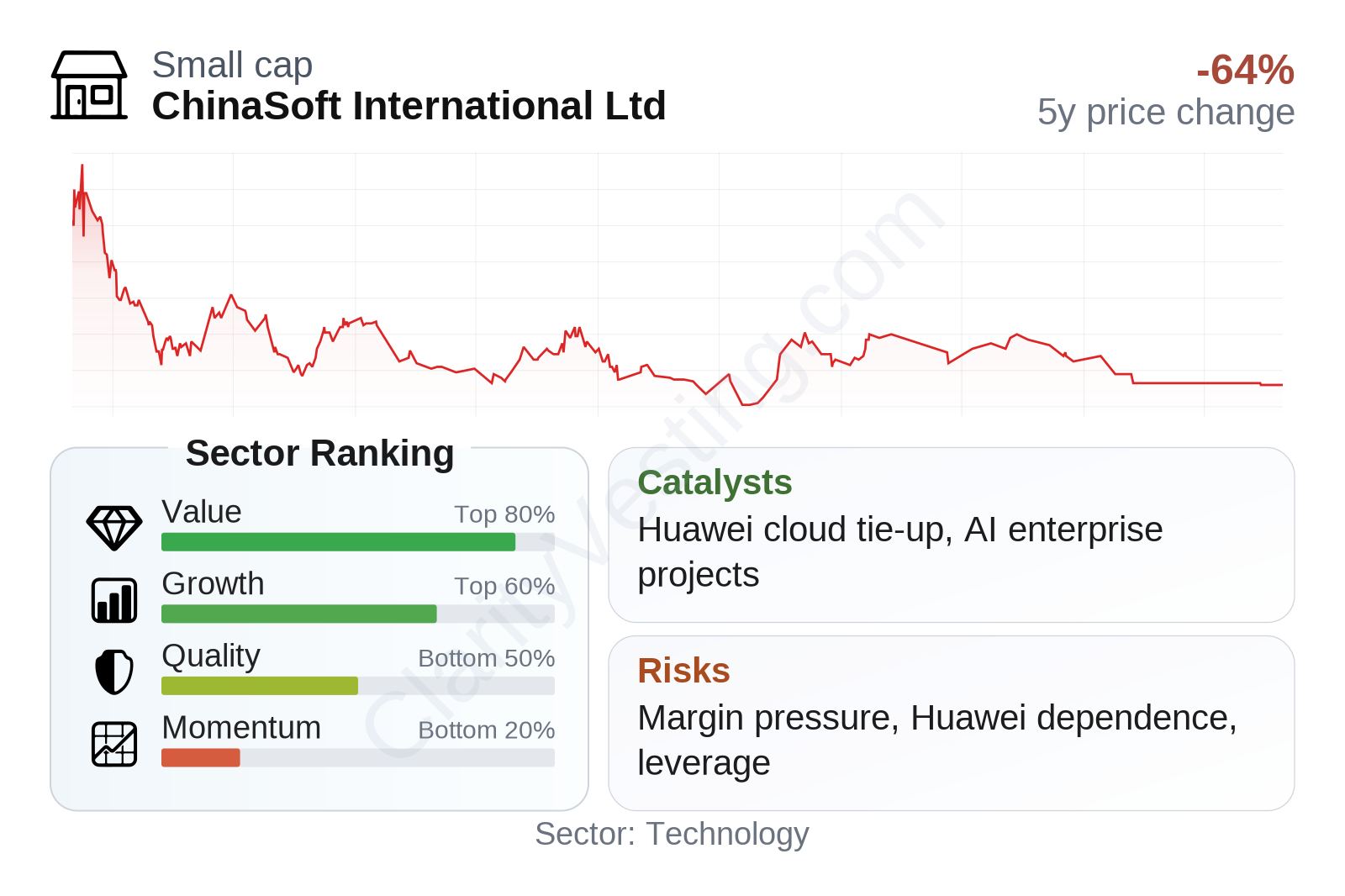
ChinaSoft is a mid-sized technology services company by market value, and its recent market behavior has been subdued. The stock has remained far below its 2021 level and has lagged the broader technology sector over one, three, and shorter time periods. That weak share performance contrasts with a business that still produces strong free cash flow and pays a comparatively high dividend yield.
The latest metrics point to a mixed profile. On valuation, the company screens relatively inexpensive versus many technology peers, helped by a price-to-earnings ratio below the sector median, a high free-cash-flow yield, and a PEG ratio below 1. On growth, the picture is more moderate: recent revenue growth is positive but slower than the sector median, while five-year earnings per share growth looks strong mainly because profit held up better than many peers over a volatile period. On quality, profitability remains the weak spot, with operating margin and profit margin below sector norms and leverage currently higher than the median.
Growth
ChinaSoft operates in a sector that still has long-term expansion potential. Enterprise cloud adoption, AI-related software demand, digital government systems, industrial digitization, and IT modernization are all durable themes in China’s technology services market. Those are not short-lived trends; they reflect multi-year shifts in how large organizations manage software, infrastructure, data, and automation.
The company’s strategy broadly fits that backdrop. ChinaSoft has positioned itself where corporate and public-sector clients often need outside help: migrating to cloud environments, integrating software across departments, and maintaining large digital systems over time. This can create recurring work, especially when customers standardize on a particular cloud or infrastructure partner.
A major catalyst is the company’s connection to Huawei’s ecosystem. As Huawei continues to promote its cloud platform, enterprise software stack, and AI infrastructure, ChinaSoft can benefit as an implementation and delivery partner. That does not guarantee rapid growth, but it gives the company access to large projects and a potentially sticky client channel in areas such as cloud-native development, industry solutions, and digital transformation.
Another supportive element is the gap between accounting profit and cash generation. Free cash flow remains strong relative to the company’s size, which gives it more flexibility to sustain dividends, invest in product capabilities, or absorb periods of slower contract growth. For a services business with modest reported margins, that cash profile is an important feature.
Recent company communications have also emphasized AI and cloud-related opportunities, including work tied to enterprise intelligent transformation. If spending around domestic cloud ecosystems and AI applications keeps broadening in China, ChinaSoft is positioned to participate because it already serves large organizations that need deployment rather than just software licenses.
Risks
This article is for informational purposes only and does not constitute financial advice. Some content is AI-generated. See Disclaimer