Stock Analysis · Compagnie Financière Tradition SA (CFNCF)
Overview
Compagnie Financière Tradition SA is an interdealer broker and market infrastructure group. In simple terms, it helps large financial institutions such as banks, asset managers, trading firms, and corporations find counterparties and execute transactions in markets that are often complex, fragmented, or less transparent than exchange-traded markets. The group operates globally through the Tradition brand and also has a significant presence in retail foreign exchange through its majority stake in Swissquote.
Its core activity is broking over-the-counter products across asset classes. These include interest rate products, foreign exchange, money markets, credit and bonds, equities and equity derivatives, and energy and commodities. The company also has technology and platform activities that support electronic and hybrid trading, which matters because more market activity is gradually shifting toward digital execution.
The main sources of revenue are organized primarily by business line. Based on the company’s annual reporting and business mix, revenue is heavily concentrated in interdealer broking, with the remainder coming from retail and other activities.
- Interdealer broking: approximately 80% to 85% of consolidated revenue. This is the main business and includes brokerage services in rates, FX, money markets, fixed income, equities, and commodities for institutional market participants.
- Retail / online foreign exchange and related activities: approximately 15% to 20% of consolidated revenue. This mainly comes from the group’s majority stake in Swissquote and includes retail trading and related financial services exposure.
- Other / technology-enabled market solutions: a small share within the group, generally embedded in the operating segments rather than always disclosed as a separate major line. This includes electronic trading tools and related market access services.
Geographically, the business is diversified across Europe, the Americas, Asia-Pacific, and the Middle East. That global footprint helps reduce dependence on any single market, although activity levels still depend on overall trading conditions and client demand.
The profit flow over recent years points to a steady improvement in scale. Revenue moved from roughly $874 million in 2021 to just over $1.05 billion in 2024, while net income rose from about $65 million to around $116 million over the same period. That combination suggests a business benefiting both from activity levels and from operating discipline.
The multi-year progression shows that revenue has been trending upward while operating income and net income have improved faster than sales. That is usually a constructive sign for a brokerage business, because it indicates that additional activity has translated into better profitability rather than being fully absorbed by costs.
Key Figures
| Metric | Value | Sector ⓘ |
|---|---|---|
| Date | Oct 17, 2026 | |
| Context | ||
| Sector | Financial Services | |
| Industry | Capital Markets | |
| Market Cap ⓘ | $2.62B | |
| Beta ⓘ | 0.16 | |
Value (Cheapness) | ||
| P/E Ratio ⓘ | 15.32 | 12.26 |
| P/B Ratio ⓘ | 7.23 | 1.23 |
| FCF Yield ⓘ | 9.46% | 10.40% |
| Dividend Yield ⓘ | 2.17% | 3.02% |
| EBIT / EV ⓘ | N/A | 8.14% |
| PEG ⓘ | N/A | |
Growth (Business expansion) | ||
| Revenue Growth ⓘ | 3.10% | 9.35% |
| RPS Growth (5Y CAGR) ⓘ | -0.66% | 12.19% |
| EPS Growth (5Y CAGR) ⓘ | -25.75% | -9.53% |
| BVPS Growth (5Y CAGR) ⓘ | -3.32% | 4.99% |
| Margin Growth (5Y Trend) ⓘ | 6.38% | -3.86% |
| FCF Growth (5Y CAGR) ⓘ | 20.56% | 4.81% |
| DPS Growth (5Y CAGR) ⓘ | 1.51% | 8.79% |
Quality (Business durability) | ||
| ROIC (Latest) ⓘ | 34.86% | 9.49% |
| ROE (Latest) ⓘ | 57.76% | 13.90% |
| ROA (Latest) ⓘ | 18.18% | 1.55% |
| ROIC (5Y Median) ⓘ | 17.13% | 7.86% |
| ROE (5Y Median) ⓘ | 24.36% | 12.17% |
| ROA (5Y Median) ⓘ | 9.16% | 1.30% |
| Net Debt / EBIT (Latest) ⓘ | -0.15 | 0.96 |
| Net Debt / EBIT (5Y Median) ⓘ | -0.27 | 0.73 |
| Net Debt / EBITDA (Latest) ⓘ | -0.13 | 0.92 |
| Operating Margin (Latest) ⓘ | 14.42% | 22.30% |
| Operating Margin (5Y Median) ⓘ | 13.84% | 24.63% |
| Debt to Equity (Latest) ⓘ | 49.74% | 58.56% |
| Profit Margin (Latest) ⓘ | 12.72% | 26.57% |
| Free Cash Flow (Latest) ⓘ | $248.12M | |
Momentum (Price trend) | ||
| 3Y Return ⓘ | +194.65% | +88.33% |
| 12M Return (excl. last month) ⓘ | +141.70% | +19.38% |
| 6M Return ⓘ | -0.68% | +4.75% |
| Price vs. 200-Day MA ⓘ | -1.65% | +3.50% |
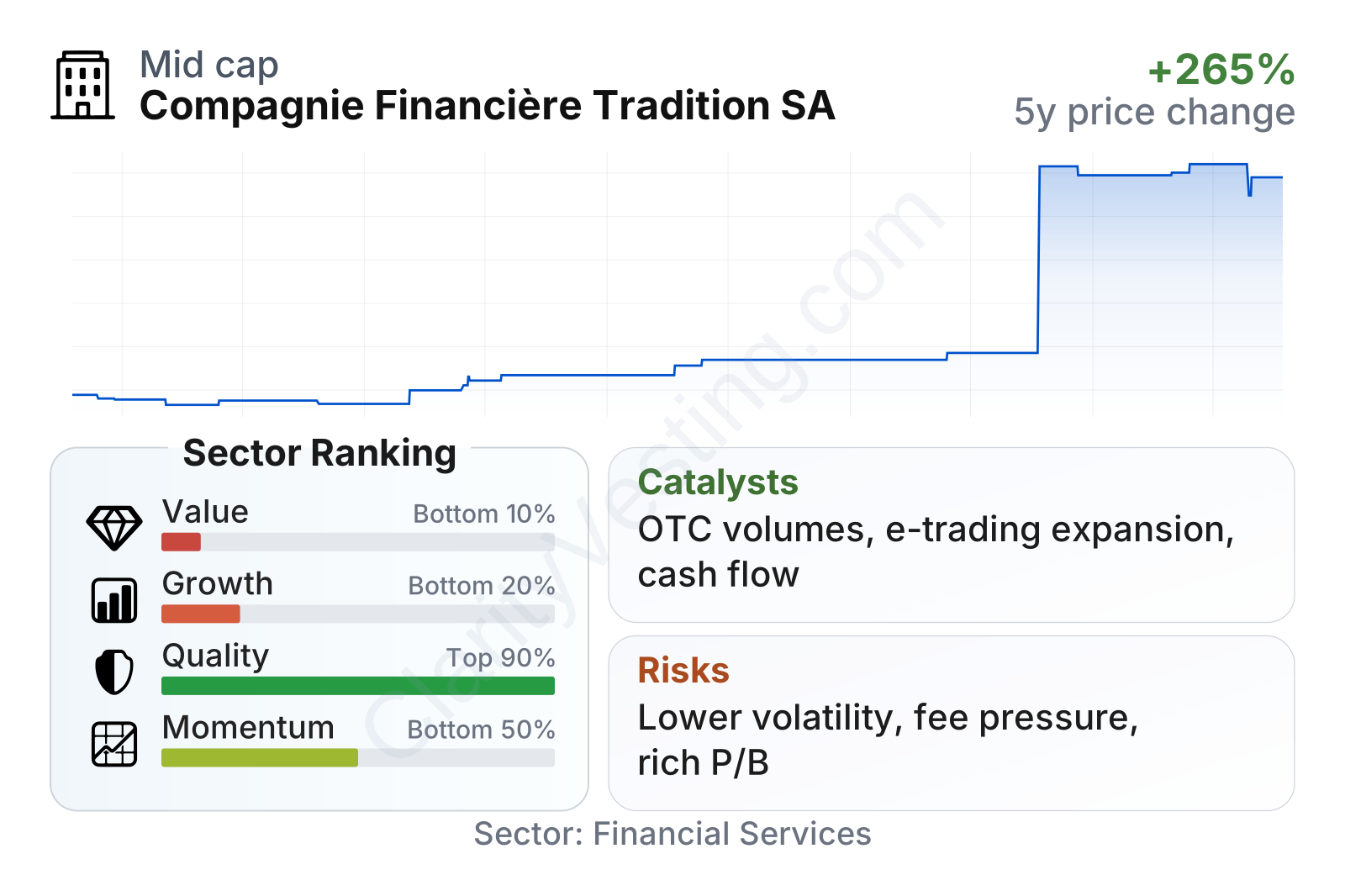
At a high level, the company stands out more for quality than for value or growth. Profitability metrics are exceptionally strong versus most financial services peers, with returns on capital, equity, and assets well above sector norms. The balance sheet also looks conservative, with net cash rather than meaningful net debt. By contrast, the stock does not screen cheaply on classic valuation ratios, especially on price-to-book, and its recent revenue growth has been modest relative to the broader sector. Market performance has been very strong over the last three years, but momentum has cooled more recently after a sharp re-rating.
The share price history reflects that pattern. The stock appreciated substantially from 2023 through 2026, including a particularly sharp jump in early 2026. That move helps explain why valuation multiples now look richer than before even though the underlying business remains profitable and cash generative.
Growth
Compagnie Financière Tradition operates in a market that is mature, but still supported by durable structural drivers. Financial institutions continue to need liquidity, price discovery, and execution in over-the-counter markets, especially in products that are less standardized or require specialist intermediation. Regulation has pushed parts of global trading toward greater transparency and electronic execution, but it has not eliminated the role of brokers. In many niches, it has changed the form of that role rather than removed it.
The company’s strategy appears coherent for that environment. It combines human brokerage, where relationships and market knowledge matter, with electronic tools that improve efficiency and client access. That hybrid positioning can be useful in rates, FX, and fixed-income markets where full automation is uneven and where clients still value specialist support in volatile conditions.
Another favorable point is that market volatility can be a business tailwind. When rate expectations shift, currencies move sharply, or credit spreads widen, institutional clients often trade more actively. For a broker that earns from transaction flow rather than balance-sheet risk taking, periods of uncertainty can create stronger volumes.
The group also benefits from global diversification. Growth does not need to come only from one geography or one asset class. If one market slows, another can partially offset it. That matters in a brokerage business where activity is cyclical but rarely weak everywhere at the same time.
Book value per share has been uneven over the last few years and has not shown a clean upward trajectory. That is not ideal, especially alongside slower long-term revenue-per-share growth. However, this should be read together with the company’s strong cash generation and very high returns on capital. In other words, the growth profile is not broad-based, but the operating model has still produced attractive economics.
A notable recent catalyst is the company’s continued earnings progression through 2024 and 2025, with revenue and profit extending their multi-year rise. That suggests the business has not simply benefited from a one-off market spike. It also supports the view that management has been able to retain business and convert activity into earnings despite competitive pressure and changing market structure.
Risks
This article is for informational purposes only and does not constitute financial advice. Some content is AI-generated. See Disclaimer


