Stock Analysis · Challenger Ltd (CFIGY)
Overview
Challenger Ltd is an Australian financial services group focused on retirement income. Its core role is to help customers turn savings into dependable cash flow, mainly through annuities and investment products. In simple terms, Challenger sits at the intersection of insurance and asset management: one side writes long-duration retirement income products, while the other side manages money for institutions, partners, and retail clients.
The business is mainly organized around two engines. The largest is its life business, which includes annuities and other retirement income products. The second is its funds management platform, now operating under the Fidante and Challenger Investment Management brands. Challenger also has distribution relationships with financial advisers, superannuation channels, and institutional partners, which matter because access to retirement savings pools is a major driver of future sales.
Based on recent company reporting, revenue is driven primarily by the life and retirement segment, with funds management contributing a smaller share. Reported accounting revenue can move around sharply in financial firms, so product sales, assets under management, and normal earnings often give a clearer picture than top-line revenue alone. At a high level, the mix is approximately:
- Life / retirement income products: about 80% to 90% of business activity. This includes annuities sold to retirees and institutional clients, as well as earnings from investing the associated balance sheet.
- Funds management: about 10% to 20%. This includes boutique investment management, institutional mandates, and partnerships through Fidante and related investment businesses.
That mix highlights what Challenger really is: a retirement income specialist first, with asset management as a supporting growth and distribution platform.
The profit flow has been volatile over the last several years, which is normal for a life insurer exposed to investment markets and interest-rate movements. The more recent picture is more encouraging: profitability and net income improved materially in the latest period, while administrative costs remained relatively contained compared with the scale of revenue.
Key Figures
| Metric | Value | Sector ⓘ |
|---|---|---|
| Date | Oct 17, 2026 | |
| Context | ||
| Sector | Financial Services | |
| Industry | Insurance - Life | |
| Market Cap ⓘ | $4.38B | |
| Beta ⓘ | 0.56 | |
Value (Cheapness) | ||
| P/E Ratio ⓘ | 16.65 | 12.26 |
| P/B Ratio ⓘ | 1.36 | 1.23 |
| FCF Yield ⓘ | 54.10% | 10.40% |
| Dividend Yield ⓘ | 3.20% | 3.02% |
| EBIT / EV ⓘ | N/A | 8.14% |
| PEG ⓘ | N/A | |
Growth (Business expansion) | ||
| Revenue Growth ⓘ | -16.90% | 9.35% |
| RPS Growth (5Y CAGR) ⓘ | 14.12% | 12.19% |
| EPS Growth (5Y CAGR) ⓘ | 3.71% | -9.53% |
| BVPS Growth (5Y CAGR) ⓘ | 2.12% | 4.99% |
| Margin Growth (5Y Trend) ⓘ | 193.84% | -3.86% |
| FCF Growth (5Y CAGR) ⓘ | -6.95% | 4.81% |
| DPS Growth (5Y CAGR) ⓘ | 13.21% | 8.79% |
Quality (Business durability) | ||
| ROIC (Latest) ⓘ | N/A | 9.49% |
| ROE (Latest) ⓘ | 17.54% | 13.90% |
| ROA (Latest) ⓘ | 1.96% | 1.55% |
| ROIC (5Y Median) ⓘ | 6.65% | 7.86% |
| ROE (5Y Median) ⓘ | 6.49% | 12.17% |
| ROA (5Y Median) ⓘ | 0.85% | 1.30% |
| Net Debt / EBIT (Latest) ⓘ | 3.38 | 0.96 |
| Net Debt / EBIT (5Y Median) ⓘ | 6.63 | 0.73 |
| Net Debt / EBITDA (Latest) ⓘ | 3.35 | 0.92 |
| Operating Margin (Latest) ⓘ | 40.96% | 22.30% |
| Operating Margin (5Y Median) ⓘ | 42.87% | 24.63% |
| Debt to Equity (Latest) ⓘ | 208.18% | 58.56% |
| Profit Margin (Latest) ⓘ | 17.62% | 26.57% |
| Free Cash Flow (Latest) ⓘ | $2.37B | |
Momentum (Price trend) | ||
| 3Y Return ⓘ | +80.98% | +88.33% |
| 12M Return (excl. last month) ⓘ | +2.53% | +19.38% |
| 6M Return ⓘ | +58.34% | +4.75% |
| Price vs. 200-Day MA ⓘ | +58.25% | +3.50% |
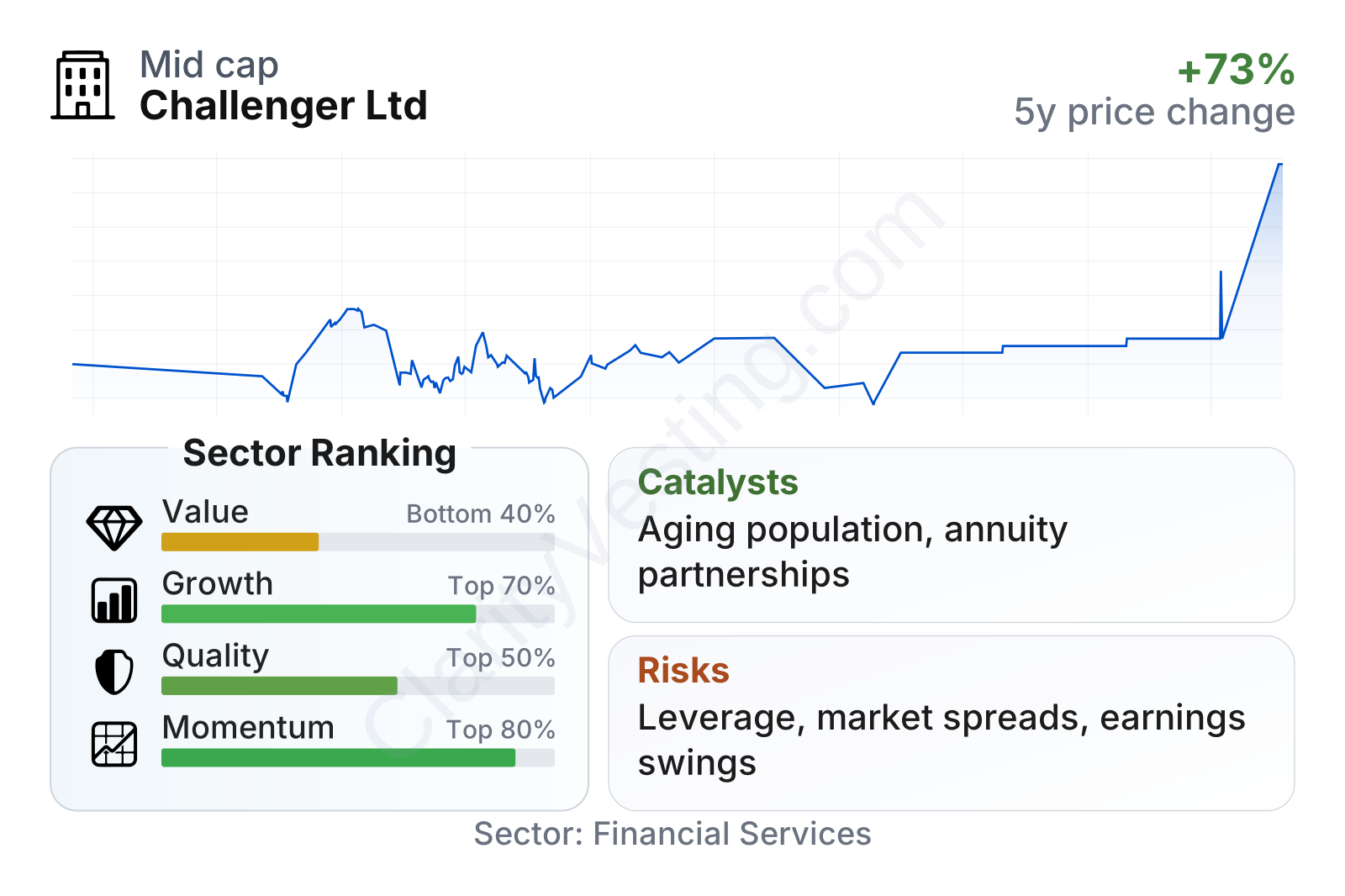
Challenger is a mid-sized financial company with a relatively low beta, meaning its share price has historically moved less than the broader market. On valuation, it screens a bit richer than the sector median on earnings and book value, which limits the argument that the stock is plainly cheap. On quality, current returns on equity and assets are ahead of sector medians, and operating margins are notably strong. Growth is mixed: five-year revenue per share and earnings per share trends are positive, but the most recent year-over-year revenue comparison is weak. Price momentum has improved sharply in recent months, suggesting sentiment has turned more favorable after a flatter multiyear period.
Growth
Challenger operates in a sector with a strong long-term tailwind: aging populations and the need for retirement income. In Australia, retirees are moving from the savings phase to the drawdown phase, and that creates demand for products that can convert accumulated superannuation balances into steady income. This is an attractive structural backdrop because it is tied less to short-term economic cycles and more to demographics and retirement policy.
The company’s strategy broadly fits that opportunity. Challenger has spent years positioning itself as a specialist in annuities and guaranteed income solutions, rather than trying to compete across every category of insurance or wealth management. That focus matters because retirement income is a niche where product design, regulation, adviser education, and balance-sheet management all create barriers to entry.
Earnings growth has not been perfectly smooth, but the longer-term trend is still positive. Over five years, earnings per share have grown, although at a modest pace compared with faster-growing financial businesses. What is more important is that profitability has recently improved as interest-rate conditions became more supportive for annuity economics and investment spreads.
Book value per share rose solidly from 2022 through 2025 before pulling back in the latest period. For an insurer and retirement-income provider, book value is an important anchor because it reflects capital strength and balance-sheet capacity. The recent dip does not automatically signal deterioration, but it does show that valuation and capital generation should be judged with some caution rather than assuming a straight upward path.
One of the clearest catalysts is product demand. Challenger has been expanding distribution partnerships with advisers, superannuation funds, and institutional channels, which can widen access to retirees who need income products. Another catalyst is the interest-rate environment: life insurers that write annuities can benefit when they are able to invest premium inflows at more attractive yields. In addition, the company’s funds management arm can support growth by bringing in third-party assets without requiring the same amount of balance-sheet capital as annuity growth.
Recent company updates have also pointed to continued emphasis on annuity sales, retirement solutions, and partnerships in both retail and institutional markets. For a business like Challenger, that is significant because scale in retirement products can improve efficiency, strengthen market presence, and deepen relationships with distribution partners over time.
Risks
This article is for informational purposes only and does not constitute financial advice. Some content is AI-generated. See Disclaimer


