Stock Analysis · Challenger Limited (CFIGF)
Overview
Challenger Limited is an Australian financial services group focused on retirement income. Its core business is helping customers convert savings into dependable cash flow in retirement, mainly through annuities and related investment solutions. The company also manages assets for institutional and retail clients, which adds a second earnings stream alongside its insurance activities.
In simple terms, Challenger sits at the intersection of insurance and asset management. On one side, it writes life and retirement products, especially annuities that promise regular payments over time. On the other, it invests the capital backing those products and also manages money for outside clients through Fidante Partners and other investment platforms.
Based on recent company reporting, Challenger’s revenue mix is driven primarily by its life business, with investment management contributing a smaller but still meaningful share.
- Life and retirement income products: approximately 75% to 90% of group revenue, depending on market movements and accounting presentation. This includes fixed-term annuities, lifetime annuities, and other retirement income products, plus earnings generated from investing policyholder and shareholder funds.
- Funds management and related fees: approximately 10% to 25% of group revenue. This includes asset management fees, distribution income, and earnings from partnerships with boutique investment managers.
The broad pattern is clear even when accounting results move around from year to year: Challenger is mainly a retirement income specialist, with a secondary asset management platform that supports diversification.
The business flow has also become stronger over the last several years. Revenue and operating income have risen materially since 2022, and the latest annual period shows a much healthier net profit than the prior year, helped by improved operating results and lower interest expense than the previous peak.
The operating picture has been uneven in presentation but directionally constructive: total revenue and operating income have expanded over time, while net income recovered sharply in the latest period after pressure in 2024 and 2025. That matters for a company whose reported numbers can be influenced by investment markets and liability valuation movements.
Key Figures
| Metric | Value | Sector ⓘ |
|---|---|---|
| Date | Oct 24, 2026 | |
| Context | ||
| Sector | Financial Services | |
| Industry | Insurance - Life | |
| Market Cap ⓘ | $3.78B | |
| Beta ⓘ | 0.56 | |
Value (Cheapness) | ||
| P/E Ratio ⓘ | 14.00 | 12.46 |
| P/B Ratio ⓘ | 0.76 | 1.25 |
| FCF Yield ⓘ | 60.83% | 9.82% |
| Dividend Yield ⓘ | 5.63% | 2.94% |
| EBIT / EV ⓘ | N/A | 8.11% |
| PEG ⓘ | N/A | |
Growth (Business expansion) | ||
| Revenue Growth ⓘ | -16.90% | 9.10% |
| RPS Growth (5Y CAGR) ⓘ | 26.95% | 12.31% |
| EPS Growth (5Y CAGR) ⓘ | -5.62% | -6.97% |
| BVPS Growth (5Y CAGR) ⓘ | 11.93% | 5.02% |
| Margin Growth (5Y Trend) ⓘ | 191.79% | -4.00% |
| FCF Growth (5Y CAGR) ⓘ | -6.47% | 4.71% |
| DPS Growth (5Y CAGR) ⓘ | 24.78% | 8.92% |
Quality (Business durability) | ||
| ROIC (Latest) ⓘ | N/A | 9.18% |
| ROE (Latest) ⓘ | 17.64% | 13.93% |
| ROA (Latest) ⓘ | 1.98% | 1.57% |
| ROIC (5Y Median) ⓘ | 6.65% | 7.80% |
| ROE (5Y Median) ⓘ | 6.49% | 12.15% |
| ROA (5Y Median) ⓘ | 0.85% | 1.28% |
| Net Debt / EBIT (Latest) ⓘ | 3.37 | 1.02 |
| Net Debt / EBIT (5Y Median) ⓘ | 6.56 | 0.72 |
| Net Debt / EBITDA (Latest) ⓘ | 3.34 | 0.88 |
| Operating Margin (Latest) ⓘ | 42.63% | 22.30% |
| Operating Margin (5Y Median) ⓘ | 42.87% | 24.50% |
| Debt to Equity (Latest) ⓘ | 208.18% | 59.34% |
| Profit Margin (Latest) ⓘ | 17.62% | 26.42% |
| Free Cash Flow (Latest) ⓘ | $2.30B | |
Momentum (Price trend) | ||
| 3Y Return ⓘ | +36.67% | +95.73% |
| 12M Return (excl. last month) ⓘ | +2.95% | +17.30% |
| 6M Return ⓘ | +2.29% | +6.07% |
| Price vs. 200-Day MA ⓘ | +3.11% | +5.36% |
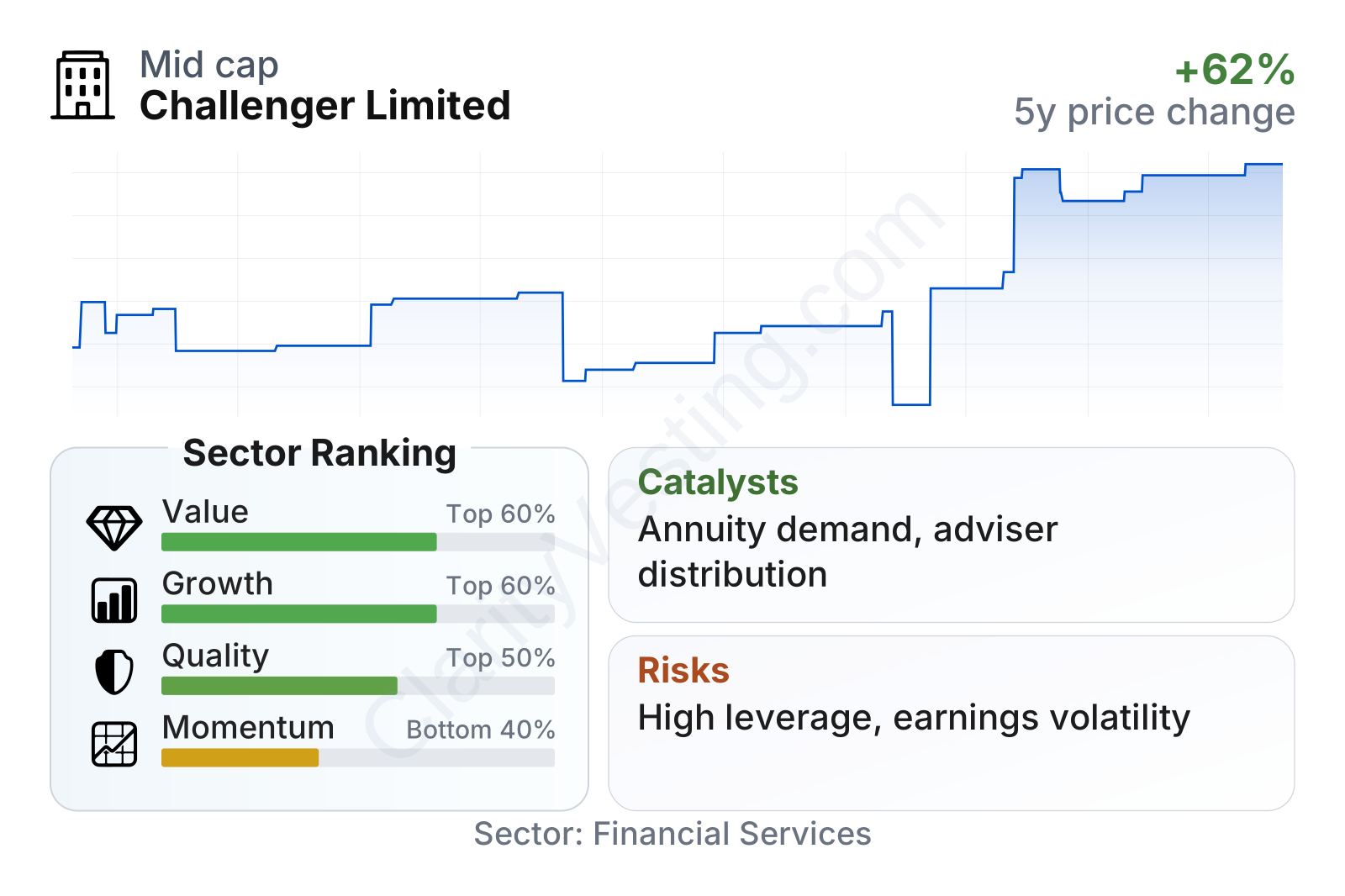
Challenger is a mid-sized financial company with a relatively low beta, suggesting the share price has historically moved less than the broader market. On valuation, the earnings multiple sits close to the sector median, while the price-to-book ratio is below the sector median. Income characteristics stand out more clearly: the trailing dividend yield is around 5.6%, above the sector median, and free cash flow yield appears unusually strong.
On profitability, the recent return on equity of about 17.6% is above the sector median, and operating margin is also notably stronger than many peers. That said, leverage is elevated: debt to equity is above 200%, and net debt relative to earnings is well above sector norms. Growth metrics are mixed. Five-year revenue per share and book value per share trends are strong, but recent year-over-year revenue declined and free cash flow growth over five years has been weaker than the sector.
The share price history reflects that mixed picture. Over the past several years, the stock has moved through periods of weakness and recovery rather than delivering a smooth upward trend, although the rebound into 2025 and 2026 has been significant.
Growth
Challenger operates in a part of finance that has a favorable long-term backdrop: aging populations and the growing need for retirement income. In Australia and several developed markets, retirees are increasingly expected to manage longevity risk themselves, which creates demand for products that can turn savings into regular income for life or for fixed periods. That is exactly where Challenger is positioned.
The company’s strategy also makes industrial sense. Retirement income products are not just about distribution; they also depend on risk management, investment expertise, and trust. Challenger has spent years building capabilities in annuities, institutional relationships, and adviser distribution. This can create a barrier to entry because the market is specialized and heavily regulated.
A useful sign of long-term progress is the company’s growth in book value per share, which has compounded at a rate comfortably above the sector median over the last five years.
That increase in book value suggests the underlying capital base has been expanding, even though reported earnings have not always followed a straight line. For a life insurer, that is an important signal because balance-sheet strength and capital generation underpin future product capacity.
Potential catalysts are tied to product demand and distribution. If annuity sales continue to benefit from higher awareness of retirement income planning, Challenger could see stronger new business volumes. Higher interest rates can also support annuity economics, as insurers are able to reinvest at better yields, though that effect is never purely one-way because liability valuation and customer demand can also shift. In addition, expansion through partnerships, superannuation channels, and adviser networks could broaden access to retirement customers.
Recent company updates have also highlighted ongoing focus on normalizing earnings, improving capital efficiency, and sharpening retirement income distribution. For a business in this niche, execution in those areas can matter as much as broad market growth.
Risks
This article is for informational purposes only and does not constitute financial advice. Some content is AI-generated. See Disclaimer


