Stock Analysis · Capitol Federal Financial Inc (CFFN)
Overview
Capitol Federal Financial Inc. is the parent company of Capitol Federal Savings Bank, a long-established regional bank based in Kansas. Its business is straightforward: it gathers deposits from customers and uses that funding mainly to make residential real estate loans, especially one- to four-family mortgage loans. Compared with many larger regional banks, Capitol Federal is more specialized and more conservative in scope, with a business model centered on traditional savings-and-loan banking rather than broad commercial banking.
The company’s revenue is driven primarily by net interest income, which is the difference between what it earns on loans and securities and what it pays on deposits and borrowings. Non-interest income exists, but it is a much smaller part of the business. Based on recent annual reporting, the revenue mix is approximately as follows:
- Net interest income: about 85% to 95% of total revenue in a normal year. This includes interest collected on residential mortgage loans, mortgage-backed securities, and other earning assets, minus interest paid on deposits and wholesale funding.
- Fees and other non-interest income: about 5% to 15%. This typically includes deposit-related service charges, gains or losses linked to securities activity, and other banking-related income.
That concentration makes the business easy to understand, but it also means earnings are heavily tied to interest rates, loan demand, deposit costs, and the value of fixed-rate mortgage assets. In recent years, Capitol Federal’s results reflected exactly that pattern: pressure when funding costs rose sharply, followed by improvement as revenue recovered faster than operating expenses.
Looking at the company’s income structure over the last several fiscal years, revenue fell sharply in fiscal 2023, turned positive again in 2024, and improved further in 2025. Operating expenses were relatively stable over that period, so the main swing factor was not spending discipline alone but the bank’s spread between asset yields and funding costs.
Key Figures
| Metric | Value | Sector ⓘ |
|---|---|---|
| Date | Oct 17, 2026 | |
| Context | ||
| Sector | Financial Services | |
| Industry | Banks - Regional | |
| Market Cap ⓘ | $1.01B | |
| Beta ⓘ | 0.68 | |
Value (Cheapness) | ||
| P/E Ratio ⓘ | 12.78 | 12.26 |
| P/B Ratio ⓘ | 1.00 | 1.23 |
| FCF Yield ⓘ | 7.09% | 10.40% |
| Dividend Yield ⓘ | 4.12% | 3.02% |
| EBIT / EV ⓘ | 4.10% | 8.14% |
| PEG ⓘ | 4.09 | |
Growth (Business expansion) | ||
| Revenue Growth ⓘ | 18.30% | 9.35% |
| RPS Growth (5Y CAGR) ⓘ | 11.77% | 12.19% |
| EPS Growth (5Y CAGR) ⓘ | -4.77% | -9.53% |
| BVPS Growth (5Y CAGR) ⓘ | -3.18% | 4.99% |
| Margin Growth (5Y Trend) ⓘ | -14.56% | -3.86% |
| FCF Growth (5Y CAGR) ⓘ | -6.44% | 4.81% |
| DPS Growth (5Y CAGR) ⓘ | -20.92% | 8.79% |
Quality (Business durability) | ||
| ROIC (Latest) ⓘ | 2.94% | 9.49% |
| ROE (Latest) ⓘ | 8.01% | 13.90% |
| ROA (Latest) ⓘ | 0.85% | 1.55% |
| ROIC (5Y Median) ⓘ | N/A | 7.86% |
| ROE (5Y Median) ⓘ | 6.02% | 12.17% |
| ROA (5Y Median) ⓘ | 0.70% | 1.30% |
| Net Debt / EBIT (Latest) ⓘ | 14.63 | 0.96 |
| Net Debt / EBIT (5Y Median) ⓘ | 19.94 | 0.73 |
| Net Debt / EBITDA (Latest) ⓘ | 13.65 | 0.92 |
| Operating Margin (Latest) ⓘ | 23.58% | 22.30% |
| Operating Margin (5Y Median) ⓘ | 19.89% | 24.63% |
| Debt to Equity (Latest) ⓘ | 160.21% | 58.56% |
| Profit Margin (Latest) ⓘ | 36.70% | 26.57% |
| Free Cash Flow (Latest) ⓘ | $71.53M | |
Momentum (Price trend) | ||
| 3Y Return ⓘ | +113.07% | +88.33% |
| 12M Return (excl. last month) ⓘ | +44.79% | +19.38% |
| 6M Return ⓘ | +10.97% | +4.75% |
| Price vs. 200-Day MA ⓘ | +5.56% | +3.50% |
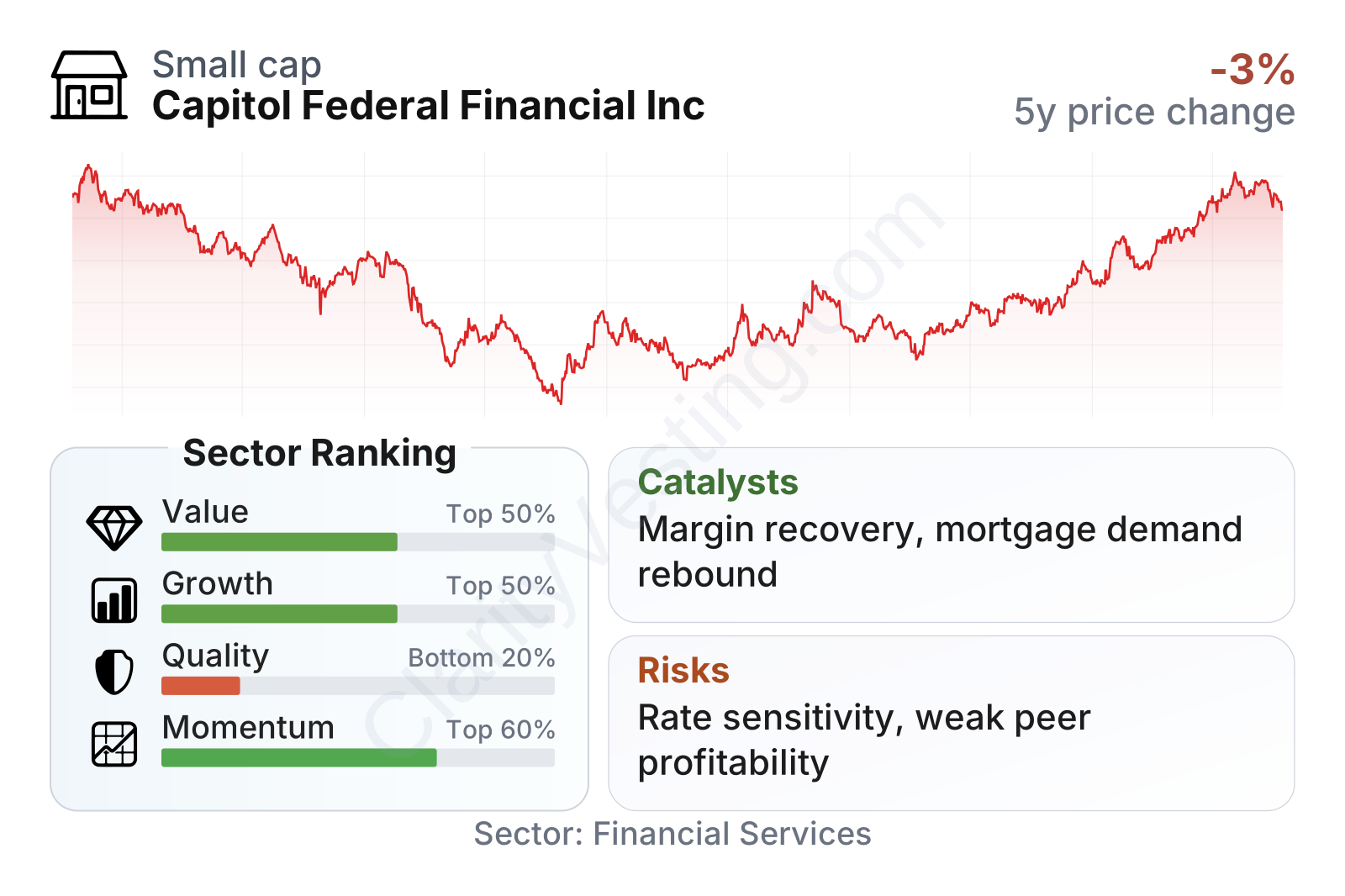
Capitol Federal is a small regional bank with a market value around $1 billion and a below-market beta, which suggests its share price has historically moved less than many stocks. Recent price performance has improved meaningfully from the lows seen during the regional banking stress period, although the longer path shows how sensitive sentiment can be for mortgage-focused banks when rates move abruptly.
The latest factor snapshot is mixed. Valuation looks close to the sector on earnings and somewhat below the sector on price-to-book, while dividend yield stands above the sector median. Growth metrics have improved on a year-over-year basis, especially revenue, but quality metrics remain weak relative to regional bank peers, with lower returns on equity and assets and a balance sheet carrying more leverage than the sector median. Momentum is somewhat better than average, reflecting the stock’s recovery over the past year and multi-year period.
Growth
Capitol Federal operates in a mature industry, not a high-growth one. Traditional regional banking generally grows through deposit gathering, loan expansion, disciplined pricing, and spread management rather than disruptive new products. Within that framework, the company’s mortgage-heavy niche has both strengths and limits. Housing finance remains a very large and essential market, but growth can be slow when affordability is strained and mortgage rates stay elevated.
The company’s strategy still has a logical foundation for the next few years. Its focus on residential lending, local deposit relationships, and a relatively simple operating model may support steadier execution than more diversified but more complex banks. A key near-term growth driver is margin normalization: if deposit costs stabilize or ease while asset yields remain firm, earnings can improve even without rapid balance-sheet growth.
The earnings trend suggests a partial recovery rather than a breakout expansion. Earnings per share dropped materially from fiscal 2022 levels, then improved in 2024 and 2025 and remained around the same level in the most recent periods. That pattern points to a business recovering from rate pressure, but not yet showing strong compounding momentum.
Book value per share has also been fairly stable lately after earlier pressure. For a bank, that matters because book value is a rough indicator of the underlying capital base supporting lending activity. Stability here is helpful, especially after the disruption many regional banks experienced when bond and mortgage portfolios lost value in a higher-rate environment.
A practical catalyst is the interest-rate backdrop. If the Federal Reserve moves into a more accommodative cycle, banks with funding-cost pressure may get some relief. Capitol Federal could also benefit if mortgage origination and refinancing activity gradually improves. Recent operating progress, including stronger revenue growth than the sector median and a return to more normal profitability after the 2023 downturn, supports the idea that the business has moved past its weakest point.
Risks
This article is for informational purposes only and does not constitute financial advice. Some content is AI-generated. See Disclaimer


