Stock Analysis · China Feihe Limited (CFEIY)
Overview
China Feihe Limited is a Chinese dairy company best known for infant formula. Its business is centered on nutrition products for babies, children, pregnant women, and families, with a particular focus on premium and ultra-premium milk formula. The group operates across the dairy value chain, from raw milk sourcing and production to branding, sales, and distribution. That vertical integration is important because product safety, ingredient traceability, and brand trust matter a great deal in infant nutrition.
Revenue is heavily concentrated in milk formula products, while other nutrition and dairy categories remain much smaller. Based on the company’s recent annual disclosures, the revenue mix is approximately:
- Infant formula products: about 89% to 91% of revenue. This is the core business and includes products for different baby age groups, especially premium and ultra-premium formulas.
- Other dairy products: about 6% to 8%. This generally includes adult milk powder and related dairy nutrition products.
- Nutritional supplements and other businesses: about 2% to 4%. This includes newer categories such as pediatric, maternal, and broader health-oriented nutrition offerings.
Geographically, the business is still overwhelmingly tied to China. That gives Feihe strong exposure to its domestic brand position, but it also means company performance depends heavily on Chinese birth trends, consumer confidence, and regulation in one market.
The multi-year profit flow shows a business that remains profitable with healthy gross margins, but it also shows clear pressure since 2021. Revenue and operating income recovered somewhat in 2024 after a weaker 2023, yet earnings remained well below earlier peak levels, and 2025 numbers suggest profitability came under renewed strain. In short, this is not a broken business, but it is one operating through a tougher demand environment than it enjoyed several years ago.
Key Figures
| Metric | Value | Sector ⓘ |
|---|---|---|
| Date | Oct 03, 2026 | |
| Context | ||
| Sector | Consumer Defensive | |
| Industry | Packaged Foods | |
| Market Cap ⓘ | $3.87B | |
| Beta ⓘ | 0.51 | |
Value (Cheapness) | ||
| P/E Ratio ⓘ | 14.16 | 18.16 |
| P/B Ratio ⓘ | 0.12 | 1.27 |
| FCF Yield ⓘ | 104.03% | 12.39% |
| Dividend Yield ⓘ | 7.28% | 2.83% |
| EBIT / EV ⓘ | N/A | 6.45% |
| PEG ⓘ | 1.09 | |
Growth (Business expansion) | ||
| Revenue Growth ⓘ | 2.30% | 3.80% |
| RPS Growth (5Y CAGR) ⓘ | -6.08% | 6.20% |
| EPS Growth (5Y CAGR) ⓘ | 39.32% | -14.64% |
| BVPS Growth (5Y CAGR) ⓘ | 2.27% | 3.26% |
| Margin Growth (5Y Trend) ⓘ | -18.81% | -0.25% |
| FCF Growth (5Y CAGR) ⓘ | -39.48% | 4.65% |
| DPS Growth (5Y CAGR) ⓘ | -9.66% | 6.86% |
Quality (Business durability) | ||
| ROIC (Latest) ⓘ | N/A | 12.58% |
| ROA (Latest) ⓘ | 9.49% | 6.35% |
| ROIC (5Y Median) ⓘ | 13.83% | 10.36% |
| ROA (5Y Median) ⓘ | 9.93% | 5.44% |
| Net Debt / EBIT (Latest) ⓘ | -1.26 | 1.91 |
| Net Debt / EBIT (5Y Median) ⓘ | -1.47 | 2.32 |
| Net Debt / EBITDA (Latest) ⓘ | -1.03 | 1.36 |
| Net Debt / Assets ⓘ | -18.98% | 21.25% |
| EBITDA / Interest ⓘ | N/A | 9.61 |
| Operating Margin (Latest) ⓘ | 16.35% | 8.96% |
| Operating Margin (5Y Median) ⓘ | 26.96% | 9.53% |
| Debt to Equity (Latest) ⓘ | 2.23% | 71.66% |
| Profit Margin (Latest) ⓘ | 9.69% | 5.40% |
| Free Cash Flow (Latest) ⓘ | $4.02B | |
Momentum (Price trend) | ||
| 3Y Return ⓘ | -28.51% | +15.25% |
| 12M Return (excl. last month) ⓘ | -20.77% | +2.63% |
| 6M Return ⓘ | -26.61% | +2.43% |
| Price vs. 200-Day MA ⓘ | -21.47% | +0.43% |
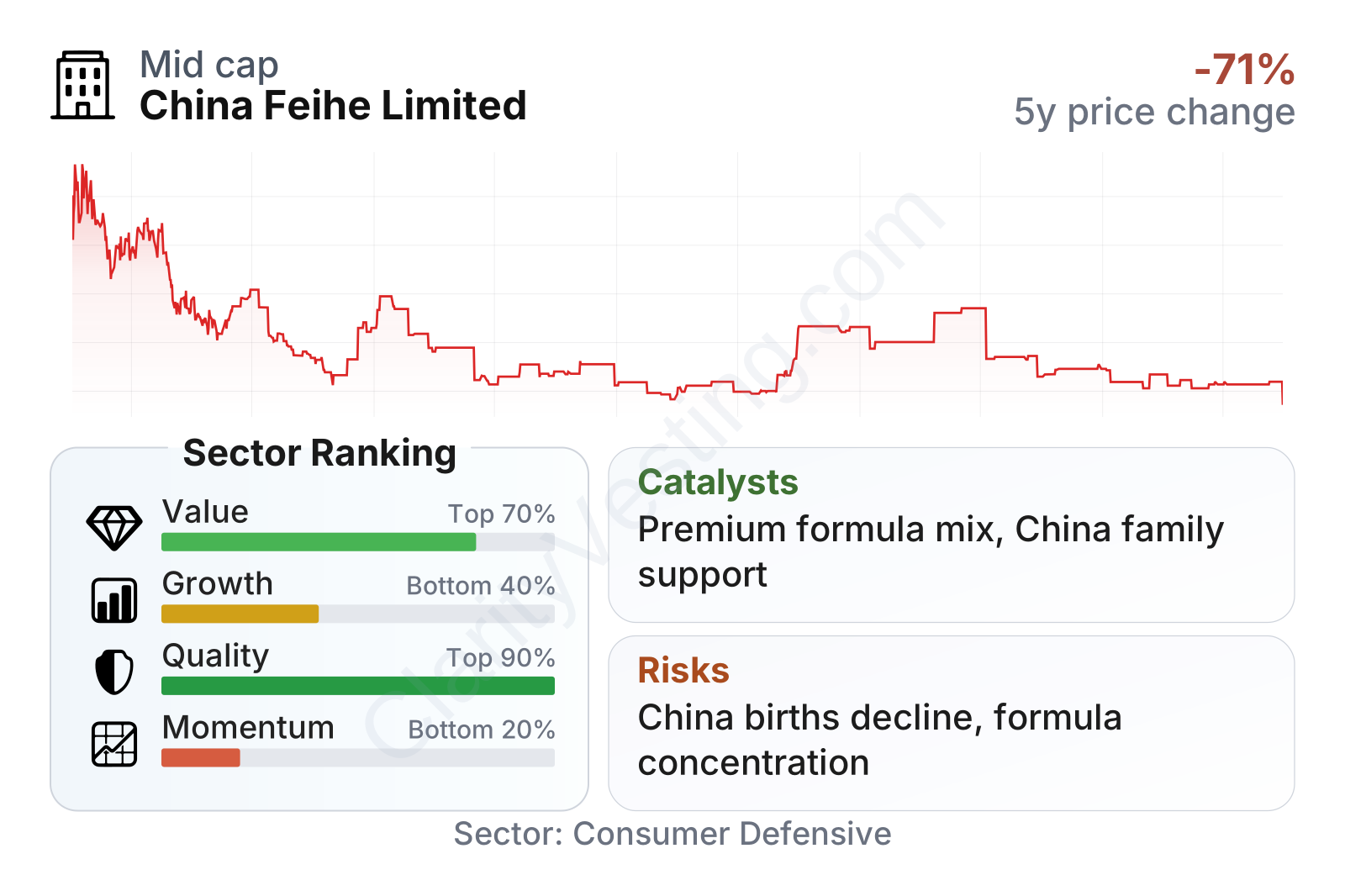
Feihe’s profile is unusual: market performance has been weak, but the balance sheet and profitability metrics remain stronger than many packaged food peers. The stock has declined materially from 2021 levels and recent price momentum is still among the weakest in its sector. At the same time, operating margin and profit margin remain above sector medians, returns on assets are solid, and the company carries very little financial leverage, with net cash rather than meaningful net debt.
Valuation metrics also look compressed relative to the sector. The earnings multiple is below the sector median, the price-to-book ratio is extremely low, and the trailing dividend yield is notably above the sector norm. Free cash flow yield screens as very high as well. The weaker side of the picture is growth: recent revenue growth has been modest, the five-year revenue-per-share trend is negative, and margin trends over five years have moved down from unusually strong past levels.
Growth
Feihe operates in a sector with mixed long-term dynamics. Infant nutrition remains an essential category, and premium formula can still be attractive because parents tend to prioritize quality and safety. However, the broader Chinese infant formula market is no longer supported by strong birth growth. China’s low birth rate is the main structural challenge facing the industry, which means growth increasingly depends on taking market share, moving consumers toward premium products, and expanding into adjacent nutrition categories rather than relying on a larger newborn population.
Within that environment, Feihe’s strategy is understandable. The company has spent years building a premium domestic brand, investing in research, and controlling more of its supply chain. It has also been broadening beyond standard infant formula into maternal, pediatric, and adult nutrition products. That approach makes sense because it can reduce dependence on a single life-stage category and extend customer relationships beyond infancy.
A potentially important catalyst is policy support for family and childcare spending in China. Government efforts to encourage childbirth do not solve demographic pressure overnight, but they can improve affordability and sentiment around parenting-related consumption. Another support point is the continuing preference among many Chinese consumers for well-known, trusted formula brands with strong quality control. In a cautious consumer environment, established names can have an advantage.
Recent company updates have also pointed to ongoing product upgrades and channel optimization, especially in premium offerings. If premium mix improves and distribution becomes more efficient, Feihe may be able to protect margins better than volume trends alone would suggest. The business does not need a booming birth market to stabilize; it needs brand resilience, disciplined costs, and enough share retention in premium formula to offset industry pressure.
Risks
This article is for informational purposes only and does not constitute financial advice. Some content is AI-generated. See Disclaimer