Stock Analysis · CF Industries Holdings Inc (CF)
Overview
CF Industries Holdings Inc. is one of the largest nitrogen fertilizer producers in the world. The company makes products that help farmers increase crop yields, and it also supplies industrial customers that use nitrogen-based chemicals in manufacturing, emissions control, mining, and other processes. Its production network is centered on converting natural gas into ammonia and then upgrading that ammonia into other nitrogen products.
Its revenue is mainly tied to nitrogen fertilizers and closely related products. Based on the company’s recent annual reporting structure, the business can be summarized as follows:
- Ammonia: approximately 30% to 35% of revenue. Ammonia is the basic building block for many nitrogen products and is sold both to external customers and used internally to make upgraded products.
- Granular urea: approximately 20% to 25% of revenue. This is a widely used dry nitrogen fertilizer for broad-acre crops.
- UAN (urea ammonium nitrate solution): approximately 20% to 25% of revenue. This liquid fertilizer is commonly used in corn production and other row crops.
- AN (ammonium nitrate): approximately 10% to 15% of revenue. This product serves both agricultural and industrial end markets.
- Other products: approximately 5% to 10% of revenue. This category includes diesel exhaust fluid, nitric acid, and other related nitrogen products.
Geographically, CF Industries is heavily linked to North American production, which matters because the region has historically offered relatively advantaged natural gas economics compared with many overseas producers. That cost position is one of the company’s most important business characteristics. Another key point is that revenue and profit can change sharply from year to year because fertilizer prices move with global crop economics, energy costs, and supply disruptions.
The multi-year financial flow also shows how cyclical the business is. Revenue and earnings surged in 2022, normalized in 2023 and 2024, and improved again in 2025. Even after that normalization, the company remained highly profitable, which suggests that its asset base and cost position are still strong.
Key Figures
| Metric | Value | Sector ⓘ |
|---|---|---|
| Date | Oct 17, 2026 | |
| Context | ||
| Sector | Basic Materials | |
| Industry | Agricultural Inputs | |
| Market Cap ⓘ | $17.74B | |
| Beta ⓘ | 0.53 | |
Value (Cheapness) | ||
| P/E Ratio ⓘ | 8.70 | 16.90 |
| P/B Ratio ⓘ | 7.14 | 1.65 |
| FCF Yield ⓘ | 10.76% | 5.76% |
| Dividend Yield ⓘ | 1.75% | 2.13% |
| EBIT / EV ⓘ | 16.89% | 6.30% |
| PEG ⓘ | 0.60 | |
Growth (Business expansion) | ||
| Revenue Growth ⓘ | 17.60% | 11.10% |
| RPS Growth (5Y CAGR) ⓘ | 9.63% | 4.49% |
| EPS Growth (5Y CAGR) ⓘ | -18.91% | -13.47% |
| BVPS Growth (5Y CAGR) ⓘ | 61.12% | 5.51% |
| Margin Growth (5Y Trend) ⓘ | 7.38% | -1.54% |
| FCF Growth (5Y CAGR) ⓘ | -6.41% | 0.37% |
| DPS Growth (5Y CAGR) ⓘ | 13.70% | 6.08% |
Quality (Business durability) | ||
| ROIC (Latest) ⓘ | 31.60% | 9.26% |
| ROA (Latest) ⓘ | 14.33% | 4.91% |
| ROIC (5Y Median) ⓘ | 23.48% | 7.70% |
| ROA (5Y Median) ⓘ | 10.56% | 3.86% |
| Net Debt / EBIT (Latest) ⓘ | 0.35 | 1.40 |
| Net Debt / EBIT (5Y Median) ⓘ | 0.82 | 1.70 |
| Net Debt / EBITDA (Latest) ⓘ | 0.27 | 0.95 |
| Net Debt / Assets ⓘ | 7.50% | 13.69% |
| EBITDA / Interest ⓘ | 24.35 | 12.34 |
| Operating Margin (Latest) ⓘ | 42.32% | 13.20% |
| Operating Margin (5Y Median) ⓘ | 33.79% | 11.80% |
| Debt to Equity (Latest) ⓘ | 62.86% | 40.56% |
| Profit Margin (Latest) ⓘ | 27.12% | 6.43% |
| Free Cash Flow (Latest) ⓘ | $1.91B | |
Momentum (Price trend) | ||
| 3Y Return ⓘ | +51.34% | +68.89% |
| 12M Return (excl. last month) ⓘ | +56.44% | +30.21% |
| 6M Return ⓘ | +1.35% | -4.16% |
| Price vs. 200-Day MA ⓘ | +5.48% | -1.27% |
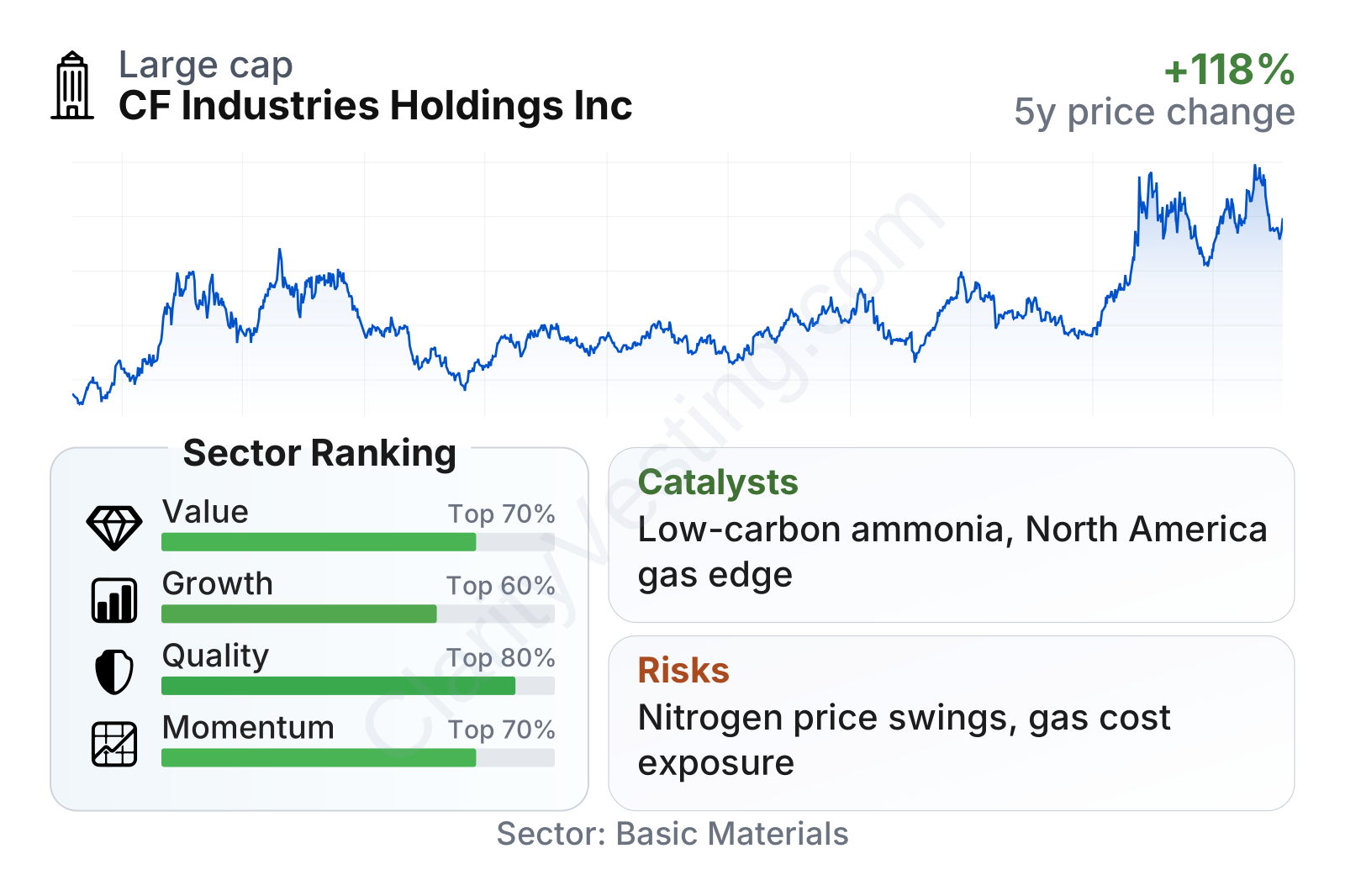
CF Industries stands out most on business quality. Profitability, returns on capital, and balance sheet coverage are well above much of the sector, even though fertilizer is a cyclical industry. Revenue growth has recovered into the mid-to-high teens year over year, and free cash flow generation remains solid. On valuation metrics, earnings and cash-flow-based multiples look comparatively low, while the price-to-book ratio is much higher than the sector median, which reflects the market assigning more value to the company’s asset quality and earning power than to a typical materials business.
The stock history also highlights a volatile pattern rather than a steady upward line. Shares climbed sharply during the fertilizer boom, then pulled back as pricing normalized, and more recently rebounded strongly. That fits the company’s economics: CF Industries is a durable operator, but not a smooth earnings compounder.
Growth
CF Industries operates in a sector with long-term structural importance rather than fast consumer-style expansion. Global agriculture needs nitrogen fertilizer every season, and food demand tends to rise over time with population growth and diet shifts. That gives the industry durable relevance. However, growth is not linear because crop prices, planting decisions, and global trade conditions can all affect fertilizer demand and realized prices.
The company’s strategy for future growth is sensible because it builds on what CF already does well: large-scale nitrogen production, access to North American feedstock, and operational efficiency. Management has also been developing a broader role for ammonia beyond traditional fertilizer, especially in low-carbon ammonia and clean energy applications. This matters because ammonia is increasingly discussed as a potential fuel, hydrogen carrier, and decarbonization input for industries that are hard to electrify.
Recent revenue momentum has improved after the sharp downcycle that followed 2022. Year-over-year sales moved back into positive territory through 2025 and remained in the high-teens range more recently. That does not eliminate cyclicality, but it does indicate that the business has moved off the post-spike trough.
Cash generation remains one of the more attractive parts of the CF profile. Free cash flow fell significantly from the unusually strong 2022 peak, but it stayed positive and later recovered to well above $1 billion on a trailing basis. For a company of this size, that provides room for dividends, share repurchases, maintenance spending, and selective growth projects without depending heavily on new borrowing.
A notable catalyst is the company’s positioning in low-carbon ammonia. CF Industries has announced and advanced projects and partnerships tied to carbon capture and cleaner ammonia production, particularly around its Donaldsonville complex. If demand for low-carbon ammonia develops as expected in energy, shipping, or industrial decarbonization, CF starts from an advantageous industrial base rather than needing to build an entirely new platform.
Another favorable factor is the broader global nitrogen supply setup. Europe has faced recurring pressure from higher energy costs, and that can weaken higher-cost producers outside North America. When global supply becomes tighter or less reliable, low-cost operators such as CF can benefit through stronger margins and export opportunities.
Risks
This article is for informational purposes only and does not constitute financial advice. Some content is AI-generated. See Disclaimer


